Heisey Dennis M, Jennelle Christopher S, Russell Robin E, Walsh Daniel P
United States Geological Survey, National Wildlife Health Center, Madison, Wisconsin, United States of America.
Department of Forest and Wildlife Ecology, University of Wisconsin, Madison, Wisconsin, United States of America.
PLoS One. 2014 Mar 27;9(3):e89843. doi: 10.1371/journal.pone.0089843. eCollection 2014.
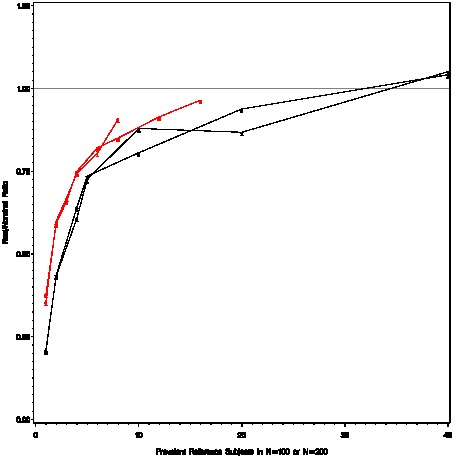
There are numerous situations in which it is important to determine whether a particular disease of interest is present in a free-ranging wildlife population. However adequate disease surveillance can be labor-intensive and expensive and thus there is substantial motivation to conduct it as efficiently as possible. Surveillance is often based on the assumption of a simple random sample, but this can almost always be improved upon if there is auxiliary information available about disease risk factors. We present a Bayesian approach to disease surveillance when auxiliary risk information is available which will usually allow for substantial improvements over simple random sampling. Others have employed risk weights in surveillance, but this can result in overly optimistic statements regarding freedom from disease due to not accounting for the uncertainty in the auxiliary information; our approach remedies this. We compare our Bayesian approach to a published example of risk weights applied to chronic wasting disease in deer in Colorado, and we also present calculations to examine when uncertainty in the auxiliary information has a serious impact on the risk weights approach. Our approach allows "apples-to-apples" comparisons of surveillance efficiencies between units where heterogeneous samples were collected.
在许多情况下,确定自由放养的野生动物种群中是否存在某种特定的目标疾病至关重要。然而,充分的疾病监测可能既耗费人力又成本高昂,因此人们有充分的动力尽可能高效地开展监测。监测通常基于简单随机抽样的假设,但如果有关于疾病风险因素的辅助信息,几乎总能对其进行改进。当有辅助风险信息可用时,我们提出一种贝叶斯疾病监测方法,这通常会比简单随机抽样有显著改进。其他人在监测中使用了风险权重,但由于没有考虑辅助信息中的不确定性,这可能导致关于无病状态的表述过于乐观;我们的方法弥补了这一问题。我们将我们的贝叶斯方法与一个已发表的应用于科罗拉多州鹿慢性消耗病的风险权重示例进行比较,并且我们还进行了计算,以研究辅助信息中的不确定性何时会对风险权重方法产生严重影响。我们的方法允许对收集了异质样本的不同单位之间的监测效率进行“同类相比”。