Watanabe Kozo, Kazama So, Omura Tatsuo, Monaghan Michael T
Leibniz-Institute of Freshwater Ecology and Inland Fisheries (IGB), Müggelseedamm 301, Berlin, Germany; Present address: Department of Civil and Environmental Engineering, Ehime University, Bunkyo-cho 3, Matsuyama, Japan.
Department of Civil and Environmental Engineering, Tohoku University, Aoba-yama 6-6-06, Sendai, Japan.
PLoS One. 2014 Mar 28;9(3):e93055. doi: 10.1371/journal.pone.0093055. eCollection 2014.
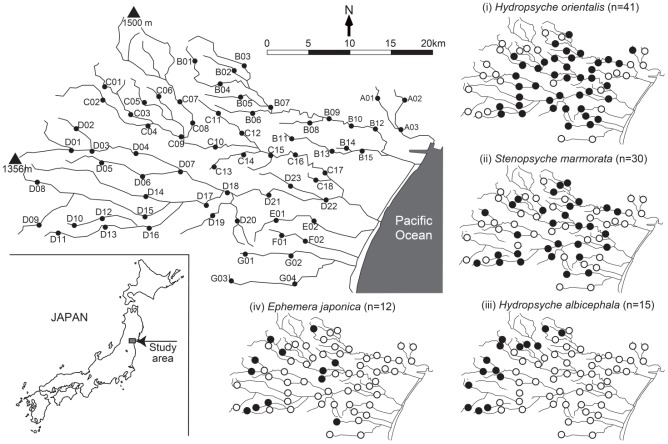
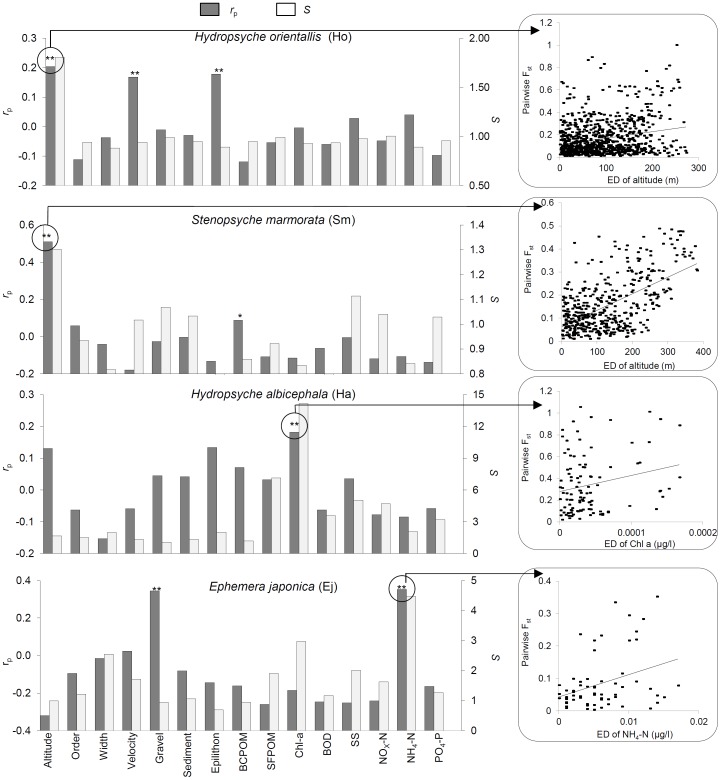
A central question linking ecology with evolutionary biology is how environmental heterogeneity can drive adaptive genetic divergence among populations. We examined adaptive divergence of four stream insects from six adjacent catchments in Japan by combining field measures of habitat and resource components with genome scans of non-neutral Amplified Fragment Length Polymorphism (AFLP) loci. Neutral genetic variation was used to measure gene flow and non-neutral genetic variation was used to test for adaptive divergence. We identified the environmental characteristics contributing to divergence by comparing genetic distances at non-neutral loci between sites with Euclidean distances for each of 15 environmental variables. Comparisons were made using partial Mantel tests to control for geographic distance. In all four species, we found strong evidence for non-neutral divergence along environmental gradients at between 6 and 21 loci per species. The relative contribution of these environmental variables to each species' ecological niche was quantified as the specialization index, S, based on ecological data. In each species, the variable most significantly correlated with genetic distance at non-neutral loci was the same variable along which each species was most narrowly distributed (i.e., highest S). These were gradients of elevation (two species), chlorophyll-a, and ammonia-nitrogen. This adaptive divergence occurred in the face of ongoing gene flow (Fst = 0.01-0.04), indicating that selection was strong enough to overcome homogenization at the landscape scale. Our results suggest that adaptive divergence is pronounced, occurs along different environmental gradients for different species, and may consistently occur along the narrowest components of species' niche.
将生态学与进化生物学联系起来的一个核心问题是环境异质性如何推动种群间的适应性遗传分化。我们通过结合栖息地和资源成分的实地测量以及非中性扩增片段长度多态性(AFLP)位点的基因组扫描,研究了来自日本六个相邻集水区的四种溪流昆虫的适应性分化。中性遗传变异用于测量基因流,非中性遗传变异用于检验适应性分化。我们通过比较15个环境变量中各站点间欧氏距离与非中性位点的遗传距离,确定了导致分化的环境特征。使用偏 Mantel 检验进行比较以控制地理距离。在所有四个物种中,我们发现有力证据表明每个物种在6到21个位点沿着环境梯度存在非中性分化。基于生态数据,这些环境变量对每个物种生态位的相对贡献被量化为专业化指数S。在每个物种中,与非中性位点遗传距离最显著相关的变量与每个物种分布最狭窄的变量相同(即最高的S)。这些变量是海拔梯度(两个物种)、叶绿素a和氨氮。这种适应性分化在持续的基因流(Fst = 0.01 - 0.04)情况下发生着,这表明选择足够强大,能够在景观尺度上克服同质化。我们的结果表明,适应性分化很明显,不同物种沿着不同的环境梯度发生,并且可能始终沿着物种生态位最狭窄的部分发生。