Department for Comparative Sensory Biology and Neurobiology, Institute of Zoology, Rheinische Friedrich-Wilhelms-University Bonn Bonn, Germany.
Front Neural Circuits. 2014 Mar 20;8:24. doi: 10.3389/fncir.2014.00024. eCollection 2014.
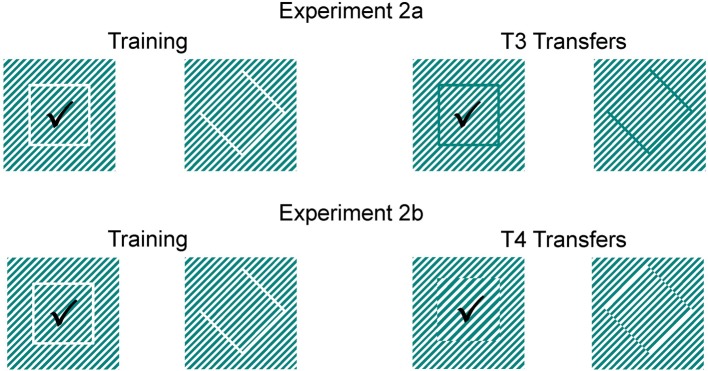
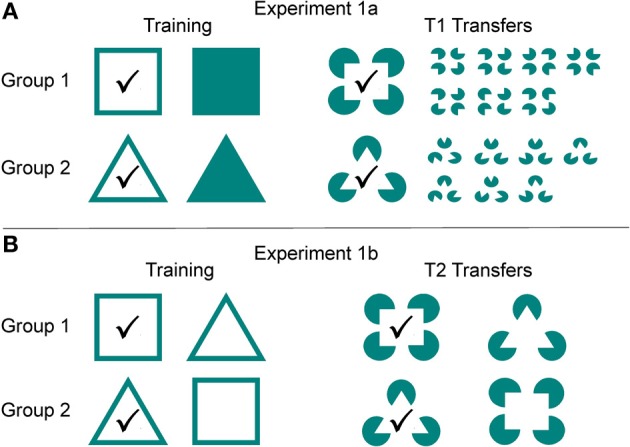
Bamboo sharks (Chiloscyllium griseum) were tested for their ability to perceive subjective and illusionary contours as well as line length illusions. Individuals were first trained to differentiate between squares, triangles, and rhomboids in a series of two alternative forced-choice experiments. Transfer tests then elucidated whether Kanizsa squares and triangles, grating gaps and phase shifted abutting gratings were also perceived and distinguished. The visual systems of most vertebrates and even invertebrates perceive illusionary contours despite the absence of physical luminance, color or textural differences. Sharks are no exception to the rule; all tasks were successfully mastered within 3-24 training sessions, with sharks discriminating between various sets of Kanizsa figures and alternative stimuli, as well as between subjective contours in >75% of all tests. However, in contrast to Kanizsa figures and subjective contours, sharks were not deceived by Müller-Lyer (ML) illusions. Here, two center lines of equal length are comparatively set between two arrowheads or -tails, in which case the line featuring the two arrow tails appears to be longer to most humans, primates and birds. In preparation for this experiment, lines of varying length, and lines of unequal length randomly featuring either two arrowheads or -tails on their ends, were presented first. Both sets of lines were successfully distinguished by most sharks. However, during presentation of the ML illusions sharks failed to succeed and succumbed either to side preferences or chose according to chance.
竹鲨(Chiloscyllium griseum)被测试其感知主观和幻象轮廓以及线长错觉的能力。个体首先在一系列二选一的强制选择实验中接受区分正方形、三角形和菱形的训练。然后,转移测试阐明了 Kanizsa 正方形和三角形、光栅间隙和相位偏移相邻光栅是否也被感知和区分。尽管没有物理亮度、颜色或纹理差异,大多数脊椎动物甚至无脊椎动物的视觉系统都能感知幻象轮廓。鲨鱼也不例外;所有任务都在 3-24 次训练课程内成功掌握,鲨鱼能够区分各种 Kanizsa 图形和替代刺激,以及在>75%的所有测试中区分主观轮廓。然而,与 Kanizsa 图形和主观轮廓不同,鲨鱼不会被 Müller-Lyer (ML) 错觉所欺骗。在这里,两条等长的中心线设置在两个箭头或尾巴之间,在这种情况下,大多数人类、灵长类动物和鸟类都会认为带有两个箭头尾巴的线看起来更长。在进行此实验之前,首先呈现了不同长度的线和随机带有两个箭头或尾巴的不等长线。大多数鲨鱼都成功区分了这两组线。然而,在呈现 ML 错觉时,鲨鱼未能成功,要么倾向于一侧,要么随机选择。