van Overbeek Leonard S, van Doorn Joop, Wichers Jan H, van Amerongen Aart, van Roermund Herman J W, Willemsen Peter T J
Plant Research International, Wageningen University and Research Centre Wageningen, Netherlands.
Applied Plant Research, Wageningen University and Research Centre Lisse, Netherlands.
Front Microbiol. 2014 Mar 20;5:104. doi: 10.3389/fmicb.2014.00104. eCollection 2014.
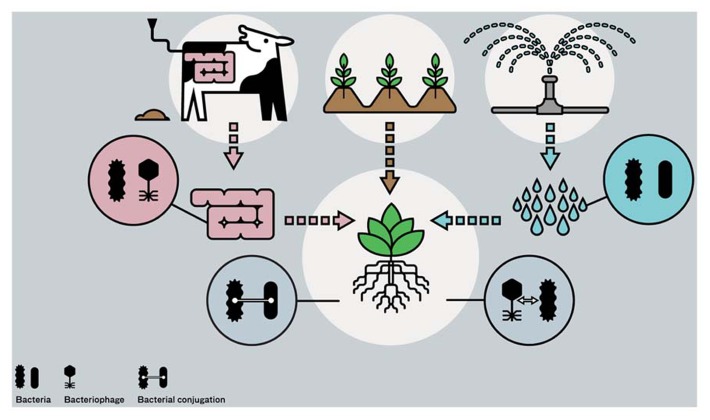
Disease incidences related to Escherichia coli and Salmonella enterica infections by consumption of (fresh) vegetables, sprouts, and occasionally fruits made clear that these pathogens are not only transmitted to humans via the "classical" routes of meat, eggs, and dairy products, but also can be transmitted to humans via plants or products derived from plants. Nowadays, it is of major concern that these human pathogens, especially the ones belonging to the taxonomical family of Enterobacteriaceae, become adapted to environmental habitats without losing their virulence to humans. Adaptation to the plant environment would lead to longer persistence in plants, increasing their chances on transmission to humans via consumption of plant-derived food. One of the mechanisms of adaptation to the plant environment in human pathogens, proposed in this paper, is horizontal transfer of genes from different microbial communities present in the arable ecosystem, like the ones originating from soil, animal digestive track systems (manure), water and plants themselves. Genes that would confer better adaptation to the phytosphere might be genes involved in plant colonization, stress resistance and nutrient acquisition and utilization. Because human pathogenic enterics often were prone to genetic exchanges via phages and conjugative plasmids, it was postulated that these genetic elements may be hold key responsible for horizontal gene transfers between human pathogens and indigenous microbes in agroproduction systems. In analogy to zoonosis, we coin the term phytonosis for a human pathogen that is transmitted via plants and not exclusively via animals.
食用(新鲜)蔬菜、豆芽以及偶尔食用水果导致的与大肠杆菌和肠炎沙门氏菌感染相关的疾病发病率表明,这些病原体不仅通过肉类、蛋类和奶制品等“传统”途径传播给人类,还可通过植物或植物衍生产品传播给人类。如今,人们主要担心的是,这些人类病原体,尤其是属于肠杆菌科的病原体,在适应环境栖息地的同时不会丧失对人类的毒力。适应植物环境会导致它们在植物中持续更长时间,增加通过食用植物性食物传播给人类的机会。本文提出,人类病原体适应植物环境的机制之一是从可耕地生态系统中存在的不同微生物群落水平转移基因,比如来自土壤、动物消化道系统(粪便)、水和植物本身的微生物群落。赋予对植物圈更好适应性的基因可能是参与植物定殖、抗逆性以及养分获取和利用的基因。由于人类致病性肠道细菌往往易于通过噬菌体和接合质粒进行基因交换,因此推测这些遗传元件可能是农业生产系统中人类病原体与本土微生物之间水平基因转移的关键因素。与动物传染病类似,我们将通过植物而非仅通过动物传播的人类病原体称为植物源疾病。