Corso Barbara, Greenberg David A
National Council Research, Neuroscience Institute, Padova, Italy.
Battelle Center for Mathematical Medicine, Nationwide Children's Hospital, Columbus, Ohio, United States of America; Department of Pediatrics, Wexner Medical Center, Ohio State University, Columbus, Ohio, United States of America.
PLoS One. 2014 Apr 1;9(4):e93398. doi: 10.1371/journal.pone.0093398. eCollection 2014.
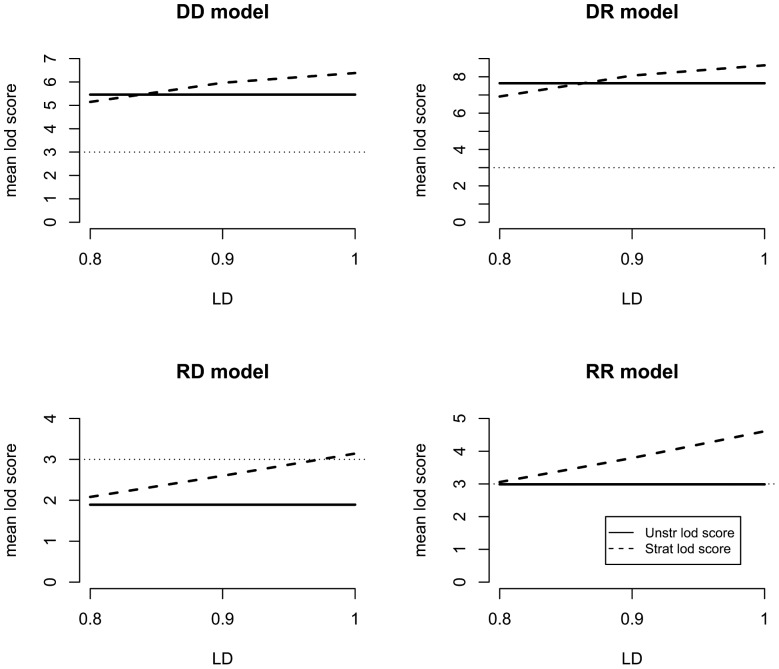
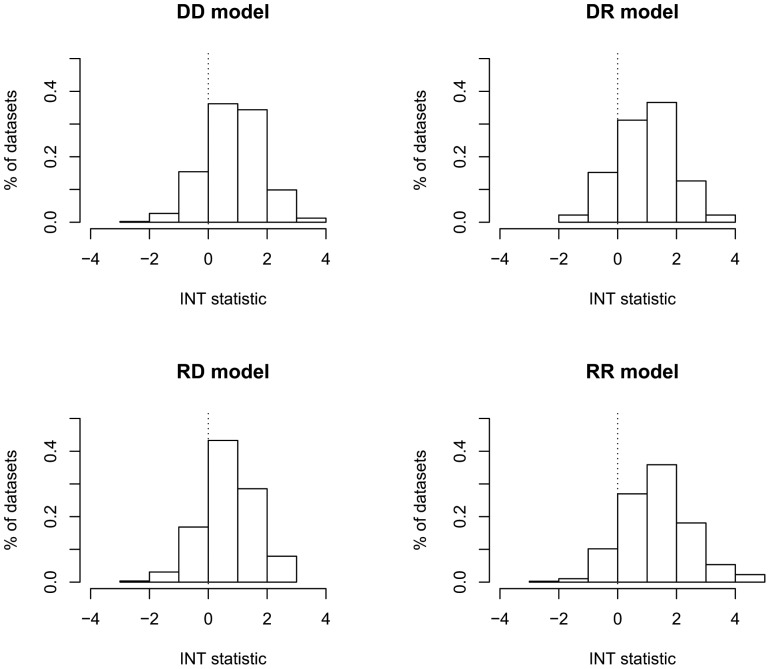
Detecting gene-gene interaction in complex diseases is a major challenge for common disease genetics. Most interaction detection approaches use disease-marker associations and such methods have low power and unknown reliability in real data. We developed and tested a powerful linkage-analysis-based gene-gene interaction detection strategy based on conditioning the family data on a known disease-causing allele or disease-associated marker allele. We computer-generated multipoint linkage data for a disease caused by two epistatically interacting loci (A and B). We examined several two-locus epistatic inheritance models: dominant-dominant, dominant-recessive, recessive-dominant, recessive-recessive. At one of the loci (A), there was a known disease-related allele. We stratified the family data on the presence of this allele, eliminating family members who were without it. This elimination step has the effect of raising the "penetrance" at the second locus (B). We then calculated the lod score at the second locus (B) and compared the pre- and post-stratification lod scores at B. A positive difference indicated interaction. We also examined if it was possible to detect interaction with locus B based on a disease-marker association (instead of an identified disease allele) at locus A. We also tested whether the presence of genetic heterogeneity would generate false positive evidence of interaction. The power to detect interaction for a known disease allele was 60-90%. The probability of false positives, based on heterogeneity, was low. Decreasing linkage disequilibrium between the disease and marker at locus A decreased the likelihood of detecting interaction. The allele frequency of the associated marker made little difference to the power.
在复杂疾病中检测基因-基因相互作用是常见疾病遗传学面临的一项重大挑战。大多数相互作用检测方法使用疾病-标记物关联,而这类方法在实际数据中的效能较低且可靠性未知。我们开发并测试了一种基于连锁分析的强大基因-基因相互作用检测策略,该策略基于对已知致病等位基因或疾病相关标记等位基因的家系数据进行条件设定。我们通过计算机生成了由两个上位性相互作用位点(A和B)导致的疾病的多点连锁数据。我们研究了几种两位点上位性遗传模型:显性-显性、显性-隐性、隐性-显性、隐性-隐性。在其中一个位点(A),存在一个已知与疾病相关的等位基因。我们根据该等位基因的存在对家系数据进行分层,剔除没有该等位基因的家庭成员。这一剔除步骤具有提高第二个位点(B)“外显率”的效果。然后我们计算第二个位点(B)的对数优势分数,并比较B位点分层前后的对数优势分数。正差值表明存在相互作用。我们还研究了是否有可能基于位点A处的疾病-标记物关联(而非已鉴定的疾病等位基因)来检测与位点B的相互作用。我们还测试了遗传异质性的存在是否会产生相互作用的假阳性证据。对于已知疾病等位基因,检测相互作用的效能为60%-90%。基于异质性的假阳性概率较低。位点A处疾病与标记之间连锁不平衡的降低会减少检测到相互作用的可能性。相关标记的等位基因频率对效能影响不大。