Enhesari Ahmad, Mardpour Saeid, Makki Zohreh, Mardpour Soura
Department of Radiology, Faculty of Medicine and Health Sciences, Kerman University of Medical Sciences, Kerman, Iran.
Applied Cell Sciences Department, School of Advanced Technologies in Medicine, Tehran University of Medical Sciences, Tehran, Iran.
Iran J Radiol. 2014 Jan;11(1):e11492. doi: 10.5812/iranjradiol.11492. Epub 2014 Jan 30.
To date, there has been little agreement on the use of ultrasonographic parameters in predicting the long-term outcome after transplantation. This study evaluates whether ultrasonography of the graft performed in the early stage after transplantation is a valuable predictor for long-term-outcome.
The aim of this study was to evaluate the association of ultrasonographic parameters (resistive index [RI], pulsatility index[PI], end diastolic velocity [EDV], graft length and graft parenchymal volume) measured within the first week after transplantation with 6 months graft function.
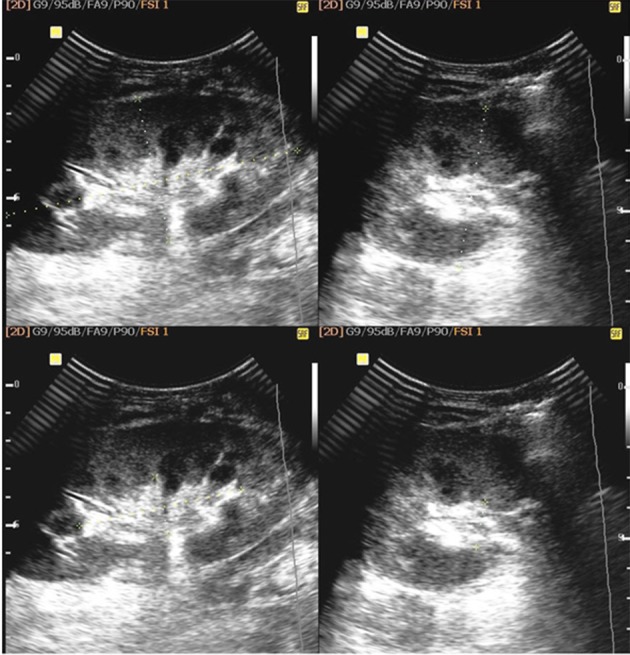
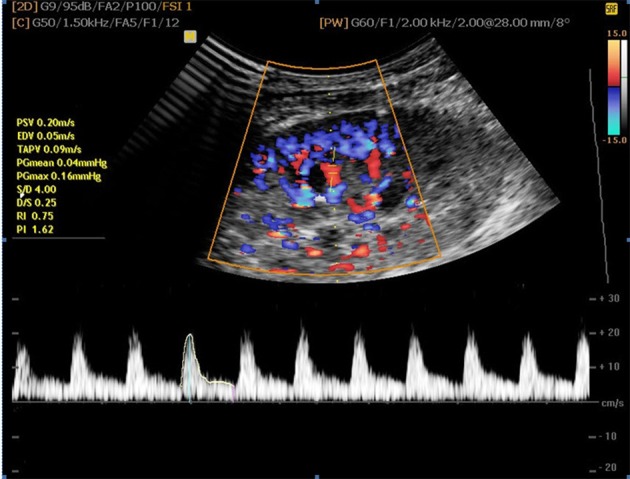
A cross-sectional study was performed on 91 (46 males and 45 females) living renal transplants between April 2011 and February 2013. All patients underwent an ultrasonography at the first week after transplantation. Intrarenal Doppler indices including RI, PI and EDV were measured at the interlobar artery level and the graft length and parenchymal volume were defined with gray scale ultrasonography. Graft function was estimated at 6months by glomerular filtration rate (GFR). Unpaired t-test and multivariate-linear and logistic regression analysis were used to estimate the relationship between ultrasonographic parameters and GFR.
Fourteen patients (15.4%) had impaired graft function after 6 months (GFR less than 60 ml/min/1.73m2). Multivariate linear regression analysis showed significant correlation between GFR at 6 months and RI, PI and EDV with a P value of 0.026, 0.016 and 0.015, respectively. Logistic regression analysis showed that GFR<60 ml/min/1.73 m2 at 6 months was significantly associated with RI>0.7 (odds ratio=2.20, P value=0.004) and PI>1.3 (odds ratio=2.74, P value<0.001) and EDV<9 cm/Sec (odds ratio=1.83, P value=0.03).
In this study, kidney transplant recipients with a lower RI and PI and a higher EDV at 1week showed better graft function at 6 months after transplantation.
迄今为止,关于超声参数在预测移植后长期预后方面的应用,尚未达成共识。本研究评估移植后早期进行的移植肾超声检查是否是长期预后的有价值预测指标。
本研究旨在评估移植后第一周内测量的超声参数(阻力指数[RI]、搏动指数[PI]、舒张末期速度[EDV]、移植肾长度和移植肾实质体积)与移植肾6个月功能之间的关联。
对2011年4月至2013年2月期间的91例(46例男性和45例女性)活体肾移植患者进行了一项横断面研究。所有患者在移植后第一周接受超声检查。在叶间动脉水平测量肾内多普勒指数,包括RI、PI和EDV,并用灰阶超声确定移植肾长度和实质体积。通过肾小球滤过率(GFR)评估6个月时的移植肾功能。采用非配对t检验以及多变量线性和逻辑回归分析来评估超声参数与GFR之间的关系。
14例患者(15.4%)在6个月后移植肾功能受损(GFR低于60 ml/min/1.73m²)。多变量线性回归分析显示,6个月时的GFR与RI、PI和EDV之间存在显著相关性,P值分别为0.026、0.016和0.015。逻辑回归分析显示,6个月时GFR<60 ml/min/1.73 m²与RI>0.7(比值比=2.20,P值=0.004)、PI>1.3(比值比=2.74,P值<0.001)以及EDV<9 cm/秒(比值比=1.83,P值=0.03)显著相关。
在本研究中,移植后1周时RI和PI较低且EDV较高的肾移植受者在移植后6个月时移植肾功能较好。