van Leeuwen D M, de Ruiter C J, Nolte P A, de Haan A
MOVE Research Institute Amsterdam, Faculty of Human Movement Sciences, VU University Amsterdam, Van der Boechorststraat 9, 1081 BT, Amsterdam, The Netherlands ; Institute for Biomedical Research into Human Movement and Health, Manchester Metropolitan University, Manchester M1 5GD, UK.
MOVE Research Institute Amsterdam, Faculty of Human Movement Sciences, VU University Amsterdam, Van der Boechorststraat 9, 1081 BT, Amsterdam, The Netherlands.
Rehabil Res Pract. 2014;2014:462750. doi: 10.1155/2014/462750. Epub 2014 Feb 13.
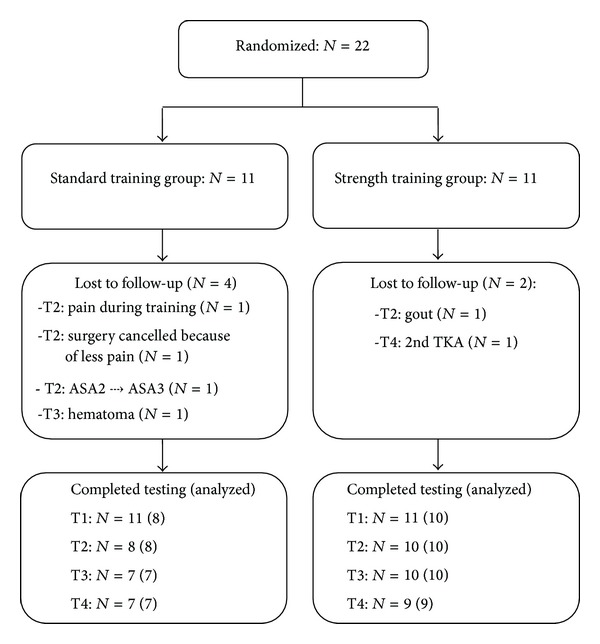
Objective. To investigate the feasibility and effects of additional preoperative high intensity strength training for patients awaiting total knee arthroplasty (TKA). Design. Clinical controlled trial. Patients. Twenty-two patients awaiting TKA. Methods. Patients were allocated to a standard training group or a group receiving standard training with additional progressive strength training for 6 weeks. Isometric knee extensor strength, voluntary activation, chair stand, 6-minute walk test (6MWT), and stair climbing were assessed before and after 6 weeks of training and 6 and 12 weeks after TKA. Results. For 3 of the 11 patients in the intensive strength group, training load had to be adjusted because of pain. For both groups combined, improvements in chair stand and 6MWT were observed before surgery, but intensive strength training was not more effective than standard training. Voluntary activation did not change before and after surgery, and postoperative recovery was not different between groups (P > 0.05). Knee extensor strength of the affected leg before surgery was significantly associated with 6-minute walk (r = 0.50) and the stair climb (r - = 0.58, P < 0.05). Conclusion. Intensive strength training was feasible for the majority of patients, but there were no indications that it is more effective than standard training to increase preoperative physical performance. This trial was registered with NTR2278.
目的。探讨术前额外进行高强度力量训练对等待全膝关节置换术(TKA)患者的可行性及效果。设计。临床对照试验。患者。22例等待TKA的患者。方法。患者被分配至标准训练组或接受标准训练并额外进行6周渐进性力量训练的组。在训练6周前后以及TKA术后6周和12周评估等长伸膝力量、自主激活、起立试验、6分钟步行试验(6MWT)和爬楼梯能力。结果。在强化力量训练组的11例患者中,有3例因疼痛不得不调整训练负荷。两组综合来看,术前观察到起立试验和6MWT有改善,但强化力量训练并不比标准训练更有效。手术前后自主激活无变化,两组术后恢复情况无差异(P>0.05)。术前患侧腿的伸膝力量与6分钟步行(r = 0.50)和爬楼梯(r = 0.58,P<0.05)显著相关。结论。强化力量训练对大多数患者是可行的,但没有迹象表明它比标准训练在提高术前身体机能方面更有效。本试验在荷兰国家试验注册库注册号为NTR2278。