Colzani Mara, Noberini Roberta, Romanenghi Mauro, Colella Gennaro, Pasi Maurizio, Fancelli Daniele, Varasi Mario, Minucci Saverio, Bonaldi Tiziana
From the ‡Department of Experimental Oncology, European Institute of Oncology, Via Adamello 16, 20139 Milano, Italy; §Center of Genomic Science, Istituto Italiano di Tecnologia, via Adamello 16, 20139 Milano, Italy;
From the ‡Department of Experimental Oncology, European Institute of Oncology, Via Adamello 16, 20139 Milano, Italy;
Mol Cell Proteomics. 2014 Jun;13(6):1495-509. doi: 10.1074/mcp.M113.034173. Epub 2014 Apr 2.
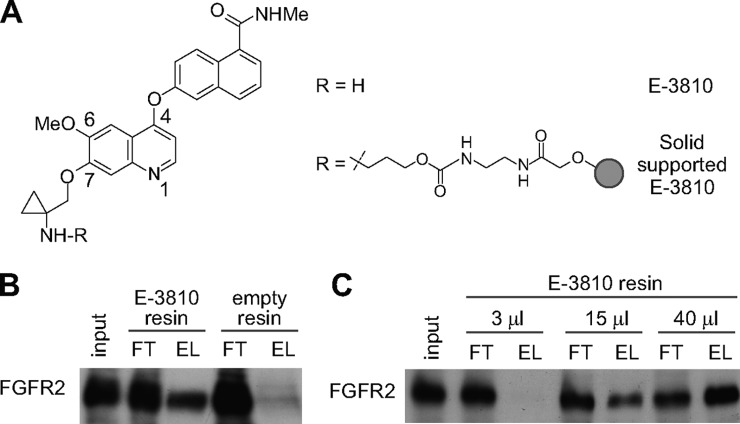
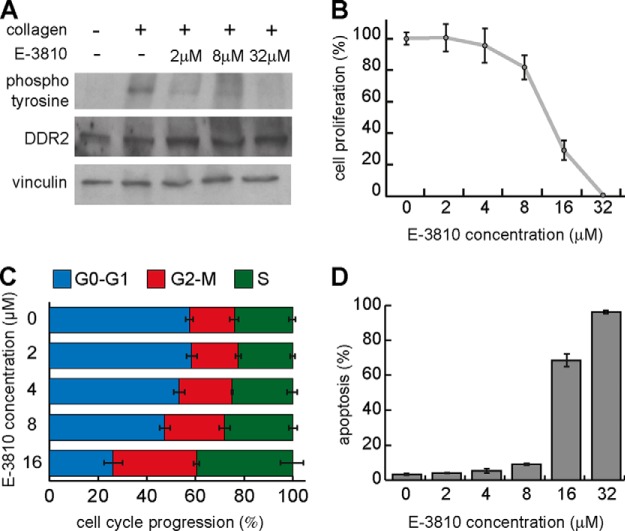
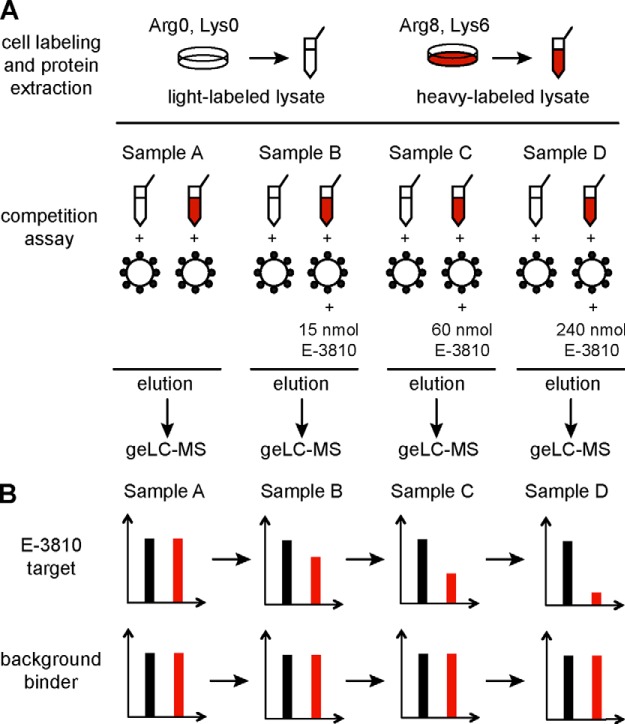
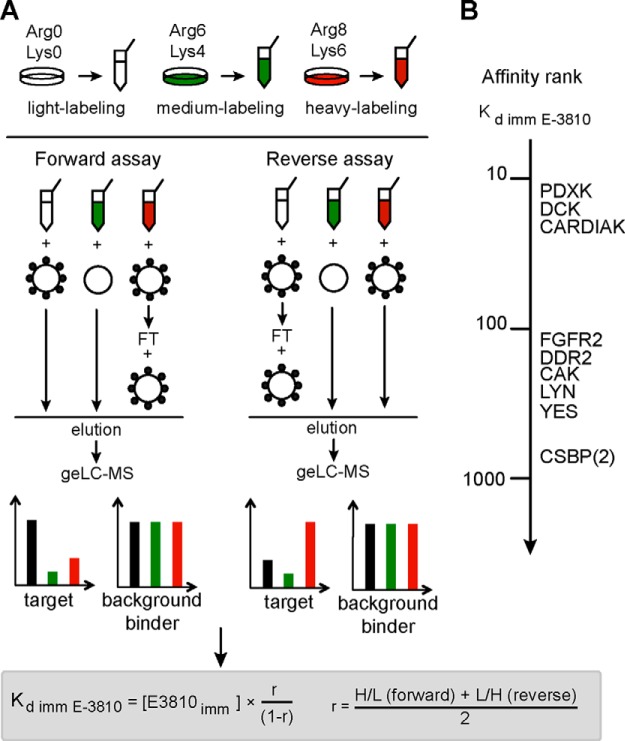
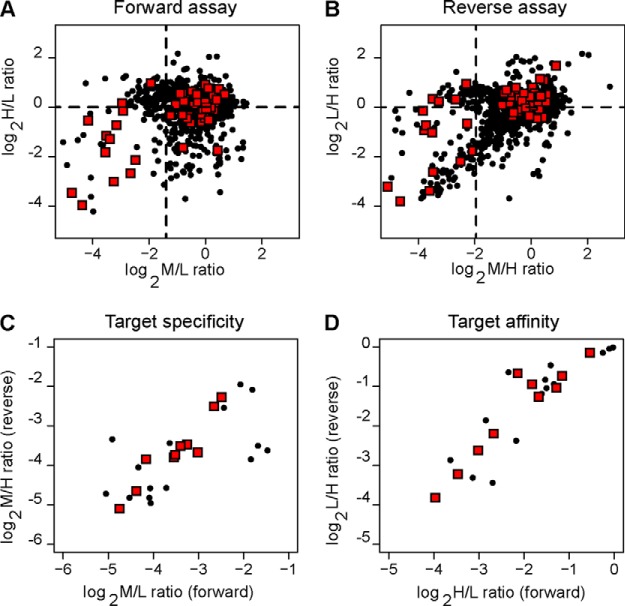
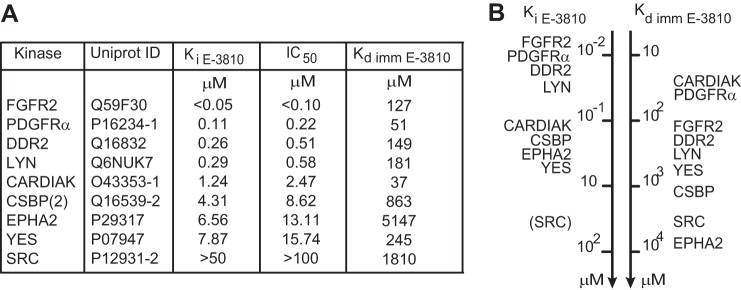
Novel drugs are designed against specific molecular targets, but almost unavoidably they bind non-targets, which can cause additional biological effects that may result in increased activity or, more frequently, undesired toxicity. Chemical proteomics is an ideal approach for the systematic identification of drug targets and off-targets, allowing unbiased screening of candidate interactors in their natural context (tissue or cell extracts). E-3810 is a novel multi-kinase inhibitor currently in clinical trials for its anti-angiogenic and anti-tumor activity. In biochemical assays, E-3810 targets primarily vascular endothelial growth factor and fibroblast growth factor receptors. Interestingly, E-3810 appears to inhibit the growth of tumor cells with low to undetectable levels of these proteins in vitro, suggesting that additional relevant targets exist. We applied chemical proteomics to screen for E-3810 targets by immobilizing the drug on a resin and exploiting stable isotope labeling by amino acids in cell culture to design experiments that allowed the detection of novel interactors and the quantification of their dissociation constant (Kd imm) for the immobilized drug. In addition to the known target FGFR2 and PDGFRα, which has been described as a secondary E-3810 target based on in vitro assays, we identified six novel candidate kinase targets (DDR2, YES, LYN, CARDIAK, EPHA2, and CSBP). These kinases were validated in a biochemical assay and-in the case of the cell-surface receptor DDR2, for which activating mutations have been recently discovered in lung cancer-cellular assays. Taken together, the success of our strategy-which integrates large-scale target identification and quality-controlled target affinity measurements using quantitative mass spectrometry-in identifying novel E-3810 targets further supports the use of chemical proteomics to dissect the mechanism of action of novel drugs.
新型药物是针对特定分子靶点设计的,但几乎不可避免地会与非靶点结合,这可能会导致额外的生物学效应,进而可能导致活性增加,或者更常见的是产生不良毒性。化学蛋白质组学是系统鉴定药物靶点和脱靶的理想方法,能够在天然环境(组织或细胞提取物)中对候选相互作用分子进行无偏筛选。E-3810是一种新型多激酶抑制剂,目前正处于临床试验阶段,具有抗血管生成和抗肿瘤活性。在生化分析中,E-3810主要靶向血管内皮生长因子和成纤维细胞生长因子受体。有趣的是,E-3810在体外似乎能抑制这些蛋白水平低至无法检测的肿瘤细胞生长,这表明存在其他相关靶点。我们应用化学蛋白质组学来筛选E-3810的靶点,方法是将药物固定在树脂上,并利用细胞培养中氨基酸的稳定同位素标记来设计实验,从而能够检测新型相互作用分子并对其与固定化药物的解离常数(Kd imm)进行定量。除了已知的靶点FGFR2和PDGFRα(基于体外分析,后者已被描述为E-3810的次要靶点),我们还鉴定出六个新型候选激酶靶点(DDR2、YES、LYN、CARDIAK、EPHA2和CSBP)。这些激酶在生化分析中得到了验证,对于细胞表面受体DDR2(最近在肺癌中发现了其激活突变),还在细胞分析中得到了验证。总之,我们的策略成功地整合了大规模靶点鉴定和使用定量质谱进行的质量控制靶点亲和力测量,从而鉴定出新型E-3810靶点,这进一步支持了使用化学蛋白质组学来剖析新型药物的作用机制。