Okamoto Masanori, Yamanaka Shintaro, Yoshimoto Wataru, Shigematsu Takashi
Division of Nephrology, Department of Internal Medicine, Wakayama Medical University, 811-1 Kimiidera, Wakayama City, Wakayama 641-0012, Japan.
J Transplant. 2014;2014:269613. doi: 10.1155/2014/269613. Epub 2014 Feb 19.
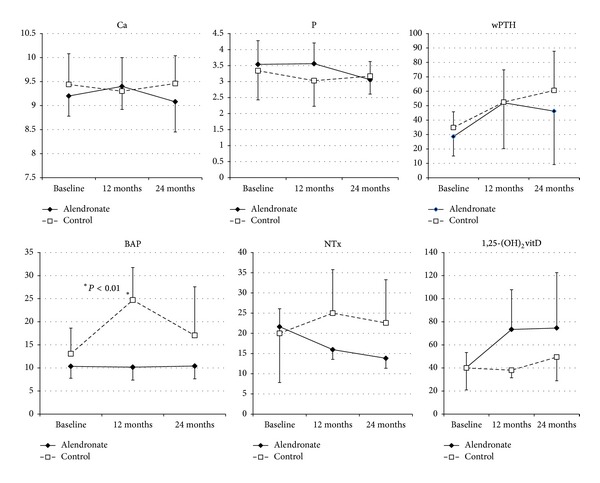
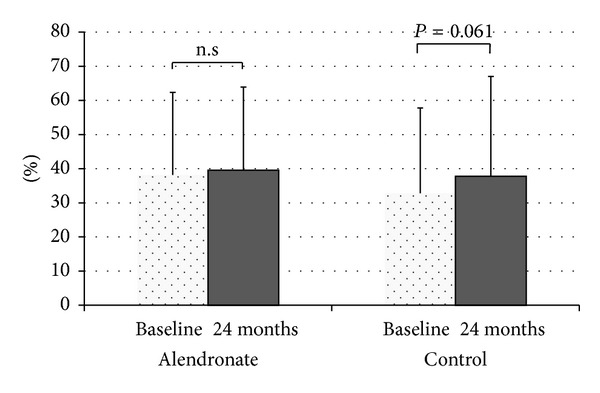
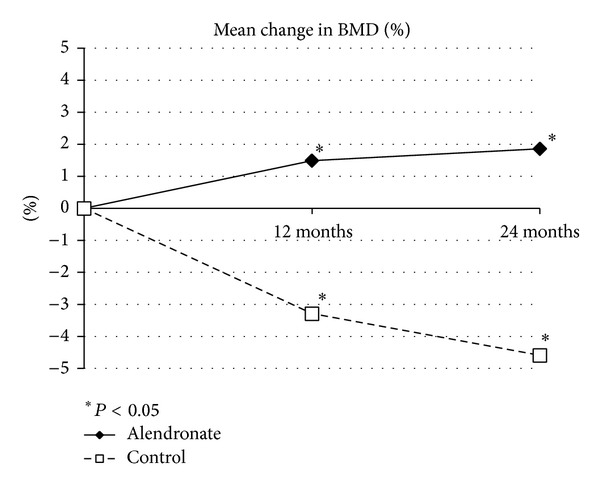
Kidney transplant recipients develop secondary osteoporosis induced by immunosuppressive medication, with a high risk of fracture, and abdominal aortic calcification (AC) is a known predictor of cardiovascular mortality. In this study of 12 stable kidney recipients, we estimated the preventive effect of bisphosphonate treatment on bone loss and progression of AC. We randomly divided the subjects into a treatment group with alendronate (group A: 5 subjects) and a control group (group C: 7 subjects). Group A patients received 35 mg/week of alendronate over 24 months, while group C patients were not administered with any bisphosphonates. Two major endpoints were established: (1) the time-dependent change in bone mineral density (BMD) estimated with DEXA and (2) progression of abdominal AC, calculated twice as an index (ACI) using computed tomography data. Over the 2-year study period, group A patients showed significantly increased BMD of 1.86 ± 0.85% (P = 0.015 versus baseline), and almost complete inhibition of ACI progression (38.2 ± 24.2% to 39.6 ± 24.3%), but group C patients showed a decrease in BMD decline with bone loss and progression of ACI (32.8 ± 25.0% to 37.8 ± 29.2%, P = 0.061). In conclusion, alendronate therapy was an effective treatment in kidney transplant recipients for secondary osteoporosis and vascular calcification as ectopic calcification. This clinical trial is registered with number JMA-IIA00155 of JMACCT CTR.
肾移植受者会因免疫抑制药物而发生继发性骨质疏松,骨折风险很高,而腹主动脉钙化(AC)是心血管死亡的已知预测指标。在这项对12名稳定肾移植受者的研究中,我们评估了双膦酸盐治疗对骨质流失和AC进展的预防作用。我们将受试者随机分为阿仑膦酸钠治疗组(A组:5名受试者)和对照组(C组:7名受试者)。A组患者在24个月内每周接受35mg阿仑膦酸钠治疗,而C组患者未接受任何双膦酸盐治疗。确定了两个主要终点:(1)用双能X线吸收法(DEXA)估计的骨矿物质密度(BMD)随时间的变化,以及(2)腹主动脉AC的进展,使用计算机断层扫描数据计算两次作为指数(ACI)。在为期2年的研究期间,A组患者的BMD显著增加1.86±0.85%(与基线相比,P = 0.015),并且ACI进展几乎完全受到抑制(从38.2±24.2%降至39.6±24.3%),但C组患者的BMD下降减少,伴有骨质流失和ACI进展(从32.8±25.0%升至37.8±29.2%,P = 0.061)。总之,阿仑膦酸钠治疗对肾移植受者的继发性骨质疏松和作为异位钙化的血管钙化是一种有效的治疗方法。该临床试验已在日本医疗中心临床试验注册系统(JMACCT CTR)注册,注册号为JMA-IIA00155。