Dahi-Taleghani Mastane, Fazli Benjamin, Ghasemi Mahshid, Vosoughian Maryam, Dabbagh Ali
Anesthesiology Research Center, Shahid Beheshti University of Medical Sciences, Tehran, Iran.
Anesth Pain Med. 2014 Feb 15;4(1):e14129. doi: 10.5812/aapm.14129. eCollection 2014 Feb.
Acutepostoperative pain is among the worst experience that patient scan undergo, and many analgesics have been used to suppress it; especially in chronic opium abusers. Ketamine is an N-methyl-D-aspartate antagonist analgesic, having both anesthetic and analgesic properties, which are not affected to the same extent in chronic opium abusers.
In this study, we assessed the analgesic effects of ketamine added to morphine as a patient-controlled analgesia method for acute pain management, compared with a placebo, inchronic maleopium abusers.
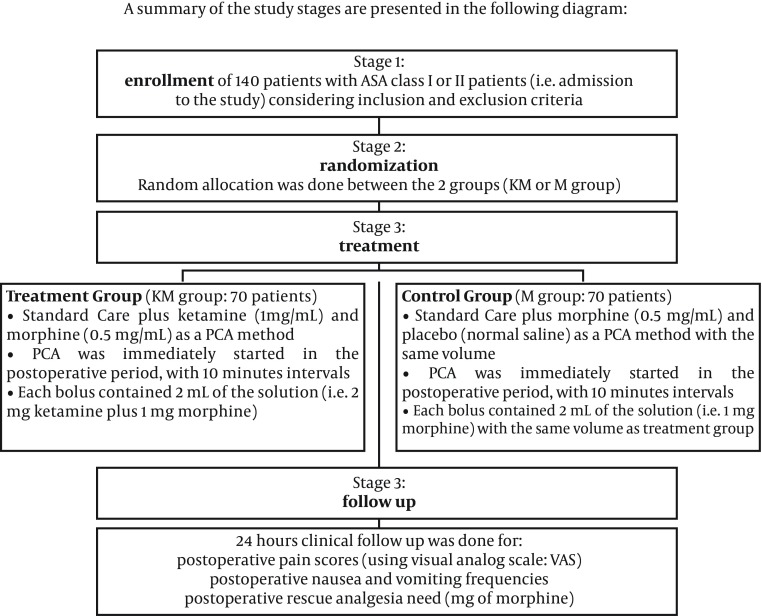
After institutional review board approval for ethical considerations, a randomized double-blinded placebo controlled clinical trial was conducted. A total of 140 male patients aged 18-65 years, undergoing orthopedic surgery, were entered into the study after matching inclusion and exclusion criteria. All patients received the same anesthesia method; while the first group received ketamine (1mg/mL) and morphine (0.5 mg/mL) as a patient-controlled analgesia (70 patients), the second group received morphine (0.5 mg/mL) plus normal saline (70 patients). P value less than 0.05 was considered statistically significant.
The ketamine and morphine group of patients experienced less postoperative pain and required less postoperative rescue analgesia. However, the unwanted postoperative side effects were nearly the same; although increased levels of postoperative nausea and vomiting were observed in the ketamine and morphine group.
This study demonstrated improved analgesic effects after using intravenous patient controlled analgesia with ketamine on postoperative pain in opium abusers.
术后急性疼痛是患者可能经历的最糟糕的体验之一,人们使用了多种镇痛药来抑制疼痛;尤其是在慢性阿片类药物滥用者中。氯胺酮是一种N-甲基-D-天冬氨酸拮抗剂镇痛药,具有麻醉和镇痛特性,在慢性阿片类药物滥用者中,其麻醉和镇痛特性受到的影响程度不同。
在本研究中,我们评估了在慢性男性阿片类药物滥用者中,将氯胺酮添加到吗啡中作为一种患者自控镇痛方法用于急性疼痛管理时的镇痛效果,并与安慰剂进行比较。
经机构审查委员会出于伦理考虑批准后,进行了一项随机双盲安慰剂对照临床试验。共有140名年龄在18 - 65岁、接受骨科手术的男性患者在符合纳入和排除标准后进入研究。所有患者接受相同的麻醉方法;第一组接受氯胺酮(1mg/mL)和吗啡(0.5mg/mL)作为患者自控镇痛(70例患者),第二组接受吗啡(0.5mg/mL)加生理盐水(70例患者)。P值小于0.05被认为具有统计学意义。
氯胺酮和吗啡组患者术后疼痛较轻,术后所需的补救性镇痛较少。然而,术后不良副作用几乎相同;尽管氯胺酮和吗啡组术后恶心和呕吐水平有所升高。
本研究表明,在阿片类药物滥用者中,静脉注射氯胺酮进行患者自控镇痛对术后疼痛具有更好的镇痛效果。