del-Rio-Vellosillo Monica, Garcia-Medina Jose Javier, Abengochea-Cotaina Antonio, Pinazo-Duran Maria Dolores, Barbera-Alacreu Manuel
Department of Anesthesia, University Hospital Virgen de la Arrixaca, Ctra. Madrid-Cartagena, s/n, El Palmar, 30120 Murcia, Spain.
Department of Ophthalmology and Optometry, School of Medicine, University of Murcia, Avenida Intendente Jorge Palacios 1, 30003 Murcia, Spain ; Department of Ophthalmology, General University Hospital Reina Sofia, Avenida Intendente Jorge Palacios 1, 30003 Murcia, Spain.
Biomed Res Int. 2014;2014:349034. doi: 10.1155/2014/349034. Epub 2014 Feb 20.
The aim of the study was to compare the sensory, motor, and neuroophthalmological effects of isobaric levobupivacaine and bupivacaine when intrathecally administered.
A prospective, double-blind, randomized study with 60 ASA grade I-II patients aged 18-65 years awaiting knee arthroscopy under spinal anesthesia. Patients received 12.5 mg of isobaric bupivacaine or levobupivacaine. Several features were recorded.
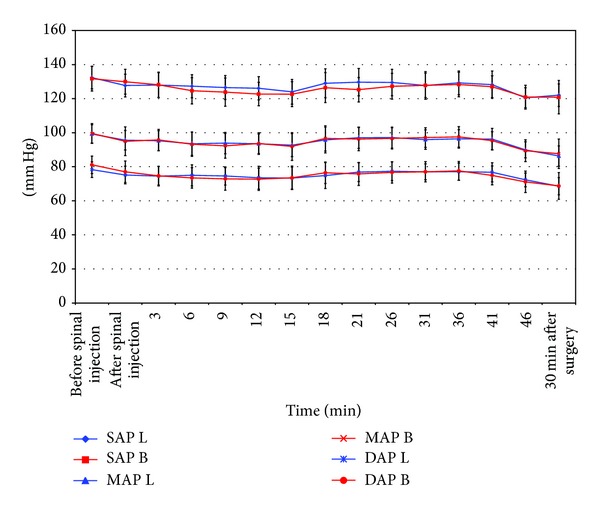
No significant intergroup differences were observed for ASA classification, time to micturate, demographic data, surgery duration, and patient/surgeon satisfaction. Similar hemodynamic parameters and sensory/motor blockade duration were found for both groups. There were no neuroophthalmological effects in either group. Sensory (P = 0.018) and motor blockade onset (P = 0.003) was faster in the bupivacaine group. T6 (T2-T12) and T3 (T2-T12) were the highest sensory block levels for the levobupivacaine and bupivacaine groups, respectively (P = 0.008). It took less time to regain maximum motor blockade in the bupivacaine group (P = 0.014), and the levobupivacaine group required use of analgesia earlier (P = 0.025).
Isobaric bupivacaine and levobupivacaine are analogous and well-tolerated anesthetics for knee arthroscopy. However, for bupivacaine, sensory and motor blockade onset was faster, and greater sensory blockade with a longer postoperative painless period was achieved.
本研究的目的是比较等比重左旋布比卡因和布比卡因鞘内给药时的感觉、运动及神经眼科效应。
一项前瞻性、双盲、随机研究,纳入60例年龄在18 - 65岁、ASA分级为I - II级、等待在脊髓麻醉下行膝关节镜检查的患者。患者接受12.5mg等比重布比卡因或左旋布比卡因。记录了几个特征。
在ASA分级、排尿时间、人口统计学数据、手术持续时间以及患者/外科医生满意度方面,未观察到显著的组间差异。两组的血流动力学参数及感觉/运动阻滞持续时间相似。两组均未出现神经眼科效应。布比卡因组的感觉(P = 0.018)和运动阻滞起效(P = 0.003)更快。左旋布比卡因组和布比卡因组的最高感觉阻滞平面分别为T6(T2 - T12)和T3(T2 - T12)(P = 0.008)。布比卡因组恢复最大运动阻滞所需时间更短(P = 0.014),左旋布比卡因组更早需要使用镇痛药物(P = 0.025)。
等比重布比卡因和左旋布比卡因是用于膝关节镜检查的类似且耐受性良好的麻醉剂。然而,布比卡因的感觉和运动阻滞起效更快,并且能实现更大的感觉阻滞以及更长的术后无痛期。