
在一名患有卵巢支持-间质细胞瘤和结节性甲状腺肿的女性中鉴定出一种新型DICER1突变:病例报告。
A novel DICER1 mutation identified in a female with ovarian Sertoli-Leydig cell tumor and multinodular goiter: a case report.
作者信息
Rossing Maria, Gerdes Anne-Marie, Juul Anders, Rechnitzer Catherine, Rudnicki Martin, Nielsen Finn C, Vo Hansen Thomas
机构信息
Center for Genomic Medicine, Rigshospitalet, Copenhagen University Hospital, Copenhagen, Denmark.
出版信息
J Med Case Rep. 2014 Apr 3;8:112. doi: 10.1186/1752-1947-8-112.
INTRODUCTION
Germ-line mutations in the micro-ribonucleic acid processing gene DICER1 have been shown to predispose to a subset of benign tumors susceptible to malignant transformation, including ovarian Sertoli-Leydig cell tumor, nontoxic multinodular goiter, multilocular cystic nephroma and pleuropulmonary blastoma, which can occur in children and young adults. This may be due to reduced Dcr-1 homolog expression in carriers of germline mutations, which causes impairment of micro-ribonucleic acid processing and deregulates the growth and differentiation of target cells, leading to an increased risk of tumorigenesis. Many carriers of germ-line DICER1 mutations remain unaffected, but development of tumors within carriers is associated with varying prognoses.
CASE PRESENTATION
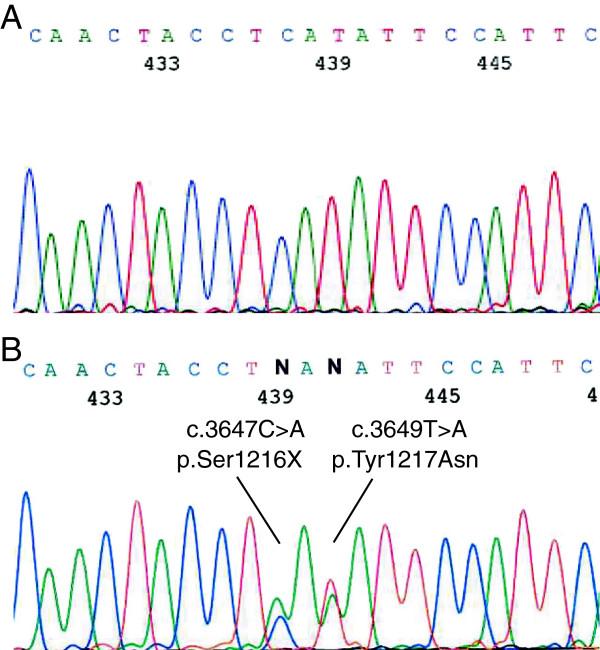
Despite the Dcr-1 homolog syndrome phenotype being incompletely defined, a DICER1 mutation was suspected when a girl (case 1 patient) of Danish ethnicity presented with both an ovarian Sertoli-Leydig cell tumor and a multinodular goiter at the age of 13 years. In addition, family history included a male sibling (case 2 patient) who also had a multinodular goiter and had undergone a hemithyroidectomy at the age of 14 years. Subsequent DICER1 screening of the girl identified two novel mutations in exon 21 - a nonsense (c.3647C>A, p.Ser1216*) and a missense (c.3649T>A, p.Tyr1217Asn) mutation. The siblings had inherited the mutations from their father and paternal grandfather, which both currently were asymptomatic, indicating reduced penetrance of the nonsense mutation. Analysis of the parents revealed that the mutations were present in cis, making the contribution of the missense mutation less significant.
CONCLUSION
We report a novel pathogenic DICER1 mutation (p.Ser1216*) in a Danish family associated with ovarian Sertoli-Leydig cell tumor and a multinodular goiter. A multinodular goiter was diagnosed in the siblings during childhood. Clinicians should be aware of a potential germ-line DICER1 mutation when evaluating multinodular goiter in young patients with or without a family history of thyroid diseases.
引言
微小核糖核酸加工基因DICER1中的种系突变已被证明易导致一部分易发生恶性转化的良性肿瘤,包括卵巢支持-间质细胞瘤、非毒性多结节性甲状腺肿、多房性囊性肾瘤和胸膜肺母细胞瘤,这些肿瘤可发生于儿童和年轻人。这可能是由于种系突变携带者中Dcr-1同源物表达降低,导致微小核糖核酸加工受损,靶细胞生长和分化失调,从而增加肿瘤发生风险。许多种系DICER1突变携带者并未发病,但携带者体内肿瘤的发生与不同的预后相关。
病例报告
尽管Dcr-1同源物综合征的表型尚未完全明确,但当一名13岁的丹麦裔女孩(病例1患者)同时出现卵巢支持-间质细胞瘤和多结节性甲状腺肿时,怀疑存在DICER1突变。此外,家族史显示其男性同胞(病例2患者)也患有多结节性甲状腺肿,并在14岁时接受了半甲状腺切除术。随后对该女孩进行的DICER1筛查在第21外显子中发现了两个新突变——一个无义突变(c.3647C>A,p.Ser1216*)和一个错义突变(c.3649T>A,p.Tyr1217Asn)。这对同胞从他们的父亲和祖父那里遗传了这些突变,而他们目前均无症状,表明无义突变的外显率降低。对其父母的分析显示,这些突变处于顺式状态,使得错义突变的作用较小。
结论
我们报告了一个丹麦家族中与卵巢支持-间质细胞瘤和多结节性甲状腺肿相关的新的致病性DICER1突变(p.Ser1216*)。这对同胞在儿童期被诊断为多结节性甲状腺肿。临床医生在评估有或无甲状腺疾病家族史的年轻患者的多结节性甲状腺肿时,应意识到潜在的种系DICER1突变。

 Zotero 插件