Ghosh Ayanjeet, Tucker Matthew J, Gai Feng
Department of Chemistry, University of Pennsylvania , Philadelphia, Pennsylvania 19104-6323, United States.
J Phys Chem B. 2014 Jul 17;118(28):7799-805. doi: 10.1021/jp411901m. Epub 2014 Apr 18.
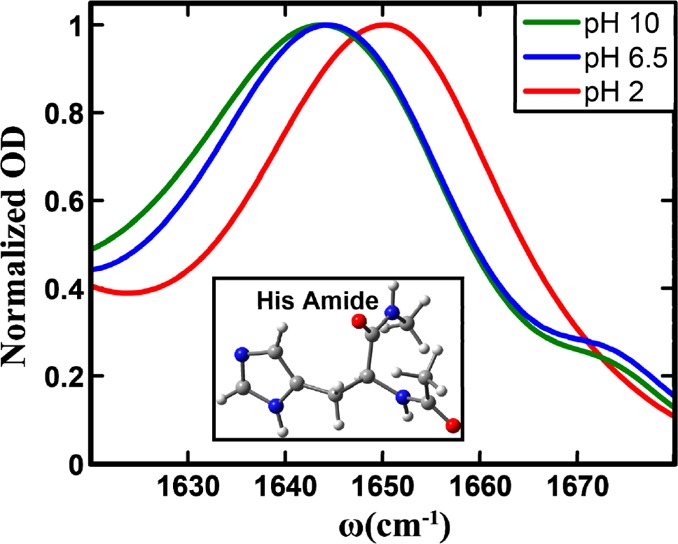
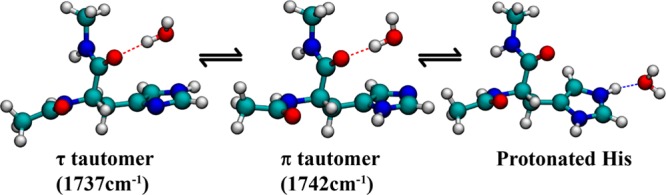
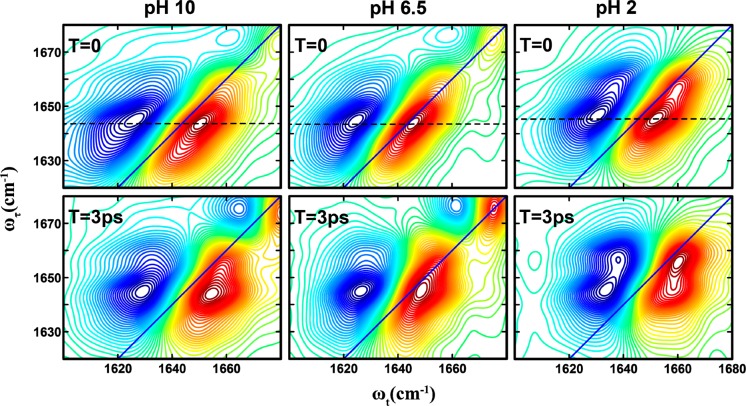
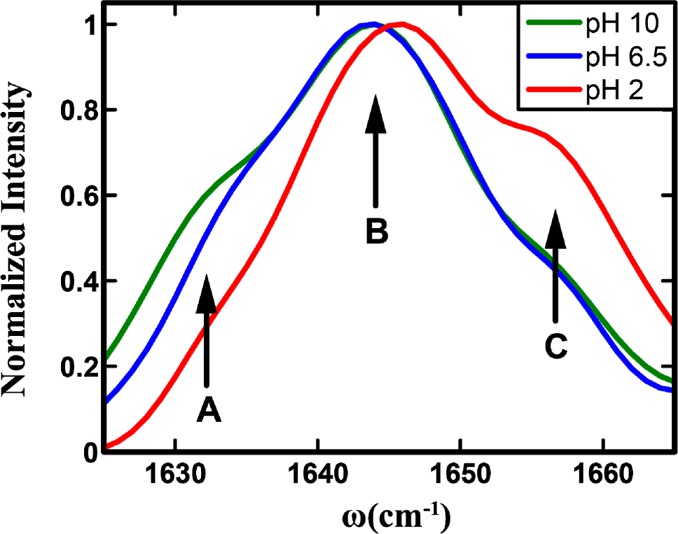
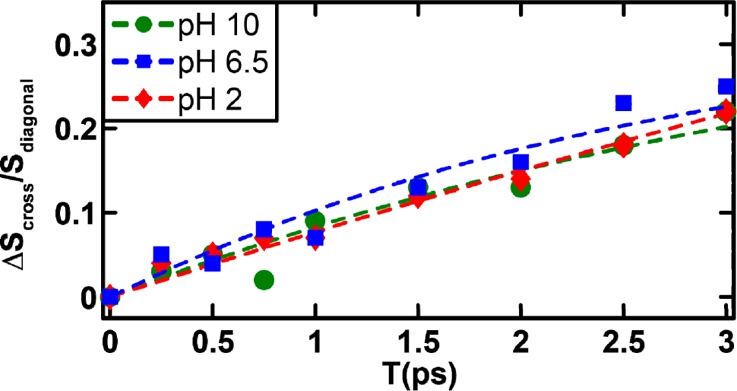
It is well known that histidine is involved in many biological functions due to the structural versatility of its side chain. However, probing the conformational transitions of histidine in proteins, especially those occurring on an ultrafast time scale, is difficult. Herein we show, using a histidine dipeptide as a model, that it is possible to probe the tautomer and protonation status of a histidine residue by measuring the two-dimensional infrared (2D IR) spectrum of its amide I vibrational transition. Specifically, for the histidine dipeptide studied, the amide unit of the histidine gives rise to three spectrally resolvable amide I features at approximately 1630, 1644, and 1656 cm(-1), respectively, which, based on measurements at different pH values and frequency calculations, are assigned to a τ tautomer (1630 cm(-1) component) and a π tautomer with a hydrated (1644 cm(-1) component) or dehydrated (1656 cm(-1) component) amide. Because of the intrinsic ultrafast time resolution of 2D IR spectroscopy, we believe that the current approach, when combined with the isotope editing techniques, will be useful in revealing the structural dynamics of key histidine residues in proteins that are important for function.
众所周知,由于组氨酸侧链结构的多样性,它参与了许多生物学功能。然而,探究蛋白质中组氨酸的构象转变,尤其是那些在超快时间尺度上发生的转变,是困难的。在此,我们以组氨酸二肽为模型表明,通过测量其酰胺I振动跃迁的二维红外(2D IR)光谱,可以探测组氨酸残基的互变异构体和质子化状态。具体而言,对于所研究的组氨酸二肽,组氨酸的酰胺单元分别在约1630、1644和1656 cm⁻¹处产生三个光谱可分辨的酰胺I特征峰,基于在不同pH值下的测量和频率计算,这些峰分别归属于τ互变异构体(1630 cm⁻¹成分)以及具有水合(1644 cm⁻¹成分)或脱水(1656 cm⁻¹成分)酰胺的π互变异构体。由于二维红外光谱固有的超快时间分辨率,我们相信当前的方法与同位素编辑技术相结合时,将有助于揭示对功能至关重要的蛋白质中关键组氨酸残基的结构动力学。