Duncan Mitch J, Kline Christopher E, Vandelanotte Corneel, Sargent Charli, Rogers Naomi L, Di Milia Lee
Centre for Physical Activity Studies, Institute for Health and Social Science Research, Central Queensland University, Rockhampton, Queensland, Australia.
Department of Psychiatry, University of Pittsburgh School of Medicine, Pittsburgh, Pennsylvania, United States of America.
PLoS One. 2014 Apr 8;9(4):e94184. doi: 10.1371/journal.pone.0094184. eCollection 2014.
The independent and combined influence of smoking, alcohol consumption, physical activity, diet, sitting time, and sleep duration and quality on health status is not routinely examined. This study investigates the relationships between these lifestyle behaviors, independently and in combination, and health-related quality of life (HRQOL).
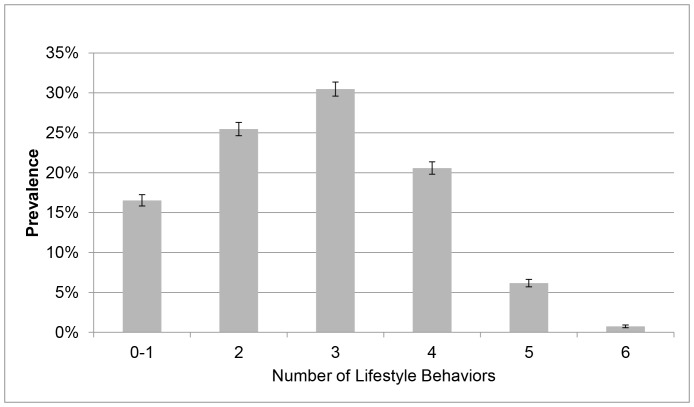
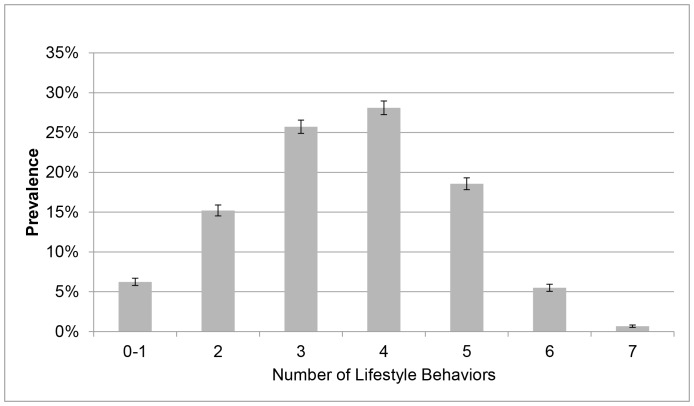
Adult members of the 10,000 Steps project (n = 159,699) were invited to participate in an online survey in November-December 2011. Participant socio-demographics, lifestyle behaviors, and HRQOL (poor self-rated health; frequent unhealthy days) were assessed by self-report. The combined influence of poor lifestyle behaviors were examined, independently and also as part of two lifestyle behavior indices, one excluding sleep quality (Index 1) and one including sleep quality (Index 2). Adjusted Cox proportional hazard models were used to examine relationships between lifestyle behaviors and HRQOL.
A total of 10,478 participants provided complete data for the current study. For Index 1, the Prevalence Ratio (p value) of poor self-rated health was 1.54 (p = 0.001), 2.07 (p≤0.001), 3.00 (p≤0.001), 3.61 (p≤0.001) and 3.89 (p≤0.001) for people reporting two, three, four, five and six poor lifestyle behaviors, compared to people with 0-1 poor lifestyle behaviors. For Index 2, the Prevalence Ratio (p value) of poor self-rated health was 2.26 (p = 0.007), 3.29 (p≤0.001), 4.68 (p≤0.001), 6.48 (p≤0.001), 7.91 (p≤0.001) and 8.55 (p≤0.001) for people reporting two, three, four, five, six and seven poor lifestyle behaviors, compared to people with 0-1 poor lifestyle behaviors. Associations between the combined lifestyle behavior index and frequent unhealthy days were statistically significant and similar to those observed for poor self-rated health.
Engaging in a greater number of poor lifestyle behaviors was associated with a higher prevalence of poor HRQOL. This association was exacerbated when sleep quality was included in the index.
吸烟、饮酒、体育活动、饮食、久坐时间以及睡眠时长和质量对健康状况的独立及综合影响尚未得到常规检验。本研究调查了这些生活方式行为单独及综合起来与健康相关生活质量(HRQOL)之间的关系。
邀请“万步计划”的成年成员(n = 159,699)参与2011年11月至12月的一项在线调查。通过自我报告评估参与者的社会人口统计学特征、生活方式行为以及HRQOL(自我健康评价差;频繁出现不健康天数)。对不良生活方式行为的综合影响进行了检验,既单独检验,也作为两个生活方式行为指数的一部分进行检验,一个不包括睡眠质量(指数1),另一个包括睡眠质量(指数2)。使用调整后的Cox比例风险模型来检验生活方式行为与HRQOL之间的关系。
共有10,478名参与者为当前研究提供了完整数据。对于指数1,与生活方式行为不良为0 - 1项的人相比,报告有两项、三项、四项、五项和六项不良生活方式行为的人自我健康评价差的患病率比值(p值)分别为1.54(p = 0.001)、2.07(p≤0.001)、3.00(p≤0.001)、3.61(p≤0.001)和3.89(p≤0.001)。对于指数2,与生活方式行为不良为0 - 1项的人相比,则分别为2.26(p = 0.007)、3.29(p≤0.001)、4.68(p≤0.001)、6.48(p≤0.001)、7.91(p≤0.001)和8.55(p≤0.001)。综合生活方式行为指数与频繁出现不健康天数之间的关联具有统计学意义,且与自我健康评价差的情况类似。
不良生活方式行为数量越多,与HRQOL差的患病率越高相关。当指数中纳入睡眠质量时,这种关联会加剧。