• 文献检索
  • 文档翻译
  • 深度研究
  • 学术资讯
  • Suppr Zotero 插件Zotero 插件
  • 邀请有礼
  • 套餐&价格
  • 历史记录
应用&插件
Suppr Zotero 插件Zotero 插件浏览器插件Mac 客户端Windows 客户端微信小程序
定价
高级版会员购买积分包购买API积分包
服务
文献检索文档翻译深度研究API 文档MCP 服务
关于我们
关于 Suppr公司介绍联系我们用户协议隐私条款
关注我们

Suppr 超能文献

核心技术专利:CN118964589B侵权必究
粤ICP备2023148730 号-1Suppr @ 2026

文献检索

告别复杂PubMed语法,用中文像聊天一样搜索,搜遍4000万医学文献。AI智能推荐,让科研检索更轻松。

立即免费搜索

文件翻译

保留排版,准确专业,支持PDF/Word/PPT等文件格式,支持 12+语言互译。

免费翻译文档

深度研究

AI帮你快速写综述,25分钟生成高质量综述,智能提取关键信息,辅助科研写作。

立即免费体验

体育训练作为神经心源性晕厥的非药物治疗方法。

Physical training as non-pharmacological treatment of neurocardiogenic syncope.

出版信息

Arq Bras Cardiol. 2014 Mar;102(3):288-94. doi: 10.5935/abc.20140021.

DOI:10.5935/abc.20140021
PMID:24714795
原文链接:https://pmc.ncbi.nlm.nih.gov/articles/PMC3987313/
Abstract

BACKGROUND

Characterized as a sudden and temporary loss of consciousness and postural tone, with quick and spontaneous recovery, syncope is caused by an acute reduction of systemic arterial pressure and, therefore, of cerebral blood flow. Unsatisfactory results with the use of drugs allowed the nonpharmacological treatment of neurocardiogenic syncope was contemplated as the first therapeutic option.

OBJECTIVES

To compare, in patients with neurocardiogenic syncope, the impact of a moderate intensity aerobic physical training (AFT) and a control intervention on the positivity of head-up tilting test (HUT) and orthostatic tolerance time.

METHODS

Were studied 21 patients with a history of recurrent neurocardiogenic syncope and HUT. The patients were randomized into: trained group (TG), n = 11, and control group (CG), n = 10. The TG was submitted to 12 weeks of AFT supervised, in cycle ergometer, and the CG to a control procedure that consisted in 15 minutes of stretching and 15 minutes of light walk.

RESULTS

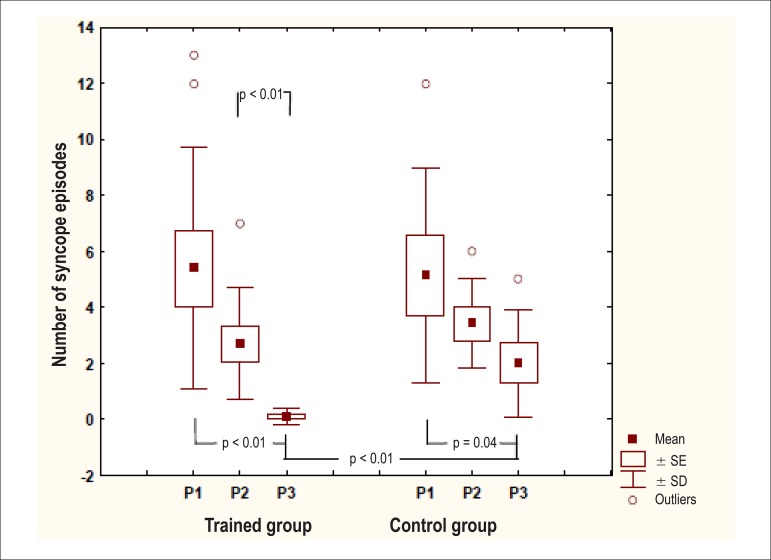
The TG had a positive effect to physical training, with a significant increase in peak oxygen consumption. The CG did not show any statistically significant change before and after the intervention. After the intervention period, 72.7% of the TG sample had negative results to the HUT, not having syncope in the revaluation.

CONCLUSION

The program of supervised aerobic physical training for 12 weeks was able to reduce the number of positive HUT, as it was able to increase tolerance time in orthostatic position during the HUT after the intervention period.

摘要

背景

晕厥是一种突然发生的、短暂的意识丧失和姿势性张力丧失,并伴有快速自发的恢复,其原因是全身动脉血压的急性降低,从而导致脑血流量减少。药物治疗效果不理想,促使人们考虑将神经心源性晕厥的非药物治疗作为首选治疗方案。

目的

比较神经心源性晕厥患者接受中等强度有氧运动训练(AFT)和对照干预对直立倾斜试验(HUT)阳性率和直立耐受时间的影响。

方法

研究了 21 例有反复发作神经心源性晕厥和 HUT 病史的患者。患者随机分为训练组(TG),n = 11 和对照组(CG),n = 10。TG 接受了 12 周的监督循环运动自行车 AFT,而 CG 则接受了 15 分钟伸展和 15 分钟轻走的对照程序。

结果

TG 对体能训练有积极影响,峰值摄氧量显著增加。CG 在干预前后均未显示出任何统计学上的显著变化。干预后,TG 样本中有 72.7%的 HUT 结果为阴性,在重新评估中没有发生晕厥。

结论

为期 12 周的监督有氧运动训练方案能够减少 HUT 的阳性率,因为它能够增加 HUT 期间直立位的耐受时间。
https://cdn.ncbi.nlm.nih.gov/pmc/blobs/ea5e/3987313/522a1d04f05f/abc-102-03-0288-g01.jpg

相似文献

1
Physical training as non-pharmacological treatment of neurocardiogenic syncope.体育训练作为神经心源性晕厥的非药物治疗方法。
Arq Bras Cardiol. 2014 Mar;102(3):288-94. doi: 10.5935/abc.20140021.
2
Tilt training: a treatment for malignant and recurrent neurocardiogenic syncope.倾斜训练:一种治疗恶性和复发性神经心源性晕厥的方法。
Pacing Clin Electrophysiol. 2000 Apr;23(4 Pt 1):493-8. doi: 10.1111/j.1540-8159.2000.tb00833.x.
3
Tilt testing in neurocardiogenic syncope: isosorbide versus isoproterenol.神经心源性晕厥的倾斜试验:异山梨酯与异丙肾上腺素的比较
Acta Cardiol. 2000 Dec;55(6):351-5. doi: 10.2143/AC.55.6.2005766.
4
False positive head-up tilt: hemodynamic and neurohumoral profile.假阳性头高位倾斜试验:血流动力学和神经体液特征
J Am Coll Cardiol. 2000 Jan;35(1):188-93. doi: 10.1016/s0735-1097(99)00500-8.
5
Neurocardiogenic syncope coexisting with postural orthostatic tachycardia syndrome in patients suffering from orthostatic intolerance: a combined form of autonomic dysfunction.体位性不耐受患者中神经心源性晕厥与体位性直立性心动过速综合征共存:一种自主神经功能障碍的联合形式。
Pacing Clin Electrophysiol. 2011 May;34(5):549-54. doi: 10.1111/j.1540-8159.2010.02994.x. Epub 2011 Jan 5.
6
Tilt training for recurrent neurocardiogenic syncope: effectiveness, patient compliance, and scheduling the frequency of training sessions.复发性神经心源性晕厥的倾斜训练:有效性、患者依从性及训练次数安排
Jpn Heart J. 2004 Sep;45(5):833-43. doi: 10.1536/jhj.45.833.
7
Predictors of positive head-up tilt test in patients with suspected neurocardiogenic syncope or presyncope.疑似神经心源性晕厥或前驱晕厥患者直立倾斜试验阳性的预测因素。
Pacing Clin Electrophysiol. 2003 Feb;26(2 Pt 1):593-8. doi: 10.1046/j.1460-9592.2003.00099.x.
8
A "dysautonomic" head-up tilt test pattern in elderly patients with neurocardiogenic syncope.
Pacing Clin Electrophysiol. 1999 Jul;22(7):1004-12. doi: 10.1111/j.1540-8159.1999.tb00564.x.
9
Monitoring of cerebral oximetry during head-up tilt test in adults with history of syncope and orthostatic intolerance.成人晕厥和直立不耐受病史患者行直立倾斜试验时的脑氧饱和度监测。
Europace. 2018 Sep 1;20(9):1535-1542. doi: 10.1093/europace/eux298.
10
Comparative study of cerebral blood flow between postural tachycardia and neurocardiogenic syncope, during head-up tilt test.头高位倾斜试验中姿势性心动过速与神经心源性晕厥脑血流量的对比研究
Europace. 2002 Oct;4(4):369-74. doi: 10.1053/eupc.2002.0226.

引用本文的文献

1
Exaggerated postural sway improves orthostatic cardiovascular and cerebrovascular control.姿势性摇摆过度可改善直立位时的心血管和脑血管调节。
Front Cardiovasc Med. 2023 Feb 16;10:1040036. doi: 10.3389/fcvm.2023.1040036. eCollection 2023.
2
Nonpharmacologic Treatments Alone are Enough to Prevent the Neurally Mediated Syncope: A 3 Years Follow-up Study.单纯非药物治疗足以预防神经介导性晕厥:一项3年随访研究。
Int J Prev Med. 2019 May 17;10:69. doi: 10.4103/ijpvm.IJPVM_386_17. eCollection 2019.
3
Pathophysiology of Noncardiac Syncope in Athletes.

本文引用的文献

1
Optimizing squatting as a physical maneuver to prevent vasovagal syncope.优化蹲姿作为一种预防血管迷走性晕厥的身体动作。
Clin Auton Res. 2008 Aug;18(4):179-86. doi: 10.1007/s10286-008-0481-0. Epub 2008 Aug 5.
2
The effects of exercise training on arterial baroreflex sensitivity in neurally mediated syncope patients.运动训练对神经介导性晕厥患者动脉压力反射敏感性的影响。
Eur Heart J. 2007 Nov;28(22):2749-55. doi: 10.1093/eurheartj/ehm208. Epub 2007 Jun 7.
3
The Second Prevention of Syncope Trial (POST II)--a randomized clinical trial of fludrocortisone for the prevention of neurally mediated syncope: rationale and study design.
运动员中非心源性晕厥的病理生理学。
Sports Med. 2018 Jul;48(7):1561-1573. doi: 10.1007/s40279-018-0911-7.
4
Cardiac Rehabilitation: Far Beyond Coronary Artery Disease.心脏康复:远不止于冠状动脉疾病。
Arq Bras Cardiol. 2015 Dec;105(6):549-51. doi: 10.5935/abc.20160002.
晕厥二级预防试验(POST II)——一项关于氟氢可的松预防神经介导性晕厥的随机临床试验:原理与研究设计
Am Heart J. 2006 Jun;151(6):1186.e11-7. doi: 10.1016/j.ahj.2006.03.013.
4
[Clinical outcome of patients with neurocardiogenic syncope (NCS) after therapy interruption].
Arq Bras Cardiol. 2006 Apr;86(4):256-60. doi: 10.1590/s0066-782x2006000400004. Epub 2006 Apr 25.
5
Prevention of Syncope Trial (POST): a randomized, placebo-controlled study of metoprolol in the prevention of vasovagal syncope.晕厥预防试验(POST):一项关于美托洛尔预防血管迷走性晕厥的随机、安慰剂对照研究。
Circulation. 2006 Mar 7;113(9):1164-70. doi: 10.1161/CIRCULATIONAHA.105.535161. Epub 2006 Feb 27.
6
Home orthostatic self-training in neurocardiogenic syncope.
Pacing Clin Electrophysiol. 2005 Jan;28 Suppl 1:S246-8. doi: 10.1111/j.1540-8159.2005.00023.x.
7
Tilt training for recurrent neurocardiogenic syncope: effectiveness, patient compliance, and scheduling the frequency of training sessions.复发性神经心源性晕厥的倾斜训练:有效性、患者依从性及训练次数安排
Jpn Heart J. 2004 Sep;45(5):833-43. doi: 10.1536/jhj.45.833.
8
Guidelines on management (diagnosis and treatment) of syncope-update 2004. Executive Summary.晕厥管理(诊断与治疗)指南——2004年更新。执行摘要。
Eur Heart J. 2004 Nov;25(22):2054-72. doi: 10.1016/j.ehj.2004.09.004.
9
Nonpharmacological treatment of reflex syncope.反射性晕厥的非药物治疗
Clin Auton Res. 2004 Oct;14 Suppl 1:62-70. doi: 10.1007/s10286-004-1009-x.
10
Neurocardiogenic syncope.神经心源性晕厥
BMJ. 2004 Aug 7;329(7461):336-41. doi: 10.1136/bmj.329.7461.336.