Lee HyunSook, Dutta Samikshan, Moon Il Soo
Department of Anatomy, Dongguk University College of Medicine, Gyeongju 780-714, Korea.
Departmet of Biochemistry and Molecular Biology, University of Nebraska Medical Center, Omaha, NE, USA.
Mol Cells. 2014 Apr;37(4):322-9. doi: 10.14348/molcells.2014.2377. Epub 2014 Apr 7.
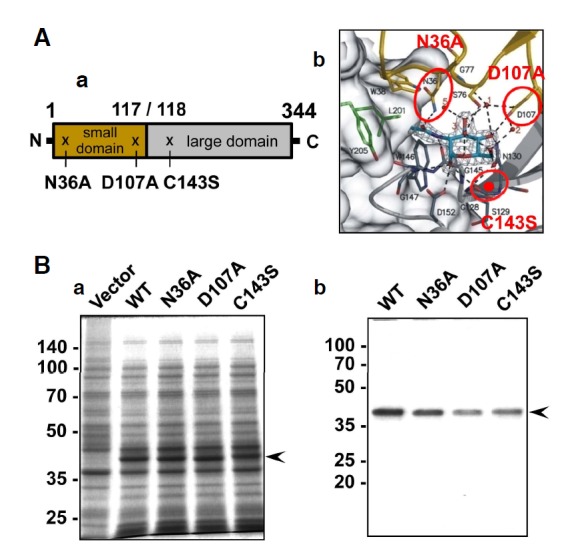
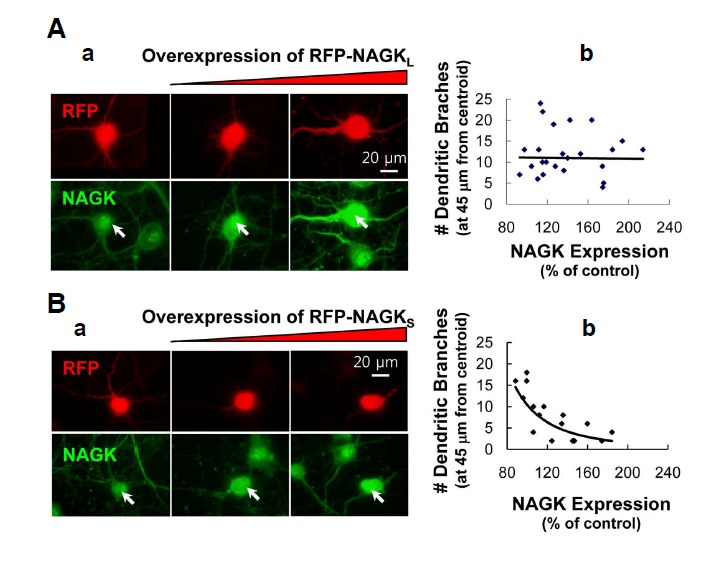
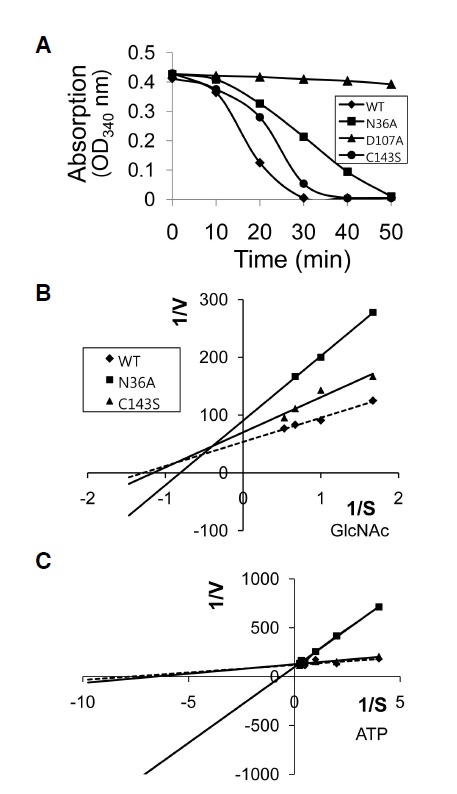
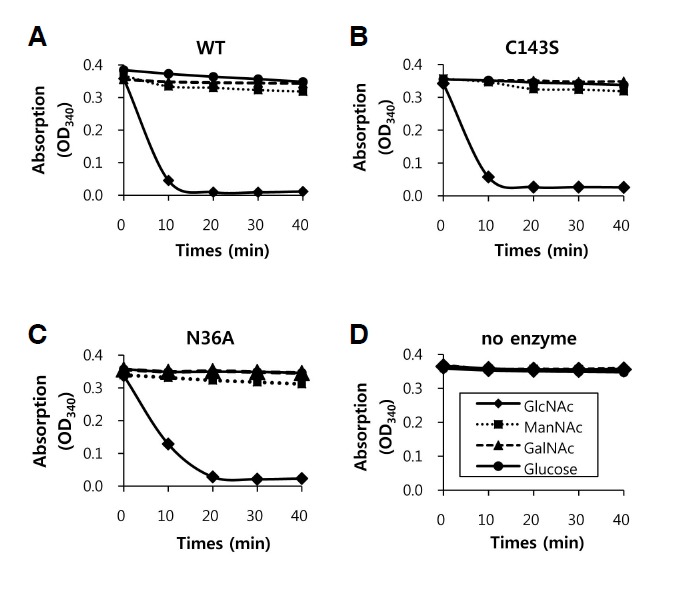
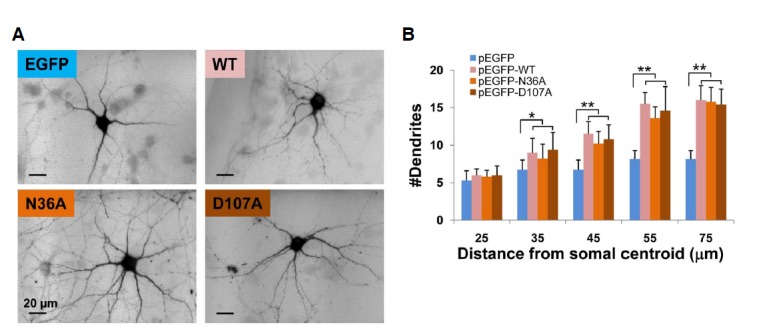
N-acetylglucosamine kinase (GlcNAc kinase or NAGK; EC 2.7.1.59) is highly expressed and plays a critical role in the development of dendrites in brain neurons. In this study, the authors conducted structure-function analysis to verify the previously proposed 3D model structure of GlcNAc/ ATP-bound NAGK. Three point NAGK mutants with different substrate binding capacities and reaction velocities were produced. Wild-type (WT) NAGK showed strong substrate preference for GlcNAc. Conversion of Cys143, which does not make direct hydrogen bonds with GlcNAc, to Ser (i.e., C143S) had the least affect on the enzymatic activity of NAGK. Conversion of Asn36, which plays a role in domain closure by making a hydrogen bond with GlcNAc, to Ala (i.e., N36A) mildly reduced NAGK enzyme activity. Conversion of Asp107, which makes hydrogen bonds with GlcNAc and would act as a proton acceptor during nucleophilic attack on the γ-phosphate of ATP, to Ala (i.e., D107A), caused a total loss in enzyme activity. The overexpression of EGFP-tagged WT or any of the mutant NAGKs in rat hippocampal neurons (DIV 5-9) increased dendritic architectural complexity. Finally, the overexpression of the small, but not of the large, domain of NAGK resulted in dendrite degeneration. Our data show the effect of structure on the functional aspects of NAGK, and in particular, that the small domain of NAGK, and not its NAGK kinase activity, plays a critical role in the upregulation of dendritogenesis.
N-乙酰葡糖胺激酶(GlcNAc激酶或NAGK;EC 2.7.1.59)在脑神经元树突发育中高表达并发挥关键作用。在本研究中,作者进行了结构-功能分析,以验证先前提出的GlcNAc/ATP结合的NAGK的三维模型结构。制备了具有不同底物结合能力和反应速度的三点NAGK突变体。野生型(WT)NAGK对GlcNAc表现出强烈的底物偏好。不与GlcNAc形成直接氢键的半胱氨酸143(Cys143)转化为丝氨酸(即C143S)对NAGK的酶活性影响最小。通过与GlcNAc形成氢键在结构域闭合中起作用的天冬酰胺36(Asn36)转化为丙氨酸(即N36A)会轻微降低NAGK酶活性。与GlcNAc形成氢键并在对ATP的γ-磷酸进行亲核攻击时充当质子受体的天冬氨酸107(Asp107)转化为丙氨酸(即D107A)导致酶活性完全丧失。在大鼠海马神经元(DIV 5-9)中过表达EGFP标记的WT或任何突变型NAGK会增加树突结构复杂性。最后,NAGK小结构域而非大结构域的过表达导致树突退化。我们的数据显示了结构对NAGK功能方面的影响,特别是NAGK的小结构域而非其NAGK激酶活性在树突发生上调中起关键作用。