Zhang Dongfeng, Liu Yang, Zhang Chunlin, Zhang Hao, Wang Bin, Xu Jian, Fu Lei, Yin Dali, Cooper Christopher B, Ma Zhenkun, Lu Yu, Huang Haihong
State Key Laboratory of Bioactive Substance and Function of Natural Medicines & Beijing Key Laboratory of Active Substances Discovery and Druggability Evaluation, Institute of Materia Medica, Peking Union Medical College & Chinese Academy of Medical Sciences, 1 Xian Nong Tan Street, Beijing 100050, China.
Department of Pharmacology, Beijing Tuberculosis and Thoracic Tumor Research Institute, Beijing Chest Hospital, Capital Medical University, 97 Ma Chang Street, Beijing 101149, China.
Molecules. 2014 Apr 9;19(4):4380-94. doi: 10.3390/molecules19044380.
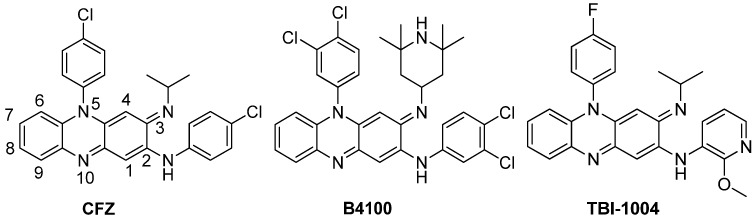
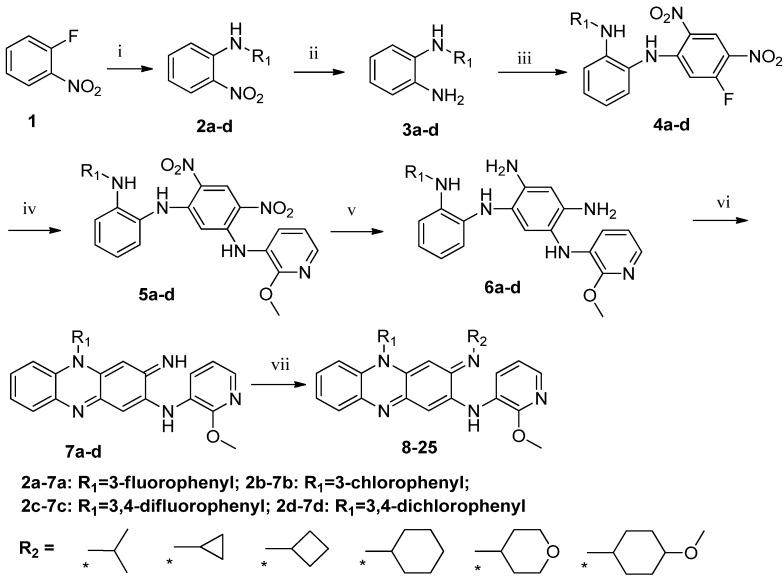
Clofazimine, a member of the riminophenazine class, is one of the few antibiotics that are still active against multidrug-resistant Mycobacterium tuberculosis (M. tuberculosis). However, the clinical utility of this agent is limited by its undesirable physicochemical properties and skin pigmentation potential. With the goal of maintaining potent antituberculosis activity while improving physicochemical properties and lowering skin pigmentation potential, a series of novel riminophenazine derivatives containing a 2-methoxypyridylamino substituent at the C-2 position of the phenazine nucleus were designed and synthesized. These compounds were evaluated for antituberculosis activity against M. tuberculosis H37Rv and screened for cytotoxicity. Riminophenazines bearing a 3-halogen- or 3,4-dihalogen-substituted phenyl group at the N-5 position exhibited potent antituberculosis activity, with MICs ranging from 0.25~0.01 μg/mL. The 3,4-dihalogen- substituted compounds displayed low cytotoxicity, with IC50 values greater than 64 μg/mL. Among these riminophenazines, compound 15 exhibited equivalent in vivo efficacy against M. tuberculosis infection and reduced skin discoloration potential in an experimental mouse infection model as compared to clofazimine. Compound 15, as compared to clofazimine, also demonstrated improved physicochemical properties and pharmacokinetic profiles with a short half-life and less drug tissue accumulation. This compound is being evaluated as a potential drug candidate for the treatment of multidrug resistant tuberculosis.
氯法齐明是吩嗪甲酰哌啶类药物的一种,是少数对耐多药结核分枝杆菌(结核杆菌)仍具活性的抗生素之一。然而,该药物的临床应用受到其不良理化性质和皮肤色素沉着可能性的限制。为了在保持强效抗结核活性的同时改善理化性质并降低皮肤色素沉着可能性,设计并合成了一系列在吩嗪核C-2位含有2-甲氧基吡啶基氨基取代基的新型吩嗪甲酰哌啶衍生物。对这些化合物进行了抗结核杆菌H37Rv活性评估并筛选了细胞毒性。在N-5位带有3-卤素或3,4-二卤素取代苯基的吩嗪甲酰哌啶表现出强效抗结核活性,最低抑菌浓度(MIC)范围为0.25~0.01μg/mL。3,4-二卤素取代的化合物显示出低细胞毒性,半数抑制浓度(IC50)值大于64μg/mL。在这些吩嗪甲酰哌啶中,化合物15在实验性小鼠感染模型中对结核杆菌感染表现出与氯法齐明相当的体内疗效,并降低了皮肤变色可能性。与氯法齐明相比,化合物15还表现出改善的理化性质和药代动力学特征,半衰期短且药物组织蓄积较少。该化合物正在作为治疗耐多药结核病的潜在候选药物进行评估。