Fatima Attia, Lynn David J, O'Boyle Padraic, Seoighe Cathal, Morris Dermot
Animal and Bioscience Research Department, Animal & Grassland Research and Innovation Centre, Teagasc, Mellows Campus, Athenry, Co, Galway, Ireland.
BMC Genomics. 2014 Apr 12;15:279. doi: 10.1186/1471-2164-15-279.
Negative energy balance (NEB) is an altered metabolic state in high yielding cows that occurs during the first few weeks postpartum when energy demands for lactation and maintenance exceed the energy supply from dietary intake. NEB can, in turn, lead to metabolic disorders and to reduced fertility. Alterations in the expression of more than 700 hepatic genes have previously been reported in a study of NEB in postpartum dairy cows. miRNAs (microRNA) are known to mediate many alterations in gene expression post transcriptionally. To study the hepatic miRNA content of postpartum dairy cows, including their overall abundance and differential expression, in mild NEB (MNEB) and severe NEB (SNEB), short read RNA sequencing was carried out. To identify putative targets of differentially expressed miRNAs among differentially expressed hepatic genes reported previously in dairy cows in SNEB computational target identification was employed.
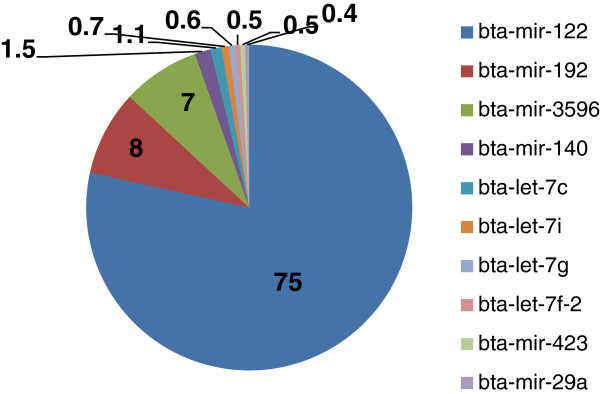
Our results indicate that the dairy cow liver expresses 53 miRNAs at a lower threshold of 10 reads per million. Of these, 10 miRNAs accounted for greater than 95% of the miRNAome (miRNA content). Of the highly expressed miRNAs, miR-122 constitutes 75% followed by miR-192 and miR-3596. Five out of thirteen let-7 miRNA family members are also among the highly expressed miRNAs. miR-143, down-regulated in SNEB, was found to have 4 putative up-regulated gene targets associated with SNEB including LRP2 (low density lipoprotein receptor-related protein 2), involved in lipid metabolism and up-regulated in SNEB.
This is the first liver miRNA-seq profiling study of moderate yielding dairy cows in the early postpartum period. Tissue specific miR-122 and liver enriched miR-192 are two of the most abundant miRNAs in the postpartum dairy cow liver. miR-143 is significantly down-regulated in SNEB and putative targets of miRNA-143 which are up-regulated in SNEB, include a gene involved in lipid metabolism.
负能量平衡(NEB)是高产奶牛产后最初几周出现的一种代谢状态改变,此时泌乳和维持所需能量超过日粮摄入的能量供应。NEB进而可导致代谢紊乱和繁殖力下降。此前一项关于产后奶牛NEB的研究报道,超过700个肝脏基因的表达发生了改变。已知微小RNA(miRNA)在转录后介导基因表达的许多改变。为了研究产后奶牛肝脏的miRNA含量,包括其总体丰度和差异表达,在轻度负能量平衡(MNEB)和重度负能量平衡(SNEB)状态下进行了短读长RNA测序。为了在先前报道的SNEB奶牛差异表达肝脏基因中鉴定差异表达miRNA的假定靶标,采用了计算靶标鉴定方法。
我们的结果表明,奶牛肝脏以每百万reads 10的较低阈值表达53种miRNA。其中,10种miRNA占miRNA组(miRNA含量)的95%以上。在高表达的miRNA中,miR-122占75%,其次是miR-192和miR-3596。13个let-7 miRNA家族成员中有5个也属于高表达的miRNA。在SNEB中下调的miR-143被发现有4个与SNEB相关的假定上调基因靶标,包括参与脂质代谢且在SNEB中上调的低密度脂蛋白受体相关蛋白2(LRP2)。
这是首次对产后早期中产奶牛进行肝脏miRNA测序分析。组织特异性的miR-122和肝脏富集的miR-192是产后奶牛肝脏中最丰富的两种miRNA。miR-143在SNEB中显著下调,且在SNEB中上调的miRNA-143的假定靶标包括一个参与脂质代谢的基因。