Max-Planck Research Unit for Enzymology of Protein Folding, 06120 Halle, Saale, Germany.
Acta Neuropathol Commun. 2014 Apr 11;2:43. doi: 10.1186/2051-5960-2-43.
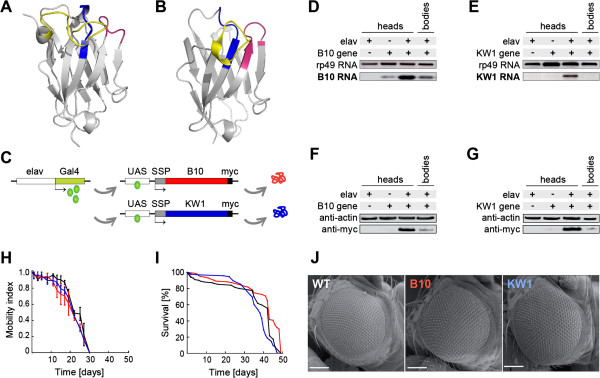
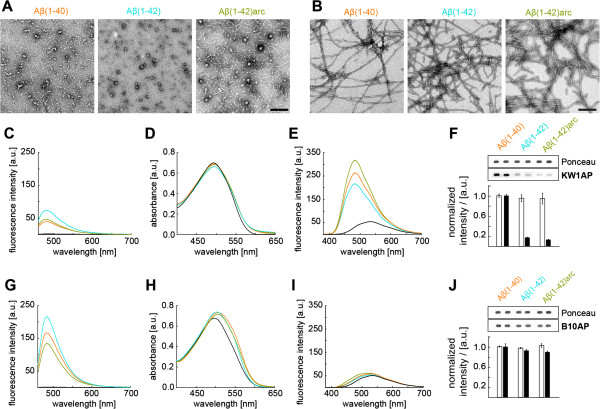
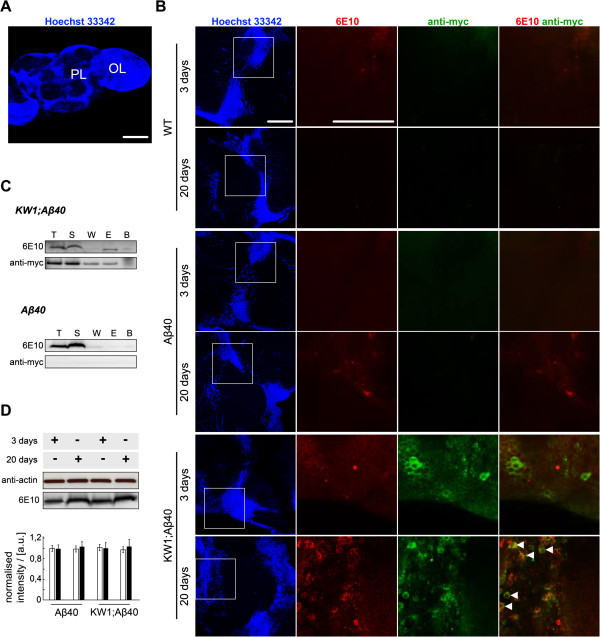
The self-assembly of Aβ peptides into a range of conformationally heterogeneous amyloid states represents a fundamental event in Alzheimer's disease. Within these structures oligomeric intermediates are considered to be particularly pathogenic. To test this hypothesis we have used a conformational targeting approach where particular conformational states, such as oligomers or fibrils, are recognized in vivo by state-specific antibody fragments.
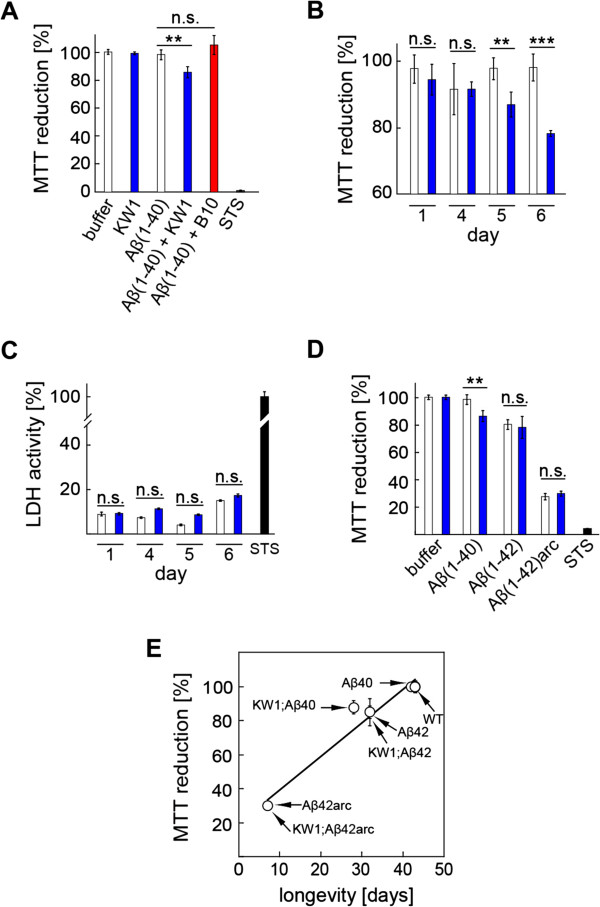
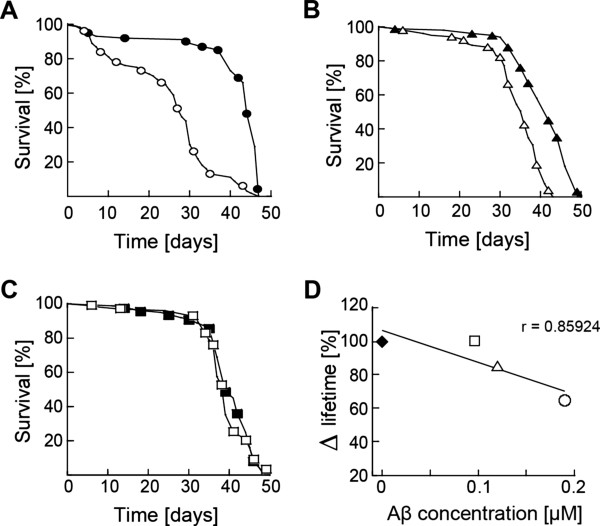
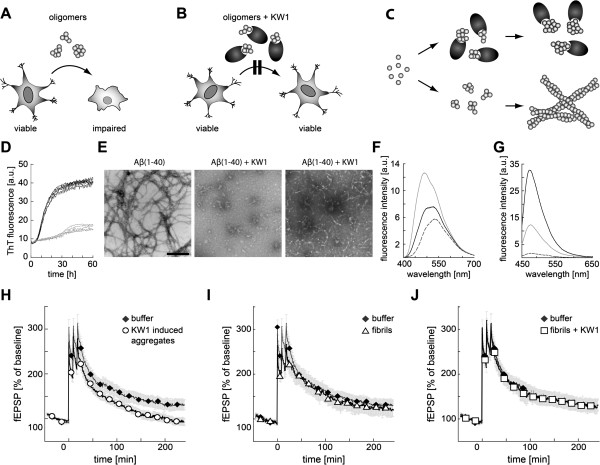
We show that oligomer targeting with the KW1 antibody fragment, but not fibril targeting with the B10 antibody fragment, affects toxicity in Aβ-expressing Drosophila melanogaster. The effect of KW1 is observed to occur selectively with flies expressing Aβ(1-40) and not with those expressing Aβ(1-42) or the arctic variant of Aβ(1-42) This finding is consistent with the binding preference of KW1 for Aβ(1-40) oligomers that has been established in vitro. Strikingly, and in contrast to the previously demonstrated in vitro ability of this antibody fragment to block oligomeric toxicity in long-term potentiation measurements, KW1 promotes toxicity in the flies rather than preventing it. This result shows the crucial importance of the environment in determining the influence of antibody binding on the nature and consequences of the protein misfolding and aggregation.
While our data support to the pathological relevance of oligomers, they highlight the issues to be addressed when developing inhibitory strategies that aim to neutralize these states by means of antagonistic binding agents.
Aβ 肽自组装成一系列构象异质的淀粉样状态,代表了阿尔茨海默病的一个基本事件。在这些结构中,寡聚中间体被认为是特别致病的。为了验证这一假说,我们采用了构象靶向方法,其中特定的构象状态,如寡聚体或纤维,在体内被特定构象状态的抗体片段识别。
我们表明,KW1 抗体片段靶向寡聚体,而 B10 抗体片段靶向纤维,都会影响 Aβ 表达的黑腹果蝇的毒性。仅在表达 Aβ(1-40)的果蝇中观察到 KW1 的效应,而在表达 Aβ(1-42)或 Aβ(1-42)的北极变体的果蝇中则没有。这一发现与 KW1 在体外对 Aβ(1-40)寡聚体的结合偏好一致。引人注目的是,与之前在长时程增强测量中证明的该抗体片段在体外阻断寡聚毒性的能力相反,KW1 在果蝇中促进了毒性,而不是阻止了毒性。这一结果表明,在确定抗体结合对蛋白质错误折叠和聚集的性质和后果的影响时,环境的重要性。
虽然我们的数据支持寡聚体的病理学相关性,但它们突出了在开发抑制策略时需要解决的问题,这些策略旨在通过拮抗结合剂来中和这些状态。