Faculty of Health and Medical Sciences, University of Surrey, Guildford, UK.
Faculty of Health and Medical Sciences, University of Surrey, Guildford, UK Surrey Clinical Research Centre, University of Surrey, Guildford, UK.
Heart. 2014 Jun;100(12):944-50. doi: 10.1136/heartjnl-2013-304599. Epub 2014 Apr 14.
To describe patterns of prehospital ECG (PHECG) use and determine its association with processes and outcomes of care in patients with ST-elevation myocardial infarction (STEMI) and non-STEMI.
Population-based linked cohort study of a national myocardial infarction registry.
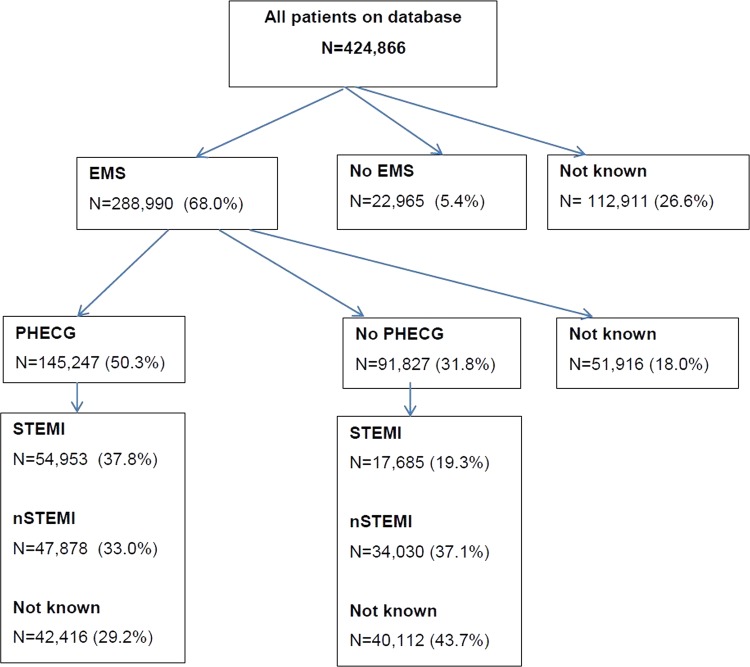
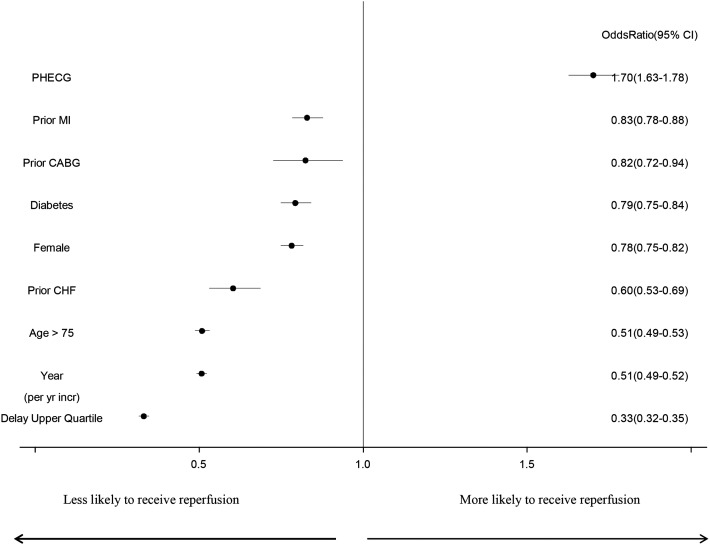
288 990 patients were admitted to hospitals via emergency medical services (EMS) between 1 January 2005 and 31 December 2009. PHECG use increased overall (51% vs 64%, adjusted OR (aOR) 2.17, 95% CI 2.12 to 2.22), and in STEMI (64% vs 79%, aOR 2.34, 95% CI 2.25 to 2.44). Patients who received PHECG were younger (71 years vs 74 years, P<0.0001); and less likely to be female (33.1% vs 40.3%, OR 0.87, 95% CI 0.86 to 0.89), or to have comorbidities than those who did not. For STEMI, reperfusion was more frequent in those having PHECG (83.5% vs 74.4%, p<0.0001). PHECG was associated with more primary percutaneous coronary intervention patients achieving call-to-balloon time <90 min (27.9% vs 21.4%, aOR 1.38, 95% CI 1.24 to 1.54) and more patients who received fibrinolytic therapy achieving door-to-needle time <30 min (90.6% vs 83.7%, aOR 2.13, 95% CI 1.91 to 2.38). Patients with PHECG exhibited significantly lower 30-day mortality rates than those who did not (7.4% vs 8.2%, aOR 0.94, 95% CI 0.91 to 0.96).
Findings from this national MI registry demonstrate a survival advantage in STEMI and non-STEMI patients when PHECG was used.
描述院前心电图(PHECG)的使用模式,并确定其与 ST 段抬高型心肌梗死(STEMI)和非 ST 段抬高型心肌梗死患者的护理过程和结局的关系。
这是一项基于人群的全国性心肌梗死注册研究的队列研究。
2005 年 1 月 1 日至 2009 年 12 月 31 日期间,通过急诊医疗服务(EMS)入院的患者共 288990 例。总体上,PHECG 的使用率有所增加(51% vs 64%,调整后的比值比(aOR)为 2.17,95%可信区间[CI]为 2.12 至 2.22),且在 STEMI 患者中更为常见(64% vs 79%,aOR 为 2.34,95% CI 为 2.25 至 2.44)。接受 PHECG 的患者年龄更小(71 岁 vs 74 岁,P<0.0001);且女性比例较低(33.1% vs 40.3%,OR 为 0.87,95% CI 为 0.86 至 0.89),合并症也较不常见。对于 STEMI 患者,接受 PHECG 的患者再灌注更为常见(83.5% vs 74.4%,p<0.0001)。PHECG 与更多接受直接经皮冠状动脉介入治疗的患者达到<90 分钟的球囊开通时间(27.9% vs 21.4%,aOR 为 1.38,95% CI 为 1.24 至 1.54)和更多接受纤溶治疗的患者达到<30 分钟的门球时间(90.6% vs 83.7%,aOR 为 2.13,95% CI 为 1.91 至 2.38)有关。接受 PHECG 的患者 30 天死亡率明显低于未接受 PHECG 的患者(7.4% vs 8.2%,aOR 为 0.94,95% CI 为 0.91 至 0.96)。
本项全国性心肌梗死登记研究的结果表明,在 STEMI 和非 STEMI 患者中使用 PHECG 可带来生存优势。