Shin Sun-Hye, Lee Sangkyu, Bae Jong-Sup, Jee Jun-Goo, Cha Hee-Jae, Lee You Mie
Research Institute of Pharmaceutical Sciences, College of Pharmacy, Kyungpook National University, Daegu 702-701, Korea.
Department of Parasitology and Genetics, Kosin University College of Medicine, Busan 602-703, Korea.
Mol Cells. 2014 Apr;37(4):330-6. doi: 10.14348/molcells.2014.0003. Epub 2014 Apr 8.
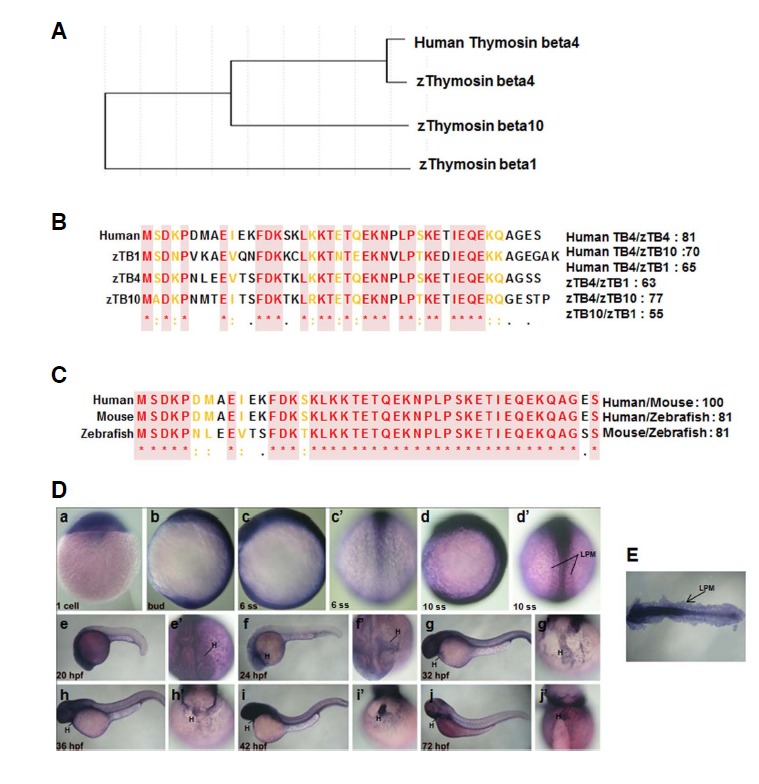
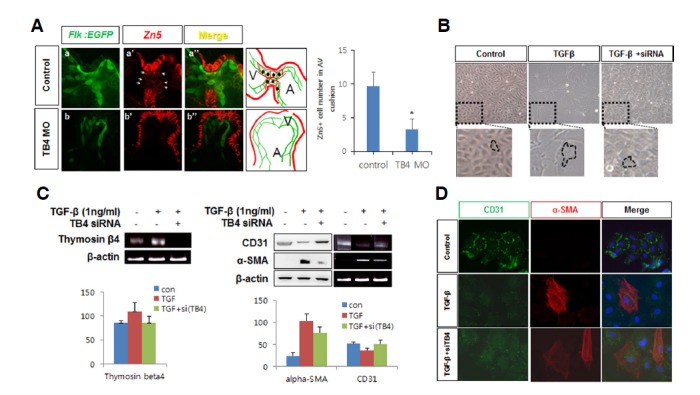
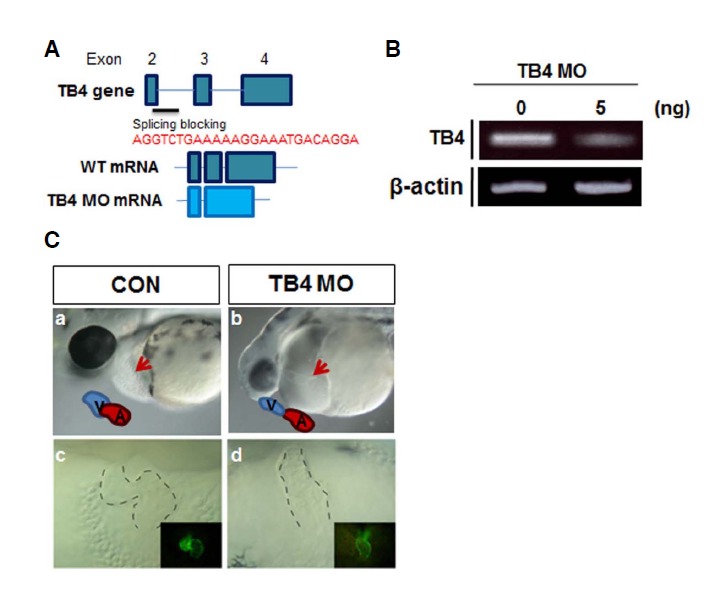
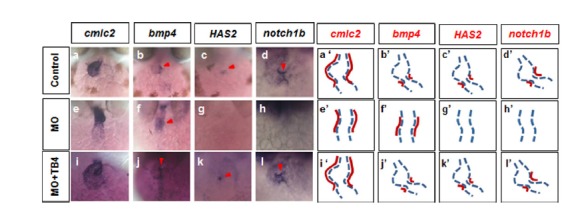
Thymosin beta4 (TB4) has multiple functions in cellular response in processes as diverse as embryonic organ development and the pathogeneses of disease, especially those associated with cardiac coronary vessels. However, the specific roles played by TB4 during heart valve development in vertebrates are largely unknown. Here, we identified a novel function of TB4 in endothelialmesenchymal transformation (EMT) in cardiac valve endocardial cushions in zebrafish. The expressions of thymosin family members in developing zebrafish embryos were determined by whole mount in situ hybridization. Of the thymosin family members only zTB4 was expressed in the developing heart region. Cardiac valve development at 48 h post fertilization was defected in zebrafish TB4 (zTB4) morpholino-injected embryos (morphants). In zTB4 morphants, abnormal linear heart tube development was observed. The expressions of bone morphogenetic protein (BMP) 4, notch1b, and hyaluronic acid synthase (HAS) 2 genes were also markedly reduced in atrio-ventricular canal (AVC). Endocardial cells in the AVC region were stained with anti-Zn5 antibody reactive against Dm-grasp (an EMT marker) to observe EMT in developing cardiac valves in zTB4 morphants. EMT marker expression in valve endothelial cells was confirmed after transfection with TB4 siRNA in the presence of transforming growth factor β (TGFβ) by RT-PCR and immunofluorescent assay. Zn5-positive endocardial AVC cells were not observed in zTB4 morphants, and knockdown of TB4 suppressed TGF-β-induced EMT in ovine valve endothelial cells. Taken together, our results demonstrate that TB4 plays a pivotal role in cardiac valve formation by increasing EMT.1.
胸腺素β4(TB4)在多种细胞反应过程中具有多种功能,这些过程涵盖了胚胎器官发育以及疾病的发病机制,尤其是与心脏冠状动脉相关的疾病。然而,TB4在脊椎动物心脏瓣膜发育过程中所起的具体作用在很大程度上尚不清楚。在此,我们在斑马鱼心脏瓣膜心内膜垫的内皮-间充质转化(EMT)过程中发现了TB4的一种新功能。通过整体原位杂交确定了斑马鱼胚胎发育过程中胸腺素家族成员的表达。在胸腺素家族成员中,只有zTB4在发育中的心脏区域表达。在注射了斑马鱼TB4(zTB4)吗啉代寡核苷酸的胚胎(形态突变体)中,受精后48小时的心脏瓣膜发育出现缺陷。在zTB4形态突变体中,观察到心脏管发育异常。骨形态发生蛋白(BMP)4、Notch1b和透明质酸合酶(HAS)2基因在房室管(AVC)中的表达也明显降低。用抗Zn5抗体对AVC区域的心内膜细胞进行染色,该抗体与Dm-grasp(一种EMT标志物)反应,以观察zTB4形态突变体发育中的心脏瓣膜中的EMT。通过RT-PCR和免疫荧光测定法,在用转化生长因子β(TGFβ)处理的情况下,用TB4 siRNA转染后,证实了瓣膜内皮细胞中EMT标志物的表达。在zTB4形态突变体中未观察到Zn5阳性的心内膜AVC细胞,并且敲低TB4可抑制TGF-β诱导的绵羊瓣膜内皮细胞中的EMT。综上所述,我们的结果表明,TB4通过增强EMT在心脏瓣膜形成中起关键作用。