Zhang Jian, Nielsen Scott E, Grainger Tess N, Kohler Monica, Chipchar Tim, Farr Daniel R
Department of Renewable Resources, University of Alberta, Edmonton, Alberta, Canada.
Department of Ecology and Evolutionary Biology, University of Toronto, Toronto, Ontario, Canada.
PLoS One. 2014 Apr 16;9(4):e95334. doi: 10.1371/journal.pone.0095334. eCollection 2014.
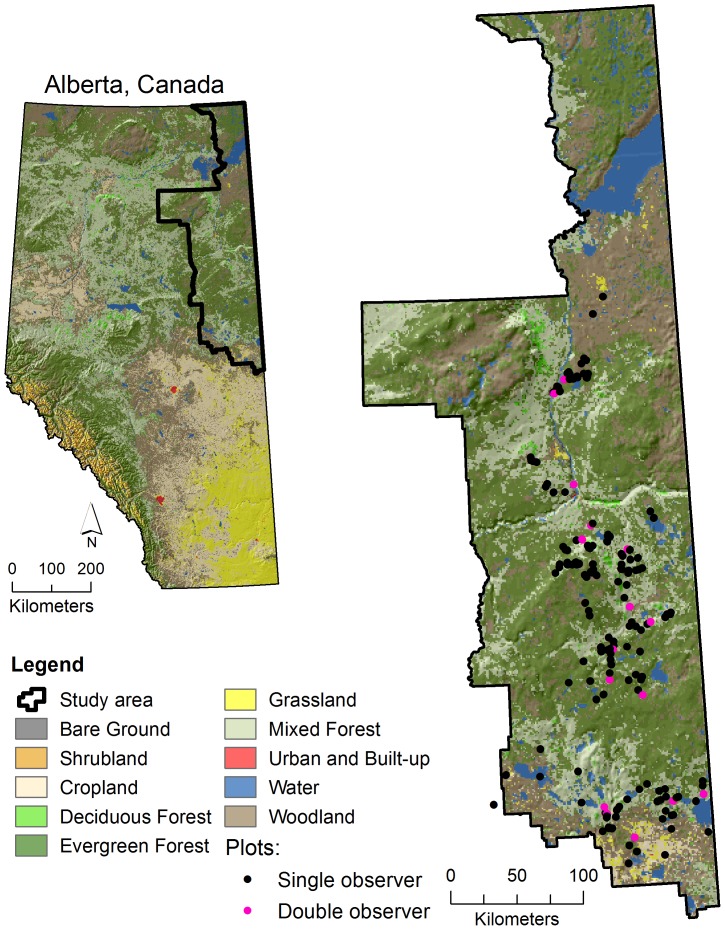
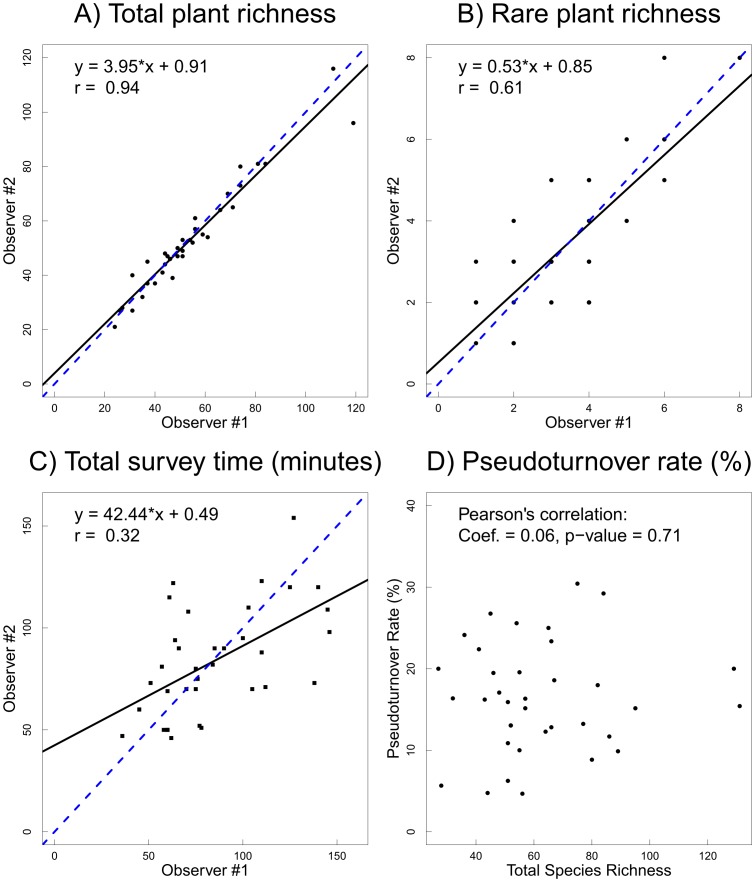
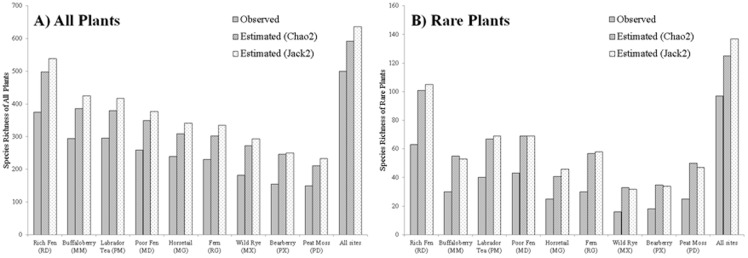
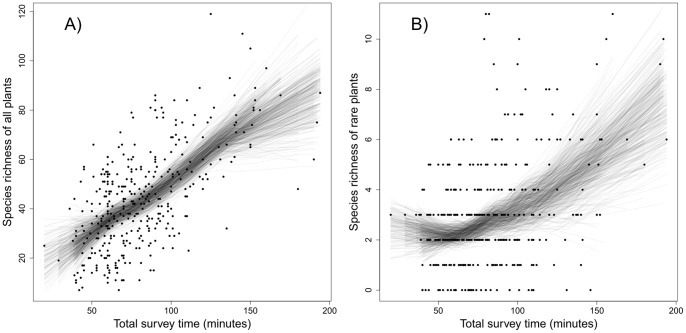
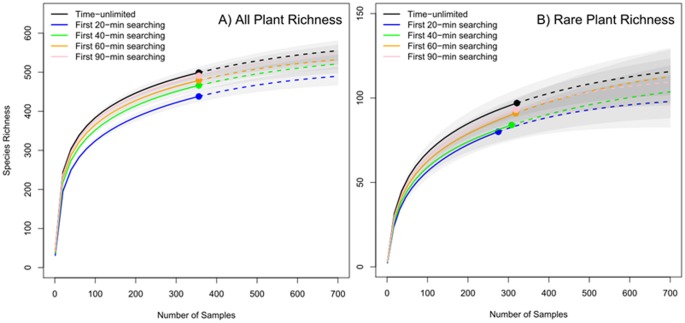
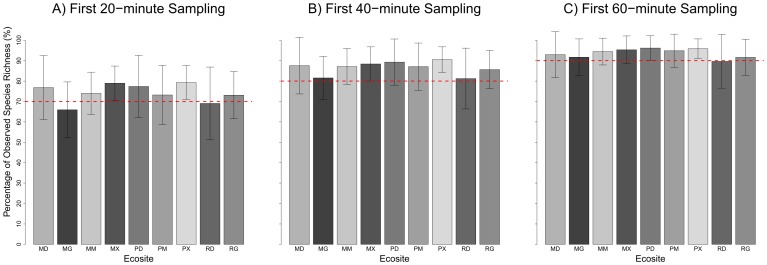
Documenting and estimating species richness at regional or landscape scales has been a major emphasis for conservation efforts, as well as for the development and testing of evolutionary and ecological theory. Rarely, however, are sampling efforts assessed on how they affect detection and estimates of species richness and rarity. In this study, vascular plant richness was sampled in 356 quarter hectare time-unlimited survey plots in the boreal region of northeast Alberta. These surveys consisted of 15,856 observations of 499 vascular plant species (97 considered to be regionally rare) collected by 12 observers over a 2 year period. Average survey time for each quarter-hectare plot was 82 minutes, ranging from 20 to 194 minutes, with a positive relationship between total survey time and total plant richness. When survey time was limited to a 20-minute search, as in other Alberta biodiversity methods, 61 species were missed. Extending the survey time to 60 minutes, reduced the number of missed species to 20, while a 90-minute cut-off time resulted in the loss of 8 species. When surveys were separated by habitat type, 60 minutes of search effort sampled nearly 90% of total observed richness for all habitats. Relative to rare species, time-unlimited surveys had ∼ 65% higher rare plant detections post-20 minutes than during the first 20 minutes of the survey. Although exhaustive sampling was attempted, observer bias was noted among observers when a subsample of plots was re-surveyed by different observers. Our findings suggest that sampling time, combined with sample size and observer effects, should be considered in landscape-scale plant biodiversity surveys.
记录和估算区域或景观尺度上的物种丰富度一直是保护工作以及进化和生态理论发展与检验的重点。然而,很少有人评估采样工作对物种丰富度和稀有度的检测及估算有何影响。在本研究中,对阿尔伯塔省东北部寒温带地区的356个四分之一公顷的无时间限制调查地块中的维管植物丰富度进行了采样。这些调查由12名观察者在两年时间内对499种维管植物(其中97种被认为是区域稀有物种)进行了15,856次观测。每个四分之一公顷地块的平均调查时间为82分钟,范围从20分钟到194分钟,总调查时间与总植物丰富度之间呈正相关。当像阿尔伯塔省其他生物多样性方法那样将调查时间限制在20分钟的搜索时,有61个物种未被发现。将调查时间延长至60分钟,未被发现的物种数量减少到20个,而90分钟的截止时间导致8个物种未被发现。当按栖息地类型分开调查时,60分钟的搜索工作采样到了所有栖息地中近90%的总观测丰富度。相对于稀有物种,无时间限制的调查在20分钟后发现的稀有植物比调查前20分钟多约65%。尽管尝试进行了详尽采样,但当不同观察者对部分地块进行重新调查时,发现观察者之间存在偏差。我们的研究结果表明,在景观尺度的植物生物多样性调查中应考虑采样时间,以及样本大小和观察者效应。