Bhatt Shvetank, Radhakrishnan Mahesh, Jindal Ankur, Devadoss Thangaraj, Dhar Arghya Kusum
Department of Pharmacy, Birla Institute of Technology and Science, Pilani, Rajasthan, India.
Indian J Pharmacol. 2014 Mar-Apr;46(2):191-6. doi: 10.4103/0253-7613.129316.
The aim of the study was to evaluate a novel 5 HT3 receptor antagonist (6g) on chronic stress induced changes in behavioural and brain oxidative stress parameter in mice. A complicated relationship exists among stressful stimuli, body's reaction to stress and the onset of clinical depression. Chronic unpredictable stressors can produce a situation similar to human depression, and such animal models can be used for the preclinical evaluation of antidepressants.
In the present study, a novel and potential 5-HT3 receptor antagonist (4-benzylpiperazin-1-yl)(3-methoxyquinoxalin-2-yl) methanone (6g) with good Log P (3.08) value and pA 2(7.5) values, synthesized in our laboratory was investigated to study the effects on chronic unpredictable mild stress (CUMS)-induced behavioural and biochemical alterations in mice. Mice were subjected to different stress paradigms daily for a period of 28 days to induce depressive-like behaviour.
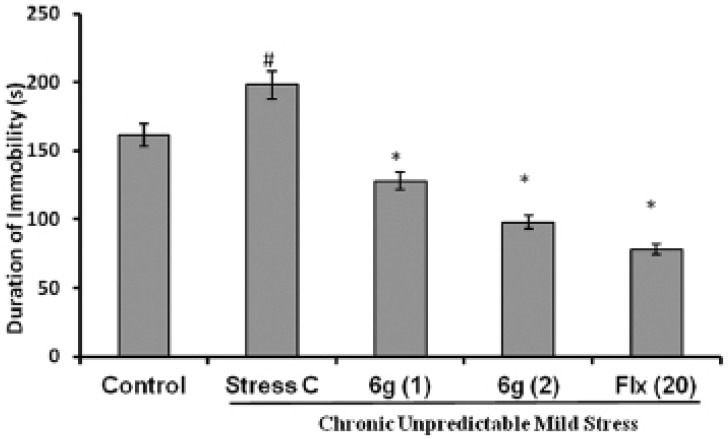
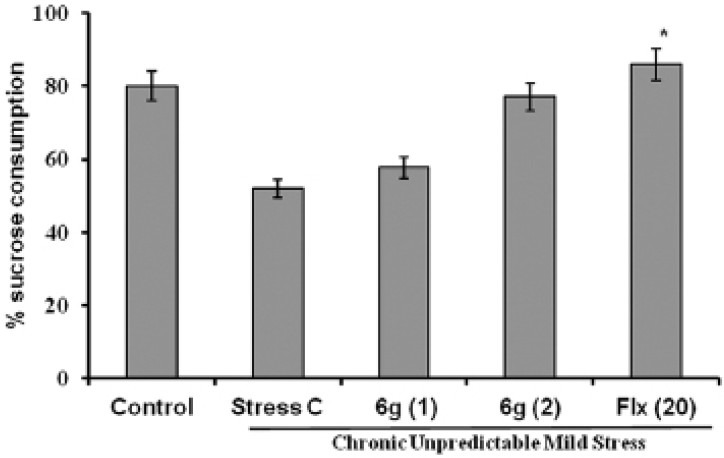
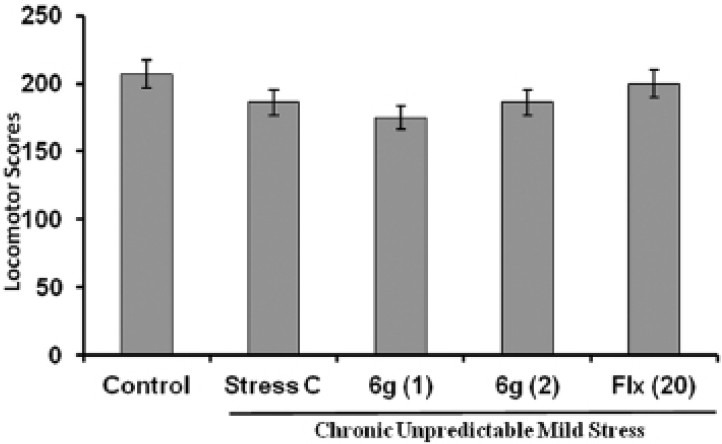
The results showed that CUMS caused depression-like behaviour in mice, as indicated by the significant (P < 0.05) decrease in sucrose consumption and locomotor activity and increase in immobility the forced swim test. In addition, it was found that lipid peroxidation and nitrite levels were significantly (P < 0.05) increased, whereas glutathione levels, superoxide dismutase and catalase activities decreased in brain tissue of CUMS-treated mice. '6g' (1 and 2 mg/kg, p.o., 21 days) and fluoxetine treatment (20 mg/kg, p.o., 21 days) significantly (P < 0.05) reversed the CUMS-induced behavioural (increased immobility period, reduced sucrose preference and decreased locomotor activity) and biochemical (increased lipid peroxidation; decreased glutathione levels, superoxide dismutase and catalase activities). However fluoxetine treatment (20 mg/kg, p.o., 21 days) significantly decreased the nitrite level in the brain while '6g' (1 and 2 mg/kg, p.o., 21 days) did not show significant (P < 0.05) effect on the nitrite levels in brain.
Compound '6g' exerted antidepressant-like effects in behavioural despair paradigm in chronically stressed mice by restoring antioxidant mechanisms.
本研究旨在评估一种新型5-羟色胺3(5-HT3)受体拮抗剂(6g)对慢性应激诱导的小鼠行为和脑氧化应激参数变化的影响。应激刺激、机体对应激的反应与临床抑郁症的发作之间存在复杂的关系。慢性不可预测应激源可产生类似于人类抑郁症的情况,此类动物模型可用于抗抑郁药的临床前评估。
在本研究中,对在我们实验室合成的具有良好脂水分配系数(Log P,3.08)值和亲和力指数(pA2,7.5)值的新型潜在5-HT3受体拮抗剂(4-苄基哌嗪-1-基)(3-甲氧基喹喔啉-2-基)甲酮(6g)进行研究,以探讨其对慢性不可预测轻度应激(CUMS)诱导的小鼠行为和生化改变的影响。小鼠每天接受不同的应激模式,持续28天,以诱导抑郁样行为。
结果显示,CUMS导致小鼠出现抑郁样行为,表现为蔗糖消耗和自发活动显著减少(P<0.05),强迫游泳试验中的不动时间增加。此外,发现CUMS处理的小鼠脑组织中脂质过氧化和亚硝酸盐水平显著增加(P<0.05),而谷胱甘肽水平、超氧化物歧化酶和过氧化氢酶活性降低。“6g”(1和2mg/kg,口服,21天)和氟西汀处理(20mg/kg,口服,21天)显著(P<0.05)逆转了CUMS诱导的行为(不动时间增加、蔗糖偏好降低和自发活动减少)和生化改变(脂质过氧化增加;谷胱甘肽水平、超氧化物歧化酶和过氧化氢酶活性降低)。然而,氟西汀处理(20mg/kg,口服,21天)显著降低了脑中的亚硝酸盐水平,而“6g”(1和2mg/kg,口服,21天)对脑中的亚硝酸盐水平未显示出显著(P<0.05)影响。
化合物“6g”通过恢复抗氧化机制,在慢性应激小鼠的行为绝望模型中发挥了抗抑郁样作用。