Adhikari Avishek
Deisseroth Laboratory, CNC Program, Bioengineering Department, Stanford University Palo Alto, CA, USA.
Front Behav Neurosci. 2014 Apr 1;8:112. doi: 10.3389/fnbeh.2014.00112. eCollection 2014.
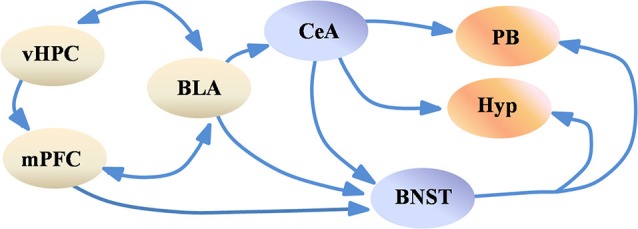
Anxiety is of paramount importance for animals, as it allows assessment of the environment while minimizing exposure to potential threats. Furthermore, anxiety disorders are highly prevalent. Consequently, the neural circuitry underlying anxiety has been a topic of great interest. In this mini review, we will discuss current views on anxiety circuits. We will focus on rodent anxiety paradigms, but we will also consider results from human neuroimaging and clinical studies. We briefly review studies demonstrating the central role that the amygdala and the bed nucleus of the stria terminals (BNST) play in modulating anxiety and present evidence showing how the bed nucleus uses different output pathways to influence specific features of anxiolysis. Lastly, we propose that several brain regions, such as the medial prefrontal cortex (mPFC) and the ventral hippocampus (vHPC), act in a coordinated fashion with the amygdala and BNST, forming a distributed network of interconnected structures that control anxiety both in rodents and humans.
焦虑对动物至关重要,因为它能在尽量减少暴露于潜在威胁的同时评估环境。此外,焦虑症非常普遍。因此,焦虑背后的神经回路一直是人们极为感兴趣的话题。在这篇小型综述中,我们将讨论关于焦虑回路的当前观点。我们将重点关注啮齿动物的焦虑范式,但也会考虑人类神经影像学和临床研究的结果。我们简要回顾了一些研究,这些研究证明了杏仁核和终纹床核(BNST)在调节焦虑中所起的核心作用,并展示了证据,说明终纹床核如何利用不同的输出通路来影响抗焦虑的特定特征。最后,我们提出,内侧前额叶皮层(mPFC)和腹侧海马体(vHPC)等几个脑区与杏仁核和BNST以协调的方式发挥作用,形成一个相互连接结构的分布式网络,该网络在啮齿动物和人类中都控制着焦虑。