Prasad G V Ramesh, Vorobeichik Leon, Nash Michelle M, Huang Michael, Rapi Lindita, Maguire Graham, Mamdani Muhammad, Yan Andrew T, Connelly Philip W
Department of Medicine, University of Toronto, Toronto, Ontario, Canada ; Keenan Research Centre, Li Ka Shing Knowledge Institute, St. Michael's Hospital, Toronto, Ontario, Canada.
Keenan Research Centre, Li Ka Shing Knowledge Institute, St. Michael's Hospital, Toronto, Ontario, Canada.
Clin Kidney J. 2012 Apr;5(2):124-129. doi: 10.1093/ckj/sfs033.
Ethnicity is an important determinant of post-renal transplant outcomes. Limited data are available on cardiovascular risk differences in kidney transplant recipients (KTR) based on ethnicity.
A group of 129 clinically stable age-matched KTR [43 South Asian (SA), 86 Caucasian]) were assessed for plasma total and high-molecular-weight (HMW) adiponectin, cystatin C, apolipoproteins A1 and B, C-reactive protein, uric acid, urine albumin-to-creatinine ratio, estimated glomerular filtration rate (eGFR) and transplant-specific plus traditional Framingham risk factors. SA and Caucasians were compared by -tests, Wilcoxon rank-sum or chi-square testing. Accounting for the matched design, multivariable linear regression was performed to determine predictors of adiponectin concentrations.
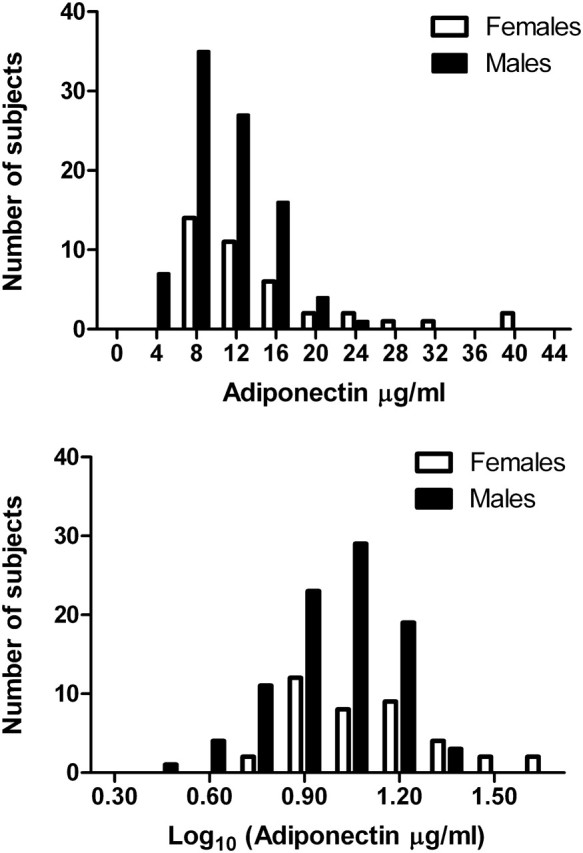
SA did not differ from Caucasians in background cardiac disease or cardioprotective medication use or risk factors other than smoking (26 versus 56%, P = 0.001). Total adiponectin (9.5 ± 3.5 versus 12.9 ± 6.7 μmg/mL, P < 0.001) and HMW adiponectin (22 ± 9 versus 29 ± 11%, P < 0.001) were significantly lower in SA. Determinants of total adiponectin included SA ethnicity (P = 0.02), cystatin C-eGFR (P < 0.001), high-density lipoprotein (HDL) cholesterol (P < 0.0001) and waist-to-hip ratio (P < 0.001), while those of HMW adiponectin included SA ethnicity (P < 0.001), cystatin C-eGFR (P = 0.03) and HDL cholesterol (P = 0.001). There were no important differences in the other measured biomarkers.
Total and HMW adiponectin concentrations are lower in SA KTR and may be promising exploratory biomarkers of post-transplant cardiovascular risk.
种族是肾移植术后预后的重要决定因素。关于基于种族的肾移植受者(KTR)心血管风险差异的数据有限。
对一组129名临床稳定、年龄匹配的KTR[43名南亚人(SA),86名白种人]进行血浆总脂联素和高分子量(HMW)脂联素、胱抑素C、载脂蛋白A1和B、C反应蛋白、尿酸、尿白蛋白与肌酐比值、估计肾小球滤过率(eGFR)以及移植特异性和传统的弗雷明汉风险因素评估。通过t检验、威尔科克森秩和检验或卡方检验对南亚人和白种人进行比较。考虑到匹配设计,进行多变量线性回归以确定脂联素浓度的预测因素。
南亚人在背景性心脏病、使用心脏保护药物或除吸烟外的风险因素方面与白种人无差异(26%对56%,P = 0.001)。南亚人的总脂联素(9.5±3.5对12.9±6.7μg/mL,P < 0.001)和HMW脂联素(22±9对29±11%,P < 0.001)显著较低。总脂联素的决定因素包括南亚种族(P = 0.02)、胱抑素C-eGFR(P < 0.001)、高密度脂蛋白(HDL)胆固醇(P < 0.0001)和腰臀比(P < 0.001),而HMW脂联素的决定因素包括南亚种族(P < 0.001)、胱抑素C-eGFR(P = 0.03)和HDL胆固醇(P = 0.001)。其他测量的生物标志物无重要差异。
南亚KTR的总脂联素和HMW脂联素浓度较低,可能是移植后心血管风险有前景的探索性生物标志物。