Department of Oncology, St. Jude Children's Research Hospital , Memphis, TN , USA ; Department of Pediatrics, University of Tennessee Health Sciences Center , Memphis, TN , USA.
Department of Biostatistics, St. Jude Children's Research Hospital , Memphis, TN , USA.
Front Oncol. 2014 Apr 1;4:67. doi: 10.3389/fonc.2014.00067. eCollection 2014.
Epidermal growth factor receptor is overexpressed in most pediatric high-grade gliomas (HGG). Since erlotinib had shown activity in adults with HGG, we conducted a phase II trial of erlotinib and local radiotherapy (RT) in children with newly diagnosed HGG.
Following maximum surgical resection, patients between 3 and 21 years with non-metastatic HGG received local RT at 59.4 Gy (54 Gy for spinal tumors and those with ≥70% brain involvement). Erlotinib started on day 1 of RT (120 mg/m(2) per day) and continued for 2 years unless there was tumor progression or intolerable toxicities. The 2-year progression-free survival (PFS) was estimated for patients with intracranial anaplastic astrocytoma (AA) and glioblastoma (GBM).
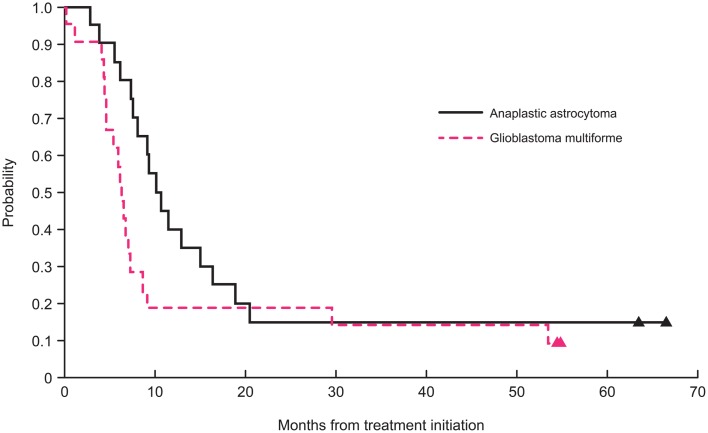
Median age at diagnosis for 41 patients with intracranial tumors (21 with GBM and 20 with AA) was 10.9 years (range, 3.3-19 years). The 2-year PFS for patients with AA and GBM was 15 ± 7 and 19 ± 8%, respectively. Only five patients remained alive without tumor progression. Twenty-six patients had at least one grade 3 or 4 toxicity irrespective of association with erlotinib; only four required dose modifications. The main toxicities were gastrointestinal (n = 11), dermatologic (n = 5), and metabolic (n = 4). One patient with gliomatosis cerebri who required prolonged corticosteroids died of septic shock associated with pancreatitis.
Although therapy with erlotinib was mostly well-tolerated, it did not change the poor outcome of our patients. Our results showed that erlotinib is not a promising medication in the treatment of children with intracranial AA and GBM.
表皮生长因子受体在大多数儿科高级别胶质瘤(HGG)中过度表达。由于厄洛替尼在 HGG 成人中显示出活性,我们对新诊断的 HGG 患儿进行了厄洛替尼联合局部放疗(RT)的 II 期试验。
在最大程度地手术后,年龄在 3 至 21 岁之间、无转移的 HGG 患者接受局部 RT,剂量为 59.4Gy(脊髓肿瘤和累及>70%大脑的肿瘤为 54Gy)。厄洛替尼于 RT 开始第 1 天(每天 120mg/m2)使用,并持续 2 年,除非肿瘤进展或出现不可耐受的毒性。颅内间变性星形细胞瘤(AA)和胶质母细胞瘤(GBM)患者的 2 年无进展生存期(PFS)进行了估计。
41 例颅内肿瘤患者(21 例 GBM 和 20 例 AA)的中位诊断年龄为 10.9 岁(范围为 3.3-19 岁)。AA 和 GBM 患者的 2 年 PFS 分别为 15±7%和 19±8%。仅有 5 例患者无肿瘤进展而存活。26 例患者无论是否与厄洛替尼相关,均至少出现 1 级或 4 级毒性反应;仅有 4 例需要调整剂量。主要毒性反应为胃肠道(n=11)、皮肤(n=5)和代谢(n=4)。1 例脑胶质细胞瘤患者需要长期使用皮质类固醇,因胰腺炎合并败血症休克而死亡。
尽管厄洛替尼治疗大多耐受良好,但并未改变患者的不良预后。我们的结果表明,厄洛替尼在治疗颅内 AA 和 GBM 患儿方面没有应用前景。