Food Nutrition and Health Program, Universidad de Cuenca, Avenida 12 de Abril s/n Ciudadela Universitaria, Cuenca, Ecuador EC010107.
BMC Pediatr. 2014 Apr 18;14:106. doi: 10.1186/1471-2431-14-106.
Physical fitness has been proposed as a marker for health during adolescence. Currently, little is known about physical fitness and its association with blood lipid profile in adolescents from low and middle-income countries. The aim of this study is therefore to assess physical fitness among urban and rural adolescents and its associations with blood lipid profile in a middle-income country.
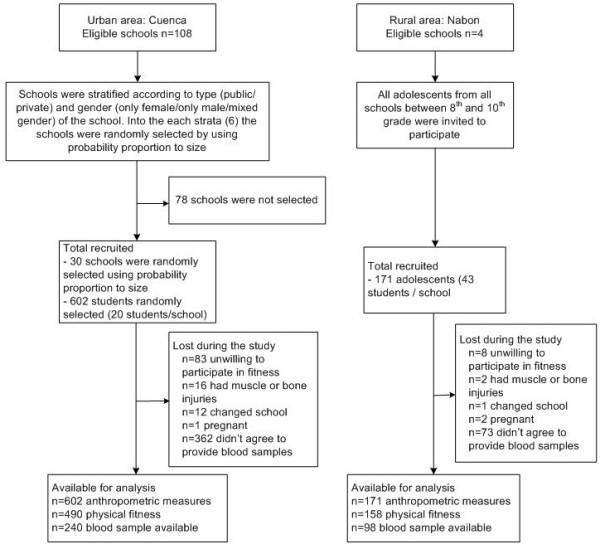
A cross-sectional study was conducted between January 2008 and April 2009 in 648 Ecuadorian adolescents (52.3% boys), aged 11 to 15 years, attending secondary schools in Cuenca (urban n = 490) and Nabón (rural n = 158). Data collection included anthropometric measures, application of the EUROFIT battery, dietary intake (2-day 24 h recall), socio-demographic characteristics, and blood samples from a subsample (n = 301). The FITNESGRAM standards were used to evaluate fitness. The associations of fitness and residential location with blood lipid profile were assessed by linear and logistic regression after adjusting for confounding factors.
The majority (59%) of the adolescents exhibited low levels of aerobic capacity as defined by the FITNESSGRAM standards. Urban adolescents had significantly higher mean scores in five EUROFIT tests (20 m shuttle, speed shuttle run, plate tapping, sit-up and vertical jump) and significantly most favorable improved plasma lipid profile (triglycerides and HDL) as compared to rural adolescents. There was a weak association between blood lipid profile and physical fitness in both urban and rural adolescents, even after adjustment for confounding factors.
Physical fitness, in our sample of Ecuadorian adolescents, was generally poor. Urban adolescents had better physical fitness and blood lipid profiles than rural adolescents. The differences in fitness did not explain those in blood lipid profile between urban and rural adolescents.
体能被认为是青少年健康的一个标志。目前,人们对中低收入国家青少年的体能及其与血脂谱的关系知之甚少。因此,本研究旨在评估中美洲城市和农村青少年的体能状况及其与血脂谱的关系。
2008 年 1 月至 2009 年 4 月,在厄瓜多尔昆卡(城市,n = 490)和纳邦(农村,n = 158)的中学,对 648 名 11 至 15 岁的青少年进行了一项横断面研究。数据收集包括人体测量学指标、EUROFIT 电池的应用、饮食摄入(2 天 24 小时回顾)、社会人口统计学特征以及来自子样本(n = 301)的血液样本。采用 FITNESSGRAM 标准评估体能。在校正混杂因素后,采用线性和逻辑回归评估体能和居住地点与血脂谱的相关性。
大多数(59%)青少年的有氧能力水平较低,这是 FITNESSGRAM 标准定义的。与农村青少年相比,城市青少年在 EUROFIT 五项测试(20 米穿梭跑、速度穿梭跑、板敲击、仰卧起坐和垂直跳跃)中的平均得分显著较高,且血浆脂质谱(甘油三酯和高密度脂蛋白)显著改善。即使在校正了混杂因素后,城市和农村青少年的血脂谱与体能之间仍存在弱相关性。
在我们的厄瓜多尔青少年样本中,体能普遍较差。城市青少年的体能和血脂谱优于农村青少年。在城市和农村青少年的血脂谱之间存在差异,但这并不能完全用体能差异来解释。