Jang Jun-Ho, Bruse Shannon, Huneidi Salam, Schrader Ronald M, Monick Martha M, Lin Yong, Carter A Brent, Klingelhutz Aloysius J, Nyunoya Toru
Division of Pulmonary, Critical Care and Sleep Medicine, Department of Internal Medicine, University of New Mexico and New Mexico VA Health Care System, Albuquerque, New Mexico, USA.
Environ Health Perspect. 2014 Sep;122(9):955-62. doi: 10.1289/ehp.1306911. Epub 2014 Apr 18.
Acrolein is a ubiquitous environmental hazard to human health. Acrolein has been reported to activate the DNA damage response and induce apoptosis. However, little is known about the effects of acrolein on cellular senescence.
We examined whether acrolein induces cellular senescence in cultured normal human lung fibroblasts (NHLF).
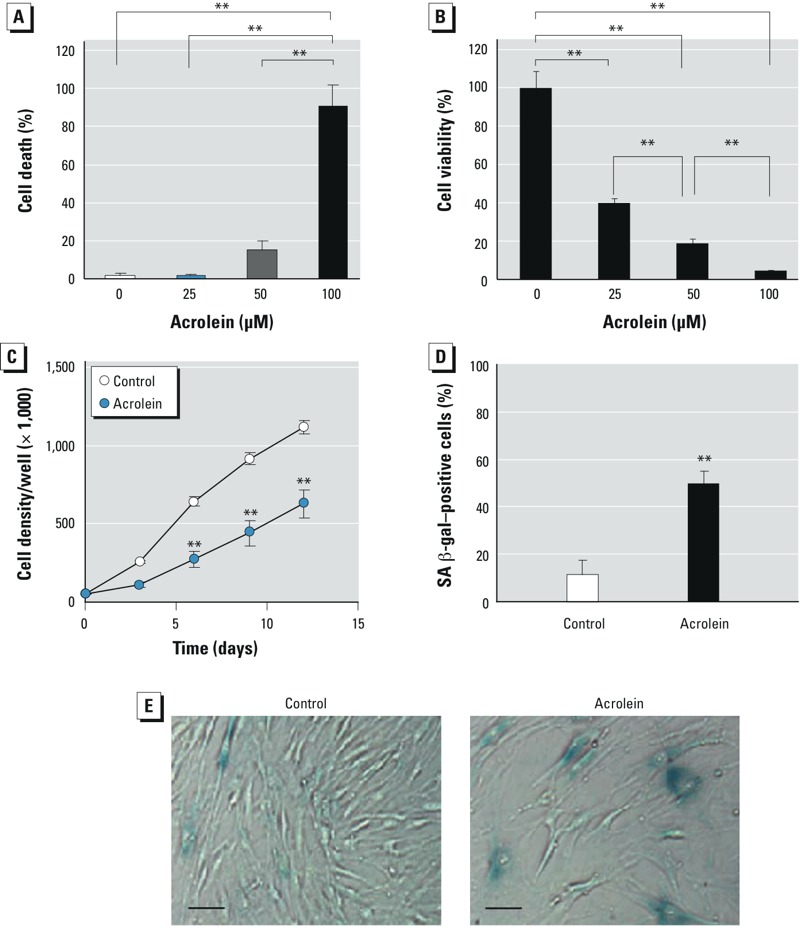
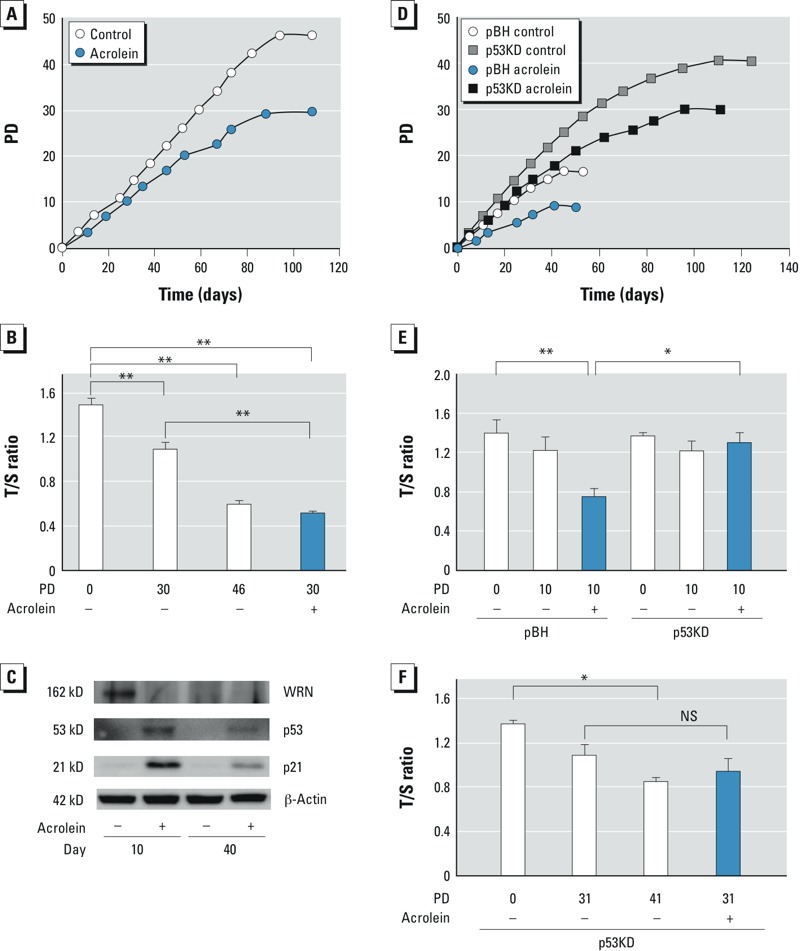
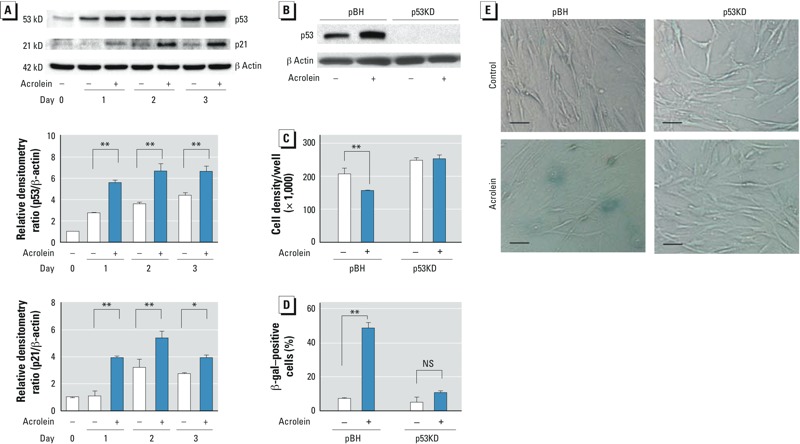
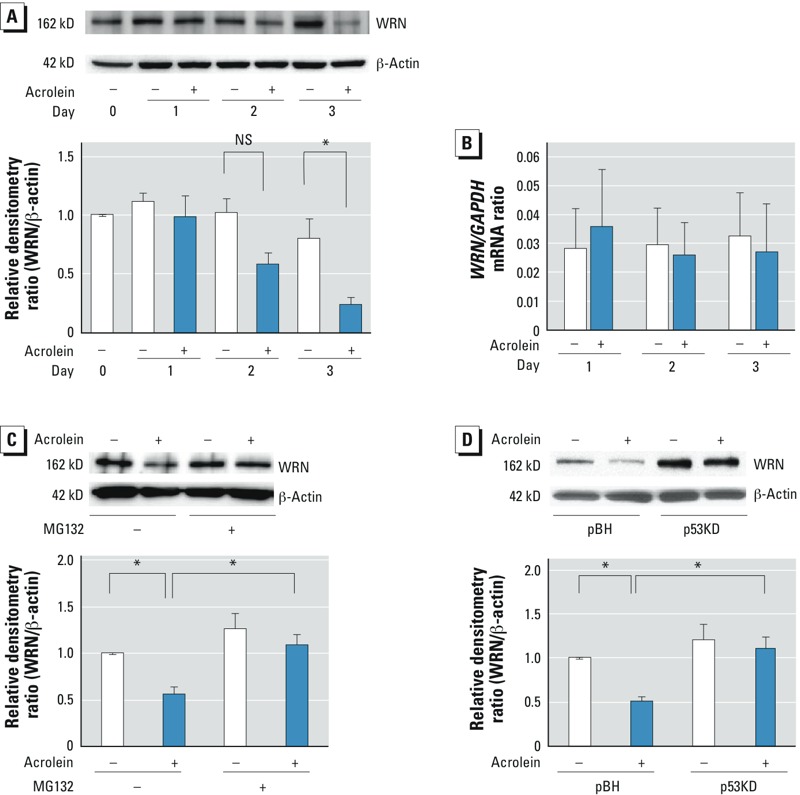
We cultured NHLF in the presence or absence of acrolein and determined the effects of acrolein on cell proliferative capacity, senescence-associated β-galactosidase activity, the known senescence-inducing pathways (e.g., p53, p21), and telomere length.
We found that acrolein induced cellular senescence by increasing both p53 and p21. The knockdown of p53 mediated by small interfering RNA (siRNA) attenuated acrolein-induced cellular senescence. Acrolein decreased Werner's syndrome protein (WRN), a member of the RecQ helicase family involved in DNA repair and telomere maintenance. Acrolein-induced down-regulation of WRN protein was rescued by p53 knockdown or proteasome inhibition. Finally, we found that acrolein accelerated p53-mediated telomere shortening.
These results suggest that acrolein induces p53-mediated cellular senescence accompanied by enhanced telomere attrition and WRN protein down-regulation.
丙烯醛是一种普遍存在的对人类健康有害的环境物质。据报道,丙烯醛可激活DNA损伤反应并诱导细胞凋亡。然而,关于丙烯醛对细胞衰老的影响知之甚少。
我们研究了丙烯醛是否会在培养的正常人肺成纤维细胞(NHLF)中诱导细胞衰老。
我们在有或没有丙烯醛的情况下培养NHLF,并确定丙烯醛对细胞增殖能力、衰老相关β-半乳糖苷酶活性、已知的衰老诱导途径(如p53、p21)和端粒长度的影响。
我们发现丙烯醛通过增加p53和p21来诱导细胞衰老。小干扰RNA(siRNA)介导的p53敲低减弱了丙烯醛诱导的细胞衰老。丙烯醛降低了Werner综合征蛋白(WRN),它是RecQ解旋酶家族的成员,参与DNA修复和端粒维持。p53敲低或蛋白酶体抑制可挽救丙烯醛诱导的WRN蛋白下调。最后,我们发现丙烯醛加速了p53介导的端粒缩短。
这些结果表明,丙烯醛诱导p53介导的细胞衰老,同时伴有端粒磨损加剧和WRN蛋白下调。