Shimizu Shinichi, Miyamoto Naoki, Matsuura Taeko, Fujii Yusuke, Umezawa Masumi, Umegaki Kikuo, Hiramoto Kazuo, Shirato Hiroki
Department of Radiation Oncology, Hokkaido University Graduate School of Medicine, Sapporo, Hokkaido, Japan.
Department of Medical Physics, Hokkaido University Graduate School of Medicine, Sapporo, Hokkaido, Japan.
PLoS One. 2014 Apr 18;9(4):e94971. doi: 10.1371/journal.pone.0094971. eCollection 2014.
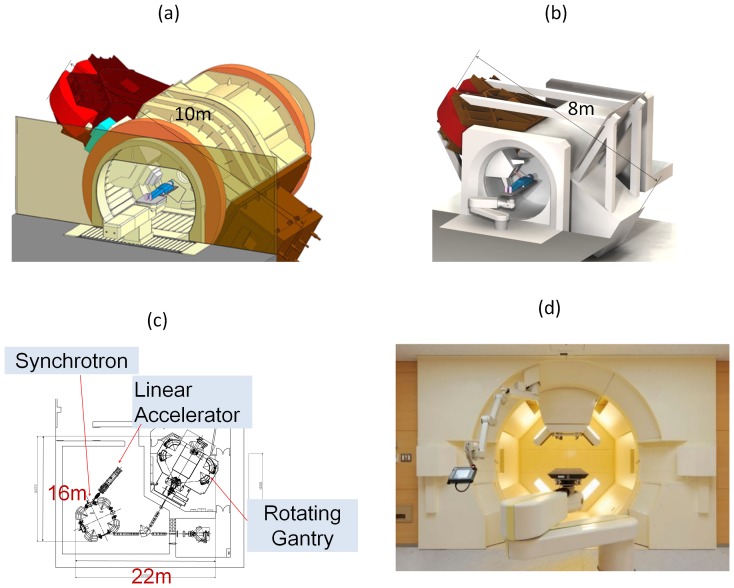
A proton beam therapy (PBT) system has been designed which dedicates to spot-scanning and has a gating function employing the fluoroscopy-based real-time-imaging of internal fiducial markers near tumors. The dose distribution and treatment time of the newly designed real-time-image gated, spot-scanning proton beam therapy (RGPT) were compared with free-breathing spot-scanning proton beam therapy (FBPT) in a simulation.
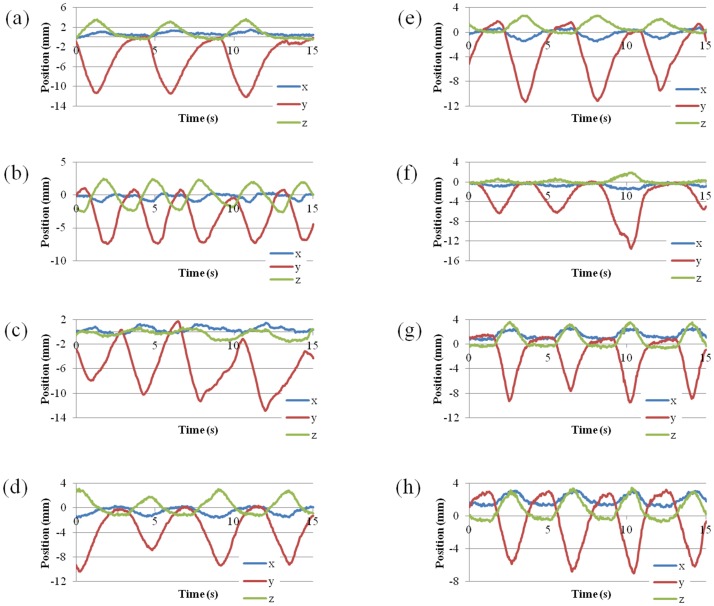
In-house simulation tools and treatment planning system VQA (Hitachi, Ltd., Japan) were used for estimating the dose distribution and treatment time. Simulations were performed for 48 motion parameters (including 8 respiratory patterns and 6 initial breathing timings) on CT data from two patients, A and B, with hepatocellular carcinoma and with clinical target volumes 14.6 cc and 63.1 cc. The respiratory patterns were derived from the actual trajectory of internal fiducial markers taken in X-ray real-time tumor-tracking radiotherapy (RTRT).
With FBPT, 9/48 motion parameters achieved the criteria of successful delivery for patient A and 0/48 for B. With RGPT 48/48 and 42/48 achieved the criteria. Compared with FBPT, the mean liver dose was smaller with RGPT with statistical significance (p<0.001); it decreased from 27% to 13% and 28% to 23% of the prescribed doses for patients A and B, respectively. The relative lengthening of treatment time to administer 3 Gy (RBE) was estimated to be 1.22 (RGPT/FBPT: 138 s/113 s) and 1.72 (207 s/120 s) for patients A and B, respectively.
This simulation study demonstrated that the RGPT was able to improve the dose distribution markedly for moving tumors without very large treatment time extension. The proton beam therapy system dedicated to spot-scanning with a gating function for real-time imaging increases accuracy with moving tumors and reduces the physical size, and subsequently the cost of the equipment as well as of the building housing the equipment.
设计了一种用于点扫描的质子束治疗(PBT)系统,该系统具有门控功能,可利用基于荧光透视的肿瘤附近内部基准标记的实时成像。在模拟中,将新设计的实时图像门控点扫描质子束治疗(RGPT)的剂量分布和治疗时间与自由呼吸点扫描质子束治疗(FBPT)进行了比较。
使用内部模拟工具和治疗计划系统VQA(日本日立有限公司)来估计剂量分布和治疗时间。对两名患有肝细胞癌且临床靶体积分别为14.6 cc和63.1 cc的患者A和B的CT数据,针对48个运动参数(包括8种呼吸模式和6种初始呼吸时机)进行了模拟。呼吸模式源自X射线实时肿瘤跟踪放射治疗(RTRT)中获取的内部基准标记的实际轨迹。
对于FBPT,48个运动参数中有9个达到了患者A成功治疗的标准,而患者B为0个。对于RGPT,48个参数全部达到标准,患者B为42个。与FBPT相比,RGPT的平均肝脏剂量更小,具有统计学意义(p<0.001);分别从规定剂量的27%降至13%以及从28%降至23%。对于患者A和B,给予3 Gy(RBE)的治疗时间相对延长估计分别为1.22(RGPT/FBPT:138秒/113秒)和1.72(207秒/120秒)。
该模拟研究表明,RGPT能够显著改善移动肿瘤的剂量分布,而不会大幅延长治疗时间。具有实时成像门控功能的用于点扫描的质子束治疗系统提高了移动肿瘤的治疗精度,减小了设备的物理尺寸,进而降低了设备以及容纳该设备的建筑物的成本。