Yu Alice L, Seidensticker Florian, Schaumberger Markus, Welge-Lussen Ulrich, Wolf Armin
Department of Ophthalmology, Ludwig-Maximilians-University, Munich, Germany.
Department of Ophthalmology, Friedrich-Alexander-University, Erlangen, Germany.
Clin Ophthalmol. 2014 Apr 11;8:743-7. doi: 10.2147/OPTH.S58410. eCollection 2014.
We wanted to determine whether multiple injections of intravitreal ranibizumab was associated with an elevated intraocular pressure (IOP) in patients treated for neovascular age-related macular degeneration (AMD).
This retrospective study examined 53 patients with neovascular AMD treated with multiple injections of intravitreal ranibizumab. The main outcome measure was the difference in IOP between the frequently-treated study eyes (≥15 injections) and the unfrequently-treated fellow control eyes (≤ five injections). Patients were divided into three study groups: group I (35 patients with 15 to 19 injections); group II (15 patients with 20 to 29 injections); and group III (three patients with ≥30 injections). The IOP was measured by Goldmann applanation tonometry 4 weeks after the last injection of intravitreal ranibizumab. For statistical analysis, the IOP was then correlated with the number of ranibizumab injections.
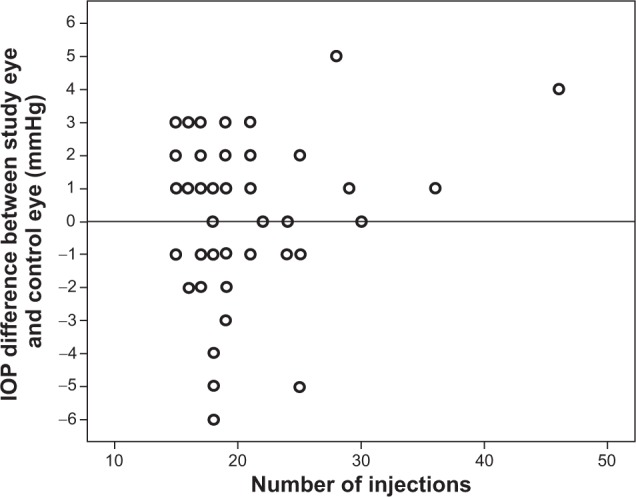
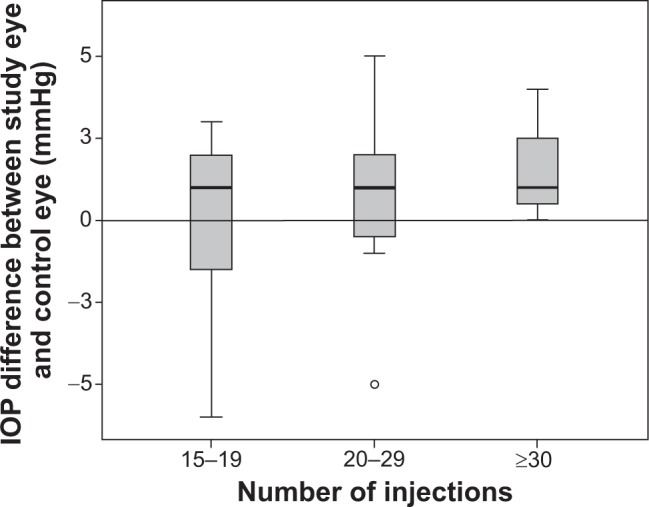
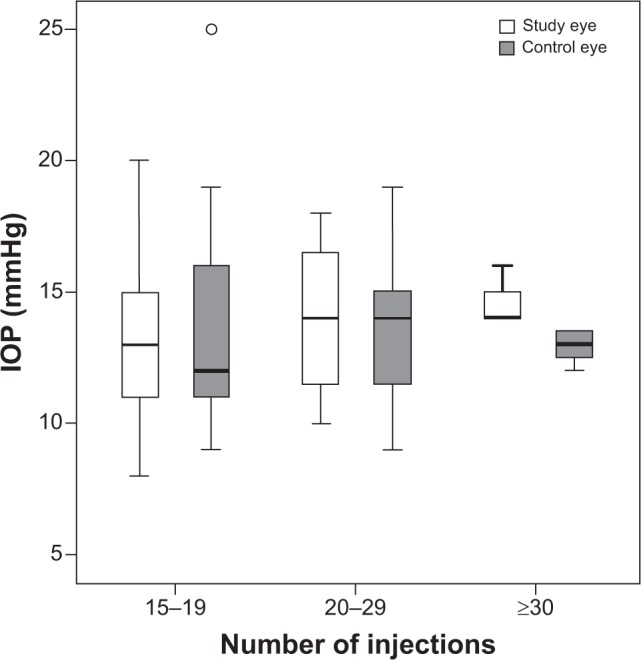
Among the frequently-treated study eyes, the mean IOP was 13.68±2.91 mmHg (range, 8 to 20 mmHg). The unfrequently-treated fellow control eyes had a mean IOP of 13.45±3.09 mmHg (range, 9 to 25 mmHg). There was no significant correlation of the IOP difference between the study and control eyes with the number of ranibizumab injections (correlation coefficient 0.77; P=0.583). For each of groups I, II, and III, the difference in mean IOP between the study and control eyes was nonsignificant (P>0.05). There was also no significant association of the IOP difference between the study and control eyes with the number of ranibizumab injections for each group (P=0.391).
Our study did not find an increased IOP in frequently-ranibizumab-treated eyes when compared to unfrequently-treated fellow control eyes. Further studies with a greater sample size are needed to evaluate whether an increased number of ranibizumab injections is associated with IOP changes.
我们想确定在接受新生血管性年龄相关性黄斑变性(AMD)治疗的患者中,多次玻璃体内注射雷珠单抗是否与眼压(IOP)升高有关。
这项回顾性研究检查了53例接受多次玻璃体内注射雷珠单抗治疗的新生血管性AMD患者。主要观察指标是频繁治疗的研究眼(≥15次注射)与不频繁治疗的对侧对照眼(≤5次注射)之间的眼压差异。患者分为三个研究组:第一组(35例患者,注射15至19次);第二组(15例患者,注射20至29次);第三组(3例患者,注射≥30次)。在最后一次玻璃体内注射雷珠单抗4周后,用Goldmann压平眼压计测量眼压。为进行统计分析,然后将眼压与雷珠单抗注射次数进行相关性分析。
在频繁治疗的研究眼中,平均眼压为13.68±2.91 mmHg(范围8至20 mmHg)。不频繁治疗的对侧对照眼平均眼压为13.45±3.09 mmHg(范围9至25 mmHg)。研究眼与对照眼之间的眼压差异与雷珠单抗注射次数无显著相关性(相关系数0.77;P = 0.583)。对于第一组、第二组和第三组中的每一组,研究眼与对照眼之间的平均眼压差异均无统计学意义(P>0.05)。每组研究眼与对照眼之间的眼压差异与雷珠单抗注射次数也无显著相关性(P = 0.391)。
我们的研究未发现与不频繁治疗的对侧对照眼相比,频繁接受雷珠单抗治疗眼睛的眼压升高。需要进行更大样本量的进一步研究,以评估雷珠单抗注射次数增加是否与眼压变化有关。