Laboratoire de Sciences Cognitives et Psycholinguistique, Ecole Normale Supérieure, CNRS, EHESS , Paris , France ; Hôpital Robert Debré, Service de Psychopathologie de l'Enfant et de l'Adolescent, APHP , Paris , France.
Inserm, Centre for Research in Epidemiology and Population Health (CESP), Epidemiology of Diabetes and Renal Diseases Lifelong Approach Team , Villejuif , France ; University Paris-Sud, UMRS , Villejuif , France.
PeerJ. 2014 Apr 1;2:e335. doi: 10.7717/peerj.335. eCollection 2014.
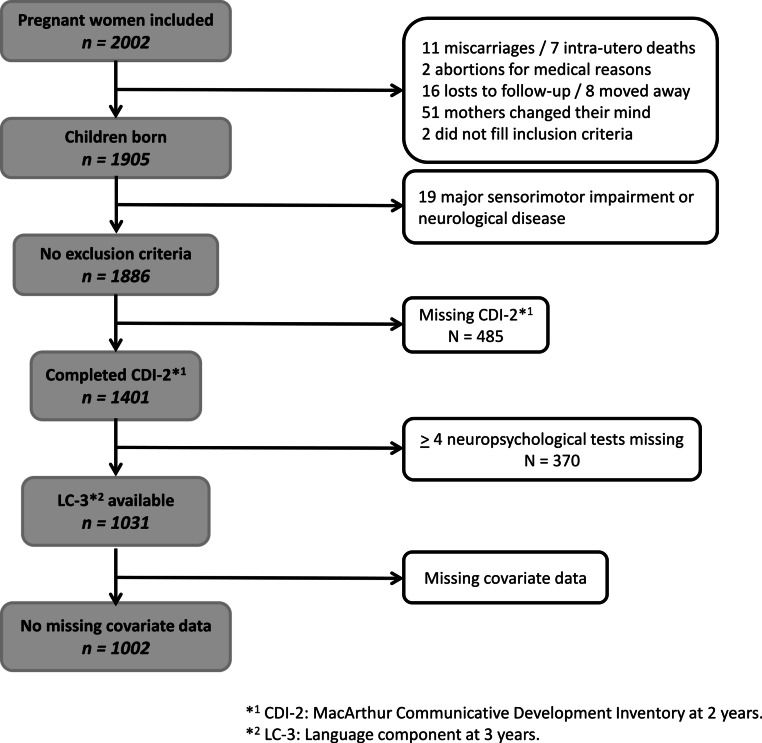
Objective. To examine the factors predicting changes in language skills between 2 and 3 years. Methods. By using longitudinal data concerning 1002 children from the EDEN study, linear regression was used to predict 3-year language performance from 2-year language performance and the risk factors associated with language delays. Logistic regressions were performed to examine two change trajectories: children who fall below the 10th percentile of language skills between 2 and 3 years (declining trajectory), and those who rose above the 10th percentile (resilient trajectory). Results. The final linear model accounted for 43% of the variance in 3-year language scores, with 2-year language scores accounting for 22%. Exposure to alcohol during pregnancy, earlier birth term, lower level of parental education and lower frequency of maternal stimulation were associated with the declining trajectory. Breastfeeding was associated with the resilient trajectory. Conclusions. This study provides a better understanding of the natural history of early language delays by identifying biological and social factors that predict changes in language skills between the ages of 2 and 3 years.
目的。研究预测 2 至 3 岁之间语言技能变化的因素。
方法。本研究使用 EDEN 研究中 1002 名儿童的纵向数据,采用线性回归分析,从 2 岁时的语言表现和与语言迟缓相关的风险因素,预测 3 岁时的语言表现。采用逻辑回归分析两种变化轨迹:2 至 3 岁期间语言技能低于第 10 百分位数的儿童(下降轨迹),以及语言技能高于第 10 百分位数的儿童(恢复轨迹)。
结果。最终的线性模型解释了 3 岁语言得分的 43%,2 岁时的语言得分解释了 22%。妊娠期间饮酒、早产、父母教育水平较低和母亲刺激频率较低与下降轨迹相关。母乳喂养与恢复轨迹相关。
结论。本研究通过确定预测 2 至 3 岁之间语言技能变化的生物学和社会因素,更好地了解了早期语言迟缓的自然史。