Department of Pain Management, Tangdu Hospital, The Fourth Military Medical University, Xi'an, China.
Cancer Sci. 2014 Jul;105(7):825-32. doi: 10.1111/cas.12428. Epub 2014 Jun 18.
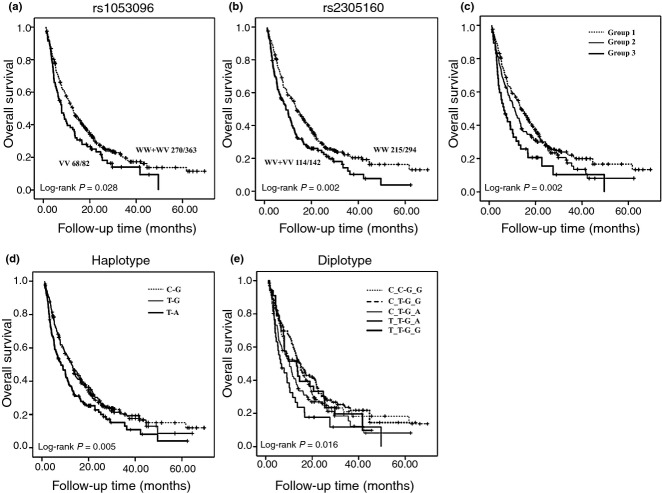
The functional abnormality of circadian regulation genes is involved in the development and progression of hepatocellular carcinoma (HCC). However, the association between functional single nucleotide polymorphisms (SNPs) in circadian gene NPAS2 and the overall survival of HCC patients treated with transcatheter arterial chemoembolization (TACE) has never been investigated. Six functional SNPs in the NPAS2 gene were genotyped using the Sequenom iPLEX genotyping system in a cohort of 448 unresectable Chinese patients with HCC treated with TACE. Multivariate Cox proportional hazards model and Kaplan-Meier curves were used for the prognosis analysis. We found that two SNPs, rs1053096 and rs2305160, in the NPAS2 gene showed significant associations with overall death risk in HCC patients in the recessive model (hazard ratio [HR] = 1.48; 95% confidence interval [CI], 1.13-1.94; P = 0.004) and in the dominant model (HR = 1.63; 95% CI, 1.29-2.07; P < 0.001), respectively. Moreover, we observed a cumulative effect of these two SNPs on HCC overall survival, indicating a significant trend of increasing death risk with increasing number of unfavorable genotypes (P for trend < 0.001). Compared with the patients without any unfavorable genotypes, the HRs for patients with one and two unfavorable genotypes were 1.41 (95% CI, 1.10-1.82; P = 0.007) and 2.09 (95% CI, 1.46-2.97, P < 0.001), respectively. The haplotype and diplotype analyses further characterized the association between NPAS2 genotype and survival of HCC patients. Our results for the first time suggest that NPAS2 gene polymorphisms may serve as an independent prognostic marker for HCC patients treated with TACE.
昼夜节律调节基因的功能异常与肝细胞癌 (HCC) 的发生和发展有关。然而,昼夜基因 NPAS2 中功能性单核苷酸多态性 (SNP) 与接受经导管动脉化疗栓塞 (TACE) 治疗的 HCC 患者总生存率之间的关联尚未被研究过。在接受 TACE 治疗的 448 例不可切除的中国 HCC 患者队列中,使用 Sequenom iPLEX 基因分型系统对 NPAS2 基因中的 6 个功能性 SNP 进行了基因分型。多变量 Cox 比例风险模型和 Kaplan-Meier 曲线用于预后分析。我们发现,NPAS2 基因中的两个 SNP(rs1053096 和 rs2305160)在 HCC 患者的隐性模型(危险比 [HR] = 1.48;95%置信区间 [CI],1.13-1.94;P = 0.004)和显性模型(HR = 1.63;95%CI,1.29-2.07;P < 0.001)中与总体死亡风险显著相关。此外,我们观察到这两个 SNP 对 HCC 总生存率的累积效应,表明随着不利基因型数量的增加,死亡风险呈显著增加趋势(P 趋势 < 0.001)。与没有任何不利基因型的患者相比,具有一个和两个不利基因型的患者的 HR 分别为 1.41(95%CI,1.10-1.82;P = 0.007)和 2.09(95%CI,1.46-2.97,P < 0.001)。单体型和二倍体型分析进一步描述了 NPAS2 基因型与 HCC 患者生存之间的关联。我们的研究结果首次表明,NPAS2 基因多态性可能是接受 TACE 治疗的 HCC 患者的独立预后标志物。