• 文献检索
  • 文档翻译
  • 深度研究
  • 学术资讯
  • Suppr Zotero 插件Zotero 插件
  • 邀请有礼
  • 套餐&价格
  • 历史记录
应用&插件
Suppr Zotero 插件Zotero 插件浏览器插件Mac 客户端Windows 客户端微信小程序
定价
高级版会员购买积分包购买API积分包
服务
文献检索文档翻译深度研究API 文档MCP 服务
关于我们
关于 Suppr公司介绍联系我们用户协议隐私条款
关注我们

Suppr 超能文献

核心技术专利:CN118964589B侵权必究
粤ICP备2023148730 号-1Suppr @ 2026

文献检索

告别复杂PubMed语法,用中文像聊天一样搜索,搜遍4000万医学文献。AI智能推荐,让科研检索更轻松。

立即免费搜索

文件翻译

保留排版,准确专业,支持PDF/Word/PPT等文件格式,支持 12+语言互译。

免费翻译文档

深度研究

AI帮你快速写综述,25分钟生成高质量综述,智能提取关键信息,辅助科研写作。

立即免费体验

广西宁明渐新统(古近纪)猪笼草科(豆科,云实亚科,猪笼草族)的叶子和果实及其生物地理意义。

Leaves and fruits of Bauhinia (Leguminosae, Caesalpinioideae, Cercideae) from the Oligocene Ningming Formation of Guangxi, South China and their biogeographic implications.

机构信息

State Key Laboratory of Systematic and Evolutionary Botany, Institute of Botany, Chinese Academy of Sciences, Beijing 100093, P,R, China.

出版信息

BMC Evol Biol. 2014 Apr 24;14:88. doi: 10.1186/1471-2148-14-88.

DOI:10.1186/1471-2148-14-88
PMID:24758153
原文链接:https://pmc.ncbi.nlm.nih.gov/articles/PMC4101841/
Abstract

BACKGROUND

The pantropical genus Bauhinia, along with the northern temperate Cercis and several tropical genera, bear bilobate, bifoliolate, or sometimes unifoliolate leaves, which constitute the tribe Cercideae as sister to the rest of the family Leguminosae based on molecular phylogenetics. Hence, the fossil record of Cercideae is pivotal to understand the early evolution and biogeographic history of legumes.

RESULTS

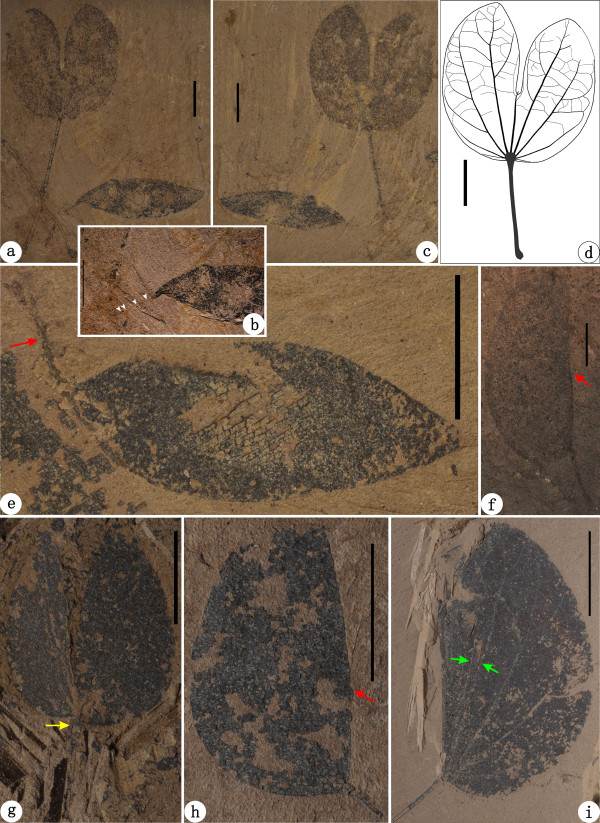
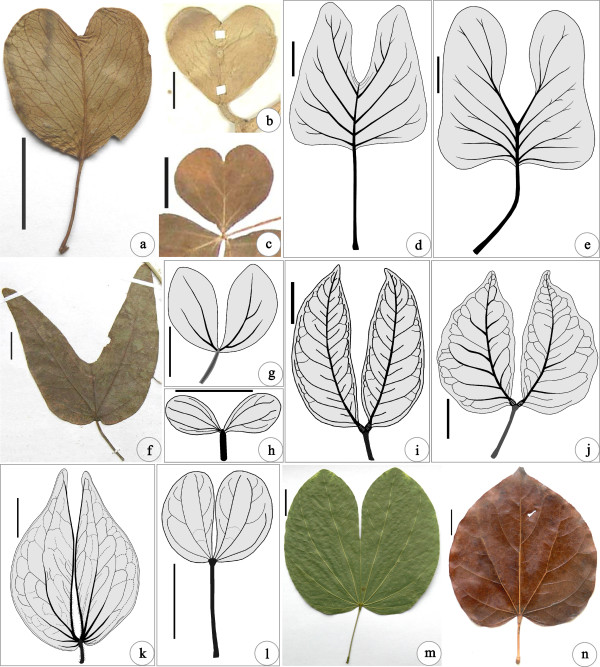
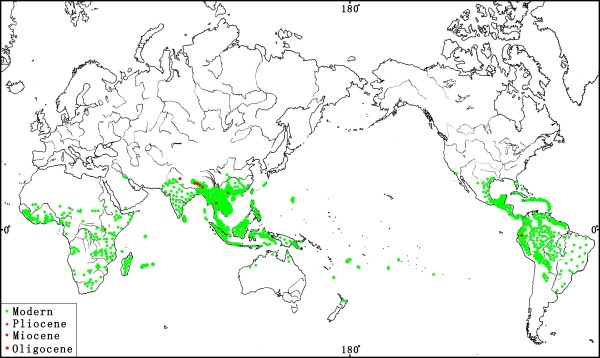
Three fossil species of Bauhinia were described from the Oligocene Ningming Formation of Guangxi, South China. Bauhinia ningmingensis sp. nov. is characterized by its bifoliolate, pulvinate leaves bearing basal acrodromous primary veins and brochidodromous secondary veins. B. cheniae sp. nov. bears moderately or deeply bilobate, pulvinate leaves, with basal actinodromous primary veins and eucamptodromous secondary veins. B. larsenii D.X. Zhang et Y.F. Chen emend. possesses shallowly or moderately bilobate, pulvinate leaves bearing basal actinodromous primary veins and brochidodromous secondary veins, as well as elliptic, stipitate, non-winged, and oligo-seeded fruits. Meanwhile, previously reported Bauhinia fossils were reviewed, and those pre-Oligocene foliage across the world are either questionable or have been rejected due to lacking of reliable evidence for their pulvini or/and basal actinodromous or acrodromous venations. Besides Oligocene leaves and fruits presented here, foliage and/or wood of Bauhinia have been documented from the Miocene-Pliocene of Thailand, India, Nepal, Uganda, and Ecuador.

CONCLUSIONS

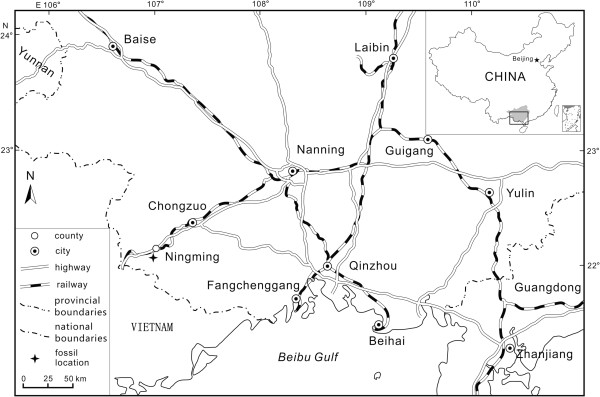
Bauhinia has exhibited a certain diversity with bifoliolate- and bilobate-leafed species in a low-latitude locality-Ningming since at least the Oligocene, implying that the tropical zone of South China may represent one of the centres for early diversification of the genus. The reliable macrofossils of Bauhinia and Cercis have made their debut in the Eocene-Oligocene floras from mid-low latitudes and appeared to lack in the coeval floras at high latitudes, implying a possible Tethys Seaway origin and spread of legumes. However, detailed scenarios for the historical biogeography of Bauhinia and its relatives still need more robust dataset from palaeobotany and molecular phylogeny in future research.

摘要

背景

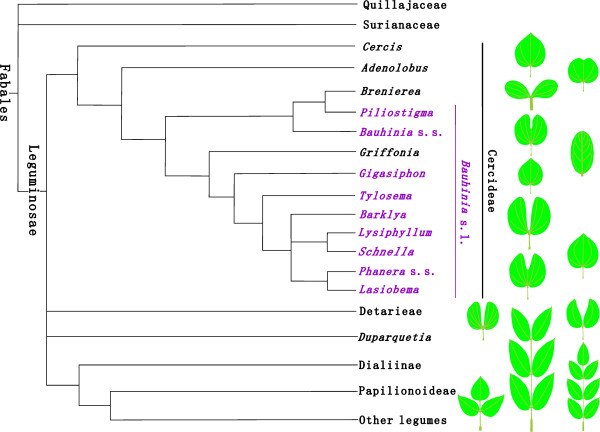
泛热带槐蓝属(Bauhinia)与北温带紫荆属(Cercis)和几个热带属一起,具有二回羽状、二回三出复叶或有时为单叶,基于分子系统发育学,这些叶子构成了紫荆族(Cercideae),是豆科其余部分的姐妹群。因此,紫荆族的化石记录对于理解豆科植物的早期进化和生物地理历史至关重要。

结果

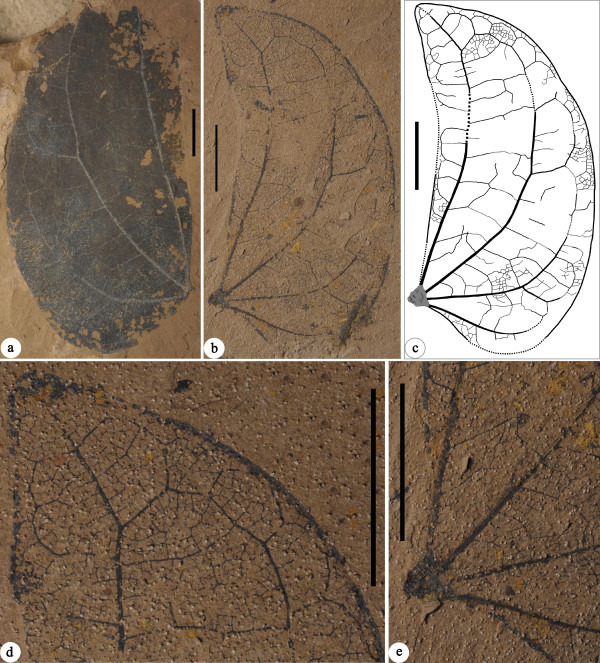
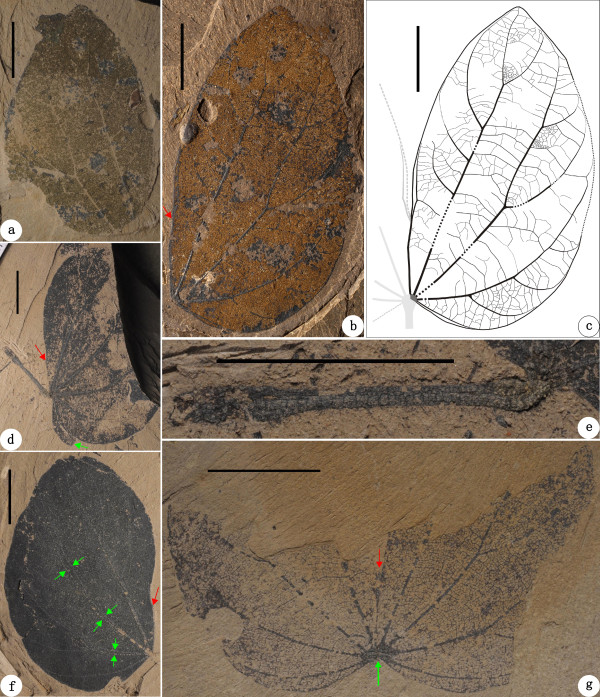
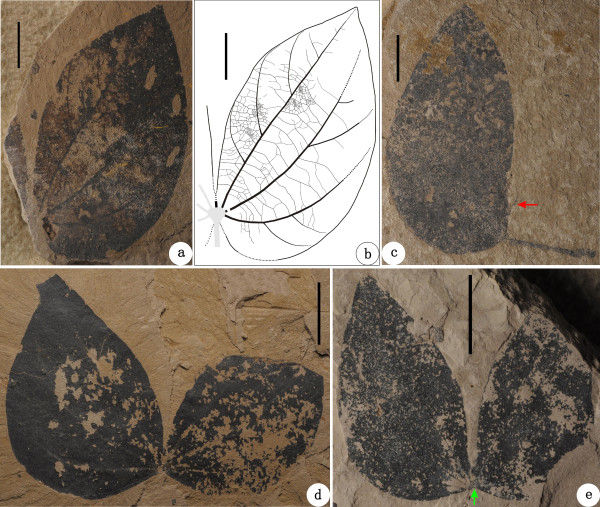
在中国广西的渐新世宁明组中描述了三种槐蓝属的化石种。新种宁明槐蓝(Bauhinia ningmingensis sp. nov.)的特征为二回三出复叶,具心形叶,具基部互生的一级脉和叉状二级脉。Cheniae 槐蓝(B. cheniae sp. nov.)具有中度或深二回羽状、心形叶,具基部直出的一级脉和弯弓状二级脉。张殿芳和陈永福修正的 Larsen 槐蓝(B. larsenii D.X. Zhang et Y.F. Chen emend.)具有浅度或中度二回羽状、心形叶,具基部直出的一级脉和叉状二级脉,以及椭圆形、具柄、无翅和少种子的果实。同时,还回顾了以前报道的槐蓝属化石,由于缺乏可靠的证据证明其具叶枕或/和基部直出或互生的脉序,因此,世界上早于渐新世的槐蓝属叶化石要么是可疑的,要么已经被拒绝。除了这里展示的渐新世叶片和果实外,槐蓝属的叶片和/或木材也已在泰国、印度、尼泊尔、乌干达和厄瓜多尔的中新世-上新世被记录下来。

结论

槐蓝属至少在渐新世就已经在宁明这样的低纬度地区表现出一定的多样性,具有二回羽状和二回三出复叶的物种,这表明中国南方的热带地区可能是该属早期多样化的中心之一。槐蓝属和紫荆属的可靠大化石在从中低纬度的始新世-渐新世植物群中首次出现,而在同期高纬度植物群中似乎缺乏,这表明豆科植物可能起源于特提斯海,并向外扩散。然而,槐蓝属及其近缘属的历史生物地理学的详细情况仍需要未来的古植物学和分子系统发育学研究提供更可靠的数据集。
https://cdn.ncbi.nlm.nih.gov/pmc/blobs/6301/4101841/6e49fea0530e/1471-2148-14-88-8.jpg
https://cdn.ncbi.nlm.nih.gov/pmc/blobs/6301/4101841/e67c0b8ede8d/1471-2148-14-88-1.jpg
https://cdn.ncbi.nlm.nih.gov/pmc/blobs/6301/4101841/b7b5501bc5f3/1471-2148-14-88-2.jpg
https://cdn.ncbi.nlm.nih.gov/pmc/blobs/6301/4101841/8e60f722d4bb/1471-2148-14-88-3.jpg
https://cdn.ncbi.nlm.nih.gov/pmc/blobs/6301/4101841/35bdd4541d36/1471-2148-14-88-4.jpg
https://cdn.ncbi.nlm.nih.gov/pmc/blobs/6301/4101841/5e865d2dd590/1471-2148-14-88-5.jpg
https://cdn.ncbi.nlm.nih.gov/pmc/blobs/6301/4101841/55b71a5318f8/1471-2148-14-88-6.jpg
https://cdn.ncbi.nlm.nih.gov/pmc/blobs/6301/4101841/fc490e0faa0d/1471-2148-14-88-7.jpg
https://cdn.ncbi.nlm.nih.gov/pmc/blobs/6301/4101841/6e49fea0530e/1471-2148-14-88-8.jpg
https://cdn.ncbi.nlm.nih.gov/pmc/blobs/6301/4101841/e67c0b8ede8d/1471-2148-14-88-1.jpg
https://cdn.ncbi.nlm.nih.gov/pmc/blobs/6301/4101841/b7b5501bc5f3/1471-2148-14-88-2.jpg
https://cdn.ncbi.nlm.nih.gov/pmc/blobs/6301/4101841/8e60f722d4bb/1471-2148-14-88-3.jpg
https://cdn.ncbi.nlm.nih.gov/pmc/blobs/6301/4101841/35bdd4541d36/1471-2148-14-88-4.jpg
https://cdn.ncbi.nlm.nih.gov/pmc/blobs/6301/4101841/5e865d2dd590/1471-2148-14-88-5.jpg
https://cdn.ncbi.nlm.nih.gov/pmc/blobs/6301/4101841/55b71a5318f8/1471-2148-14-88-6.jpg
https://cdn.ncbi.nlm.nih.gov/pmc/blobs/6301/4101841/fc490e0faa0d/1471-2148-14-88-7.jpg
https://cdn.ncbi.nlm.nih.gov/pmc/blobs/6301/4101841/6e49fea0530e/1471-2148-14-88-8.jpg

相似文献

1
Leaves and fruits of Bauhinia (Leguminosae, Caesalpinioideae, Cercideae) from the Oligocene Ningming Formation of Guangxi, South China and their biogeographic implications.广西宁明渐新统(古近纪)猪笼草科(豆科,云实亚科,猪笼草族)的叶子和果实及其生物地理意义。
BMC Evol Biol. 2014 Apr 24;14:88. doi: 10.1186/1471-2148-14-88.
2
Bilobate leaves of Bauhinia (Leguminosae, Caesalpinioideae, Cercideae) from the middle Miocene of Fujian Province, southeastern China and their biogeographic implications.中国东南部福建省中新世中期豆科云实亚科紫荆族植物的二裂叶及其生物地理学意义
BMC Evol Biol. 2015 Nov 16;15:252. doi: 10.1186/s12862-015-0540-9.
3
New Biogeographic insight into Bauhinia s.l. (Leguminosae): integration from fossil records and molecular analyses.对广义羊蹄甲属(豆科)的新生物地理学见解:来自化石记录和分子分析的整合
BMC Evol Biol. 2014 Aug 10;14:181. doi: 10.1186/s12862-014-0181-4.
4
Winged Fruits of Deviacer in the Oligocene from the Ningming Basin in Guangxi, South China.中国南方广西宁明盆地渐新世的德氏翅果
PLoS One. 2015 Dec 1;10(12):e0144009. doi: 10.1371/journal.pone.0144009. eCollection 2015.
5
Paliurus Fruits from the Oligocene of South China and Their Phytogeographic Implications.来自中国南方渐新世的马甲子果实及其植物地理学意义
PLoS One. 2015 Nov 4;10(11):e0140653. doi: 10.1371/journal.pone.0140653. eCollection 2015.
6
A new Oligocene Calocedrus from South China and its implications for transpacific floristic exchanges.中国南方晚始新世新柏木属及其对跨太平洋植物区系交流的意义。
Am J Bot. 2012 Jan;99(1):108-20. doi: 10.3732/ajb.1100331.
7
Fruits of Koelreuteria (Sapindaceae) from the Cenozoic throughout the northern hemisphere: their ecological, evolutionary, and biogeographic implications.来自北半球新生代的栾树属(无患子科)果实:其生态、进化和生物地理意义。
Am J Bot. 2013 Feb;100(2):422-49. doi: 10.3732/ajb.1200415. Epub 2013 Jan 29.
8
Mummified Oligocene fruits of Schima (Theaceae) and their systematic and biogeographic implications.始新世南洋杉果实的木乃伊及其系统学和生物地理学意义。
Sci Rep. 2017 Jun 21;7(1):4009. doi: 10.1038/s41598-017-04349-6.
9
A fossil-calibrated phylogeny reveals the biogeographic history of the Cladrastis clade, an amphi-Pacific early-branching group in papilionoid legumes.化石校准的系统发育揭示了豆科崖豆藤族的生物地理历史,该族是一个具有环太平洋分布的豆科中早期分支的类群。
Mol Phylogenet Evol. 2020 Feb;143:106673. doi: 10.1016/j.ympev.2019.106673. Epub 2019 Nov 7.
10
First occurrence of Cedrelospermum (Ulmaceae) in Asia and its biogeographic implications.亚洲首次发现的樟榆属(榆科)植物及其生物地理学意义。
J Plant Res. 2015 Sep;128(5):747-61. doi: 10.1007/s10265-015-0739-2. Epub 2015 Jul 4.

引用本文的文献

1
Comparative Analysis of Complete Chloroplast Genomes and Phylogenetic Relationships in Medicinally Important Pantropical Genus s.s. (Leguminosae) from Southern Africa and Eastern Asia.来自南部非洲和东亚的具有重要药用价值的泛热带狭义属(豆科)叶绿体全基因组比较分析及系统发育关系研究
Int J Mol Sci. 2025 Jan 5;26(1):397. doi: 10.3390/ijms26010397.
2
Biome evolution in subfamily Cercidoideae (Leguminosae): a tropical arborescent clade with a relictual depauperate temperate lineage.苏木亚科(豆科)的生物群落演化:一个具有残余贫化温带谱系的热带乔木分支。
Rev Bras Bot. 2025;48(1):11. doi: 10.1007/s40415-024-01058-z. Epub 2024 Dec 18.
3

本文引用的文献

1
A new Oligocene Calocedrus from South China and its implications for transpacific floristic exchanges.中国南方晚始新世新柏木属及其对跨太平洋植物区系交流的意义。
Am J Bot. 2012 Jan;99(1):108-20. doi: 10.3732/ajb.1100331.
2
Phylogeny of Cercis based on DNA sequences of nuclear ITS and four plastid regions: implications for transatlantic historical biogeography.基于核 ITS 和四个质体区域的 DNA 序列对紫荆属的系统发育分析:对跨大西洋历史生物地理学的启示。
Mol Phylogenet Evol. 2012 Mar;62(3):816-25. doi: 10.1016/j.ympev.2011.11.016. Epub 2011 Nov 27.
3
Degradation of the upper pulvinus in modern and fossil leaves of Cercis (Fabaceae).
, gen. et sp. nov., the youngest ellimmichthyiform (clupeomorph) fish to date from the Oligocene of South China.
新属新种,是迄今为止来自中国南方渐新世最年轻的艾氏鱼形(鲱形亚目)鱼类。
PeerJ. 2021 Jun 1;9:e11418. doi: 10.7717/peerj.11418. eCollection 2021.
4
Winged Fruits of Deviacer in the Oligocene from the Ningming Basin in Guangxi, South China.中国南方广西宁明盆地渐新世的德氏翅果
PLoS One. 2015 Dec 1;10(12):e0144009. doi: 10.1371/journal.pone.0144009. eCollection 2015.
5
Bilobate leaves of Bauhinia (Leguminosae, Caesalpinioideae, Cercideae) from the middle Miocene of Fujian Province, southeastern China and their biogeographic implications.中国东南部福建省中新世中期豆科云实亚科紫荆族植物的二裂叶及其生物地理学意义
BMC Evol Biol. 2015 Nov 16;15:252. doi: 10.1186/s12862-015-0540-9.
6
Paliurus Fruits from the Oligocene of South China and Their Phytogeographic Implications.来自中国南方渐新世的马甲子果实及其植物地理学意义
PLoS One. 2015 Nov 4;10(11):e0140653. doi: 10.1371/journal.pone.0140653. eCollection 2015.
7
New Biogeographic insight into Bauhinia s.l. (Leguminosae): integration from fossil records and molecular analyses.对广义羊蹄甲属(豆科)的新生物地理学见解:来自化石记录和分子分析的整合
BMC Evol Biol. 2014 Aug 10;14:181. doi: 10.1186/s12862-014-0181-4.
现代和化石槐属(豆科)叶片上托叶的退化。
Am J Bot. 1998 Feb;85(2):273.
4
A phylogeny of legumes (Leguminosae) based on analysis of the plastid matK gene resolves many well-supported subclades within the family.基于质体 matK 基因分析的豆科(豆科)系统发育解决了该科内许多支持良好的亚科。
Am J Bot. 2004 Nov;91(11):1846-62. doi: 10.3732/ajb.91.11.1846.
5
Evolutionary rates analysis of Leguminosae implicates a rapid diversification of lineages during the tertiary.豆科植物的进化速率分析表明,在第三纪期间谱系发生了快速分化。
Syst Biol. 2005 Aug;54(4):575-94. doi: 10.1080/10635150590947131.
6
The rest of the iceberg. Legume diversity and evolution in a phylogenetic context.冰山的其余部分。系统发育背景下的豆科植物多样性与进化。
Plant Physiol. 2003 Mar;131(3):900-10. doi: 10.1104/pp.102.018150.