Division of Intractable Diseases, Center for Biomedical Sciences, National Institute of Health, Chungcheongbuk-do 363-951, South Korea.
BMC Med Genet. 2014 Apr 28;15:46. doi: 10.1186/1471-2350-15-46.
Patient genetic heterogeneity renders it difficult to discover disease-cause genes. Whole-exome sequencing is a powerful new strategy that can be used to this end. The purpose of the present study was to identify a hitherto unknown mutation causing autosomal recessive nonsyndromic hearing loss (ARNSHL) in Korean families.
We performed whole-exome sequencing in 16 individuals from 13 unrelated small families with ARNSHL. After filtering out population-specific polymorphisms, we focused on known deafness genes. Pathogenic effects of the detected mutations on protein structure or function were predicted via in silico analysis.
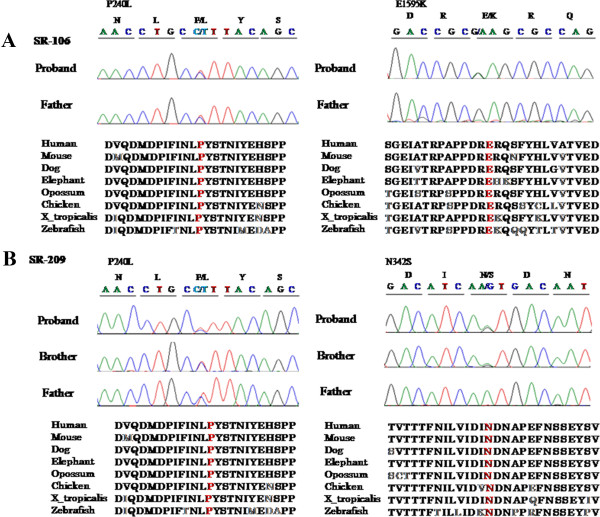
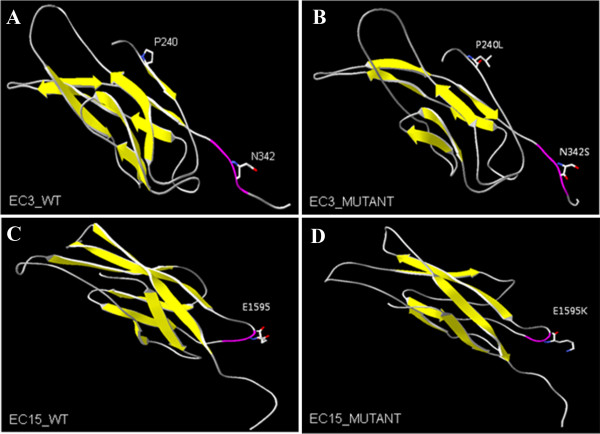
We identified compound heterozygous CDH23 mutations in hearing-loss genes of two families. These include two previously reported pathological mutations, p.Pro240Leu and p.Glu1595Lys, as well as one novel mutation, p.Asn342Ser. The p.Pro240Leu mutation was found in both families. We also identified 26 non-synonymous variants in CDH23 coding exons from 16 hearing-loss patients and 30 Korean exomes.
The present study is the first to show that CDH23 mutations cause hearing loss in Koreans. Although the precise contribution made by such mutations needs to be determined using a larger patient cohort, our data indicate that mutations in the CDH23 gene are one of the most important causes of non-syndromic hearing loss in East Asians. Further exome sequencing will identify common mutations or polymorphisms and contribute to the molecular diagnosis of, and development of new therapies for, hereditary hearing loss.
患者遗传异质性使得发现疾病相关基因变得困难。全外显子组测序是一种强大的新策略,可用于此目的。本研究的目的是鉴定一个迄今未知的导致韩国家族常染色体隐性非综合征性听力损失(ARNSHL)的突变。
我们对 13 个无亲缘关系的 ARNSHL 小家族的 16 名个体进行了全外显子组测序。在排除群体特异性多态性后,我们专注于已知的耳聋基因。通过计算机分析预测检测到的突变对蛋白质结构或功能的致病性影响。
我们在两个家族的听力损失基因中发现了复合杂合的 CDH23 突变。其中包括两个先前报道的病理性突变,p.Pro240Leu 和 p.Glu1595Lys,以及一个新的突变,p.Asn342Ser。p.Pro240Leu 突变在两个家族中均发现。我们还在 16 名听力损失患者和 30 名韩国外显子组中发现了 CDH23 编码外显子的 26 个非同义变异。
本研究首次表明 CDH23 突变导致韩国人听力损失。尽管需要使用更大的患者队列来确定这些突变的确切贡献,但我们的数据表明,CDH23 基因突变是东亚人群中非综合征性听力损失的最重要原因之一。进一步的外显子组测序将鉴定常见的突变或多态性,并有助于遗传性听力损失的分子诊断和新疗法的开发。