Onishi Hiroshi, Kawasaki Tomonori, Zakoji Hidenori, Yoshida Takashi, Komiyama Takafumi, Kuriyama Kengo, Araya Masayuki, Saito Ryo, Aoki Shinichi, Maehata Yoshiyasu, Tominaga Licht, Marino Kan, Watanabe Iori, Oguri Mitsuhiko, Araki Tsutomu, Enomoto Nobuyuki, Takeda Masayuki, Katoh Ryohei
Department of Radiation Oncology, University of Yamanashi, 1110 Shimokato, 409-3898 Chuo-city, Yamanashi, Japan.
BMC Res Notes. 2014 Apr 26;7:270. doi: 10.1186/1756-0500-7-270.
Treatment of primary renal cell carcinoma using radiotherapy with curative intent is rare, because renal cell carcinoma is generally regarded as a radiation-resistant tumor. Recently, stereotactic body radiation therapy has been radically applied for cancers in various organs including renal cell carcinoma. However, there were few reports describing pathological changes of renal cell carcinoma post stereotactic body radiation therapy. This is the first report we are aware of documenting late histological effects of stereotactic body radiation therapy on renal cell carcinoma and surrounding normal tissue.
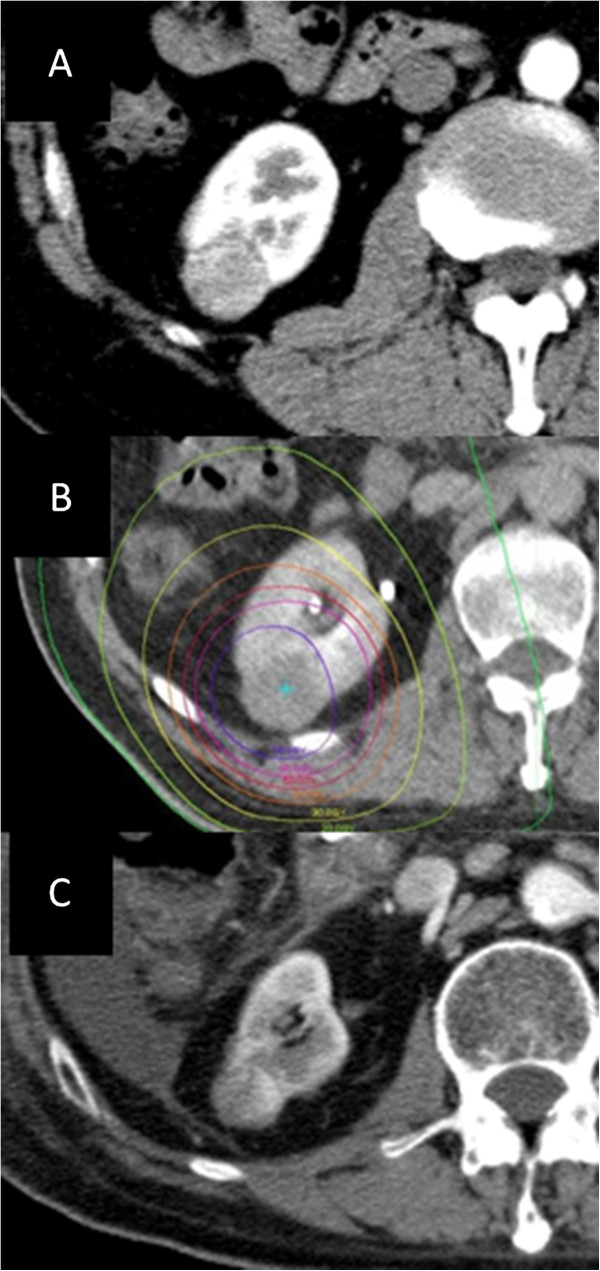
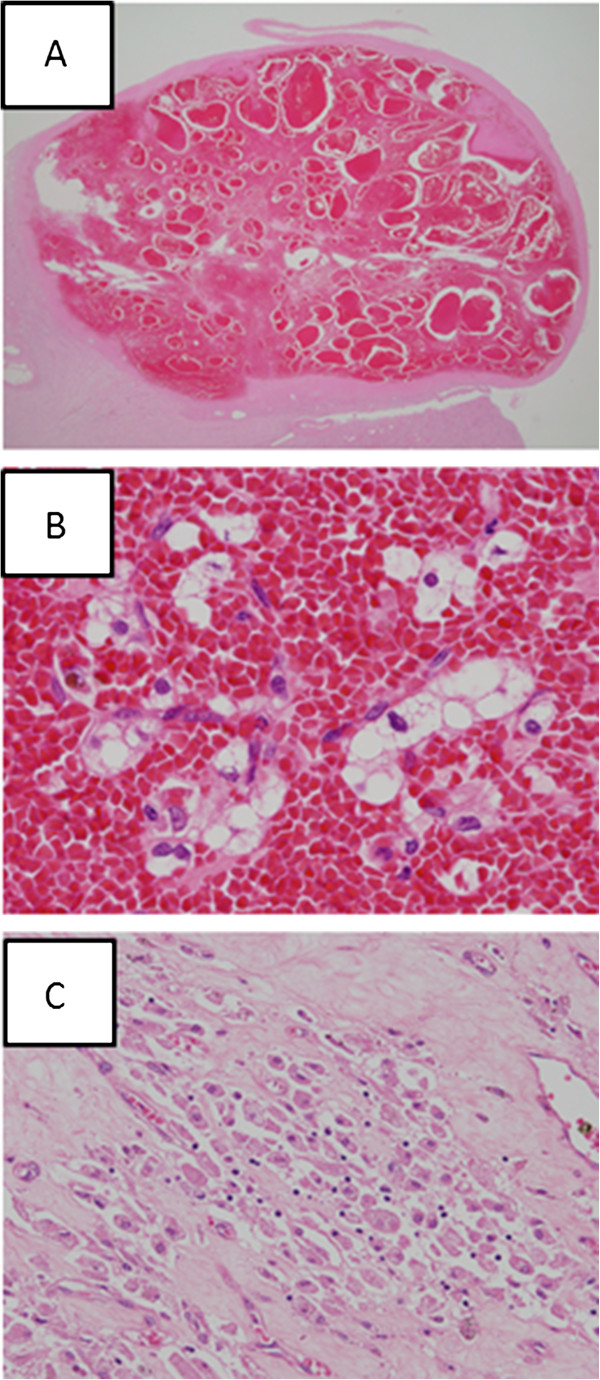
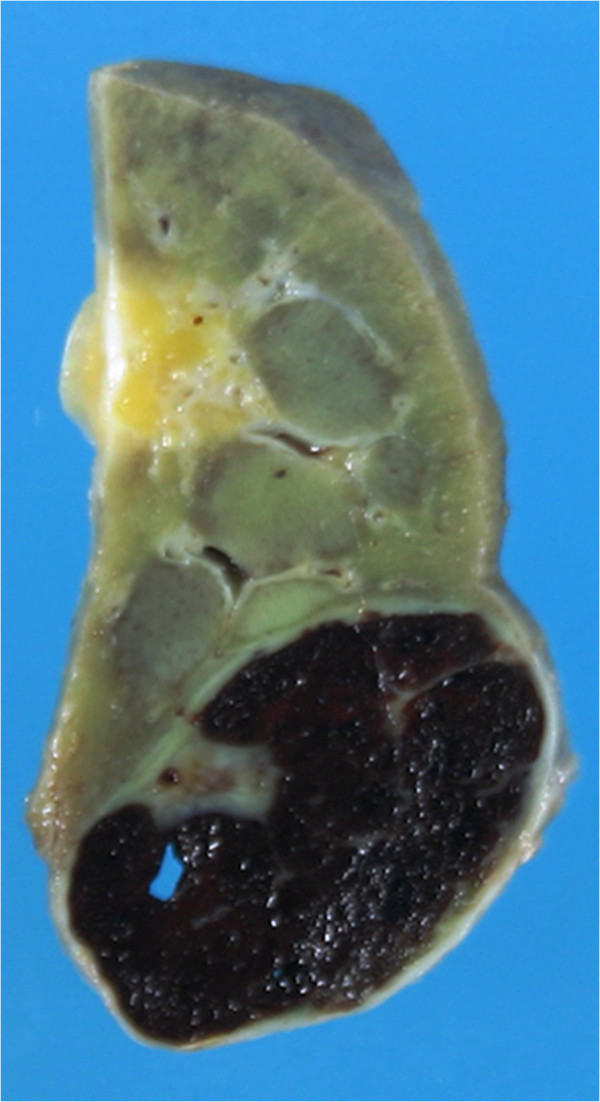
A right renal tumor was identified in a Japanese 70-year-old man on follow-up computed tomography for his chronic hepatitis. T1N0M0 renal cell carcinoma was clinically diagnosed as the tumor was 3 cm in diameter and well-enhanced with intravenously infused contrast material in the arterial phase on computed tomography. No metastases in regional lymph nodes or distant sites were evident. Stereotactic body radiation therapy was selected as an alternative therapy to surgery because of his poor liver function. A total dose of 60 Gy in 10 fractions over 12 days was delivered using a 10-megavolt X-ray. The renal tumor gradually decreased in size and partial response had been achieved at 2 years after completing stereotactic body radiation therapy. Hepatocellular carcinoma was identified during follow-up in the patient and he died of progression of hepatocellular carcinoma with hepatic failure 2.5 years after completing stereotactic body radiation therapy. Autopsy was done and it showed almost complete necrosis of tumor tissues with a small amount of viable renal carcinoma cells. These pathological findings suggested marked effects of stereotactic body radiation therapy on clear cell renal cell carcinoma.
Our case demonstrates a good pathological response with small foci of remnant viable cancer cells after stereotactic body radiation therapy of 60Gy in 10 fractions for small renal cell carcinoma. Although further experiences and longer follow-up are mandatory to conclude the optimal treatment schedule and efficacy of stereotactic body radiation therapy for renal cell carcinoma, stereotactic body radiation therapy may represent a novel less-invasive option for the treatment of primary renal cell carcinoma.
采用根治性放疗治疗原发性肾细胞癌的情况较为罕见,因为肾细胞癌通常被视为放射抗拒性肿瘤。近年来,立体定向体部放疗已被广泛应用于包括肾细胞癌在内的各种器官的癌症治疗。然而,关于肾细胞癌接受立体定向体部放疗后的病理变化的报道较少。这是我们所知的第一份记录立体定向体部放疗对肾细胞癌及周围正常组织的晚期组织学效应的报告。
一名70岁日本男性在慢性肝炎随访计算机断层扫描中发现右肾肿瘤。临床诊断为T1N0M0期肾细胞癌,因为肿瘤直径为3 cm,在计算机断层扫描动脉期经静脉注射造影剂后强化良好。区域淋巴结或远处未见转移。由于患者肝功能较差,选择立体定向体部放疗作为手术的替代治疗方法。使用10兆伏X射线在12天内分10次给予总剂量60 Gy。肾肿瘤体积逐渐缩小,在完成立体定向体部放疗后2年达到部分缓解。随访期间发现患者患有肝细胞癌,在完成立体定向体部放疗后2.5年死于肝细胞癌进展伴肝功能衰竭。进行了尸检,结果显示肿瘤组织几乎完全坏死,仅残留少量存活的肾癌细胞。这些病理结果表明立体定向体部放疗对透明细胞肾细胞癌有显著效果。
我们的病例显示,对于小肾细胞癌,在接受10次分割、总剂量60 Gy的立体定向体部放疗后,病理反应良好,仅残留少量存活癌细胞灶。尽管需要更多经验和更长时间的随访来确定立体定向体部放疗治疗肾细胞癌最佳治疗方案和疗效,但立体定向体部放疗可能是治疗原发性肾细胞癌的一种新的微创选择。