Mizuno S, Ajisaka T, Lahbib S, Kokubu Y, Alabsi M N, Komatsu T
Atmosphere and Ocean Research Institute, University of Tokyo, 5-1-5, Kashiwanoha, Kashiwa, Chiba 277-8564 Japan.
Kyoto University, Oiwake, Kitashirakawa, Sakyou, Kyoto, Kyoto 606-8502 Japan.
J Appl Phycol. 2014;26(2):1159-1167. doi: 10.1007/s10811-013-0139-8. Epub 2013 Nov 12.
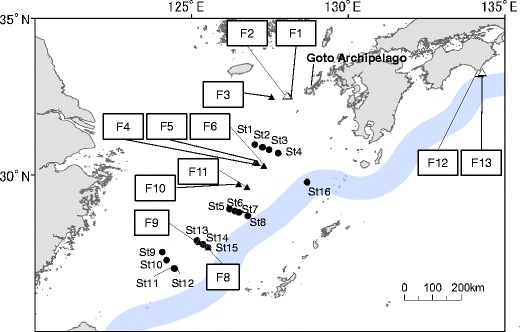
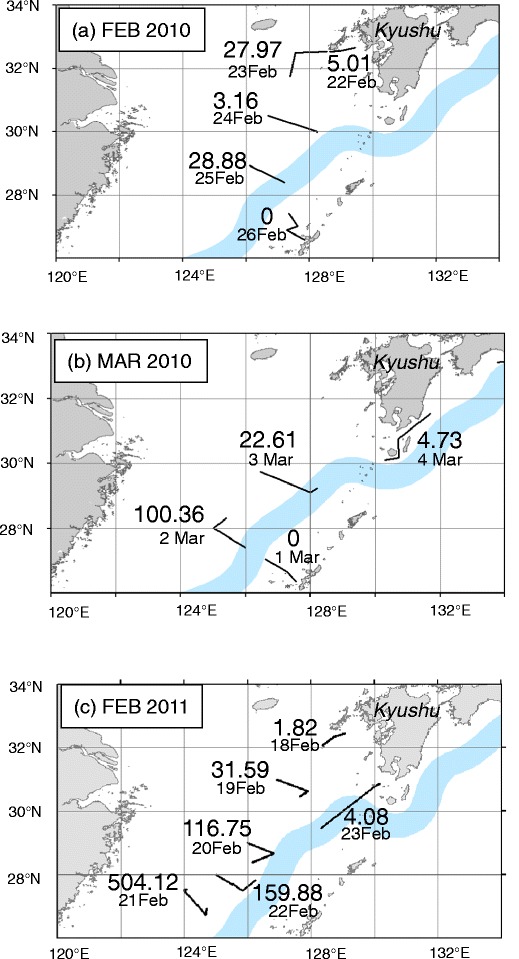
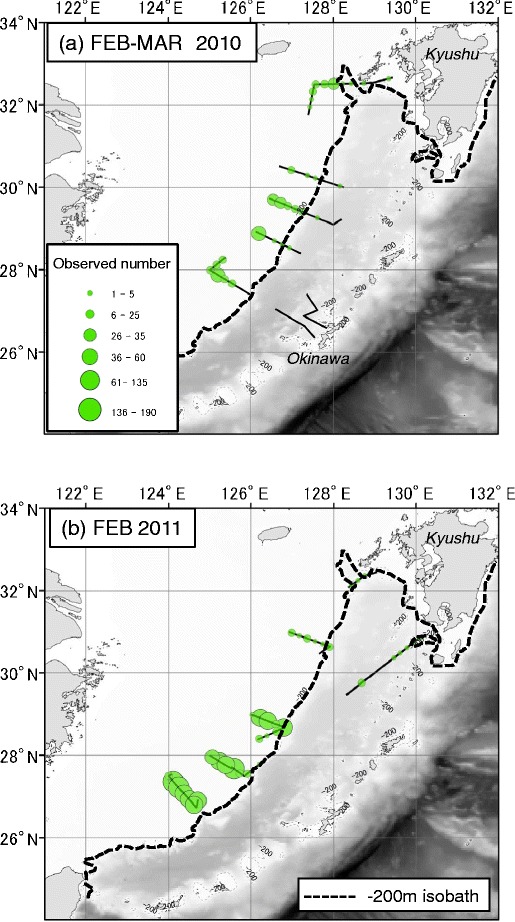
Floating seaweeds play an important role as a habitat for many animals accompanying or attaching to them in offshore waters. It was in 2000 that the first report described abundant distributions of floating seaweeds in offshore waters in the East China Sea in spring. Young individuals of the yellowtail are captured for aquaculture purposes from floating seaweeds in the East China Sea. Therefore, a sound understanding of the distributions of floating seaweeds in the East China Sea is needed. Detailed information is especially important during the late winter to early spring, which corresponds to the juvenile period of the yellowtail. Thus, field surveys using R/V Tansei-Maru were conducted in the Japanese Exclusive Economic Zone in the East China Sea from late winter to early spring in 2010 and 2011. We obtained positions of the vessel by GPS and transversal distances from the vessel to a raft by visual observation. Distance sampling method (Thomas et al. 2010) was applied to estimation of floating seaweed densities (rafts km). Seaweed rafts were also randomly sampled using nets during the research cruises. In the East China Sea, seaweed rafts were distributed mainly on the continental shelf west of the Kuroshio, especially in waters between 26° N and 30° N. Collected rafts consisted of only one species, (Turner) C. Agardh. Taking into account surface currents and geographical distribution of . , it is estimated that these floating seaweeds originated from natural beds along the coast between mid and south China. Considering the approximate travel times, it is suggested that floating patches are colonized by yellowtails early on during their trips, i.e., close to the Chinese coast.
漂浮的海藻在近海海域作为许多伴随或附着其上的动物的栖息地发挥着重要作用。2000年首次有报告描述了春季东海近海海域漂浮海藻的丰富分布情况。黄尾鱼的幼鱼被从东海的漂浮海藻中捕捞用于水产养殖。因此,需要深入了解东海漂浮海藻的分布情况。在冬末至早春期间(这与黄尾鱼的幼鱼期相对应)详细信息尤为重要。于是,在2010年和2011年冬末至早春期间,使用“丹西丸”号科研船在东中国海的日本专属经济区内进行了实地调查。我们通过全球定位系统获取船只位置,并通过目视观察获得从船只到筏子的横向距离。采用距离抽样法(托马斯等人,2010年)来估算漂浮海藻密度(每千米筏子数)。在研究航行期间还使用网对海藻筏进行随机采样。在东中国海,海藻筏主要分布在黑潮以西的大陆架上,特别是在北纬26°至30°之间的海域。采集到的筏子仅由一种(特纳)C. 阿加德海藻组成。考虑到表面洋流和该海藻的地理分布,据估计这些漂浮海藻源自中国中南部沿海的天然生长地。考虑到大致的漂流时间,有人提出漂浮海藻斑块在其漂流行程早期,即靠近中国海岸时就被黄尾鱼占据。