Sayama Christina M, Sorour Mohammad, Schmidt Richard H
Clinical Neurosciences Center, University of Utah, Salt Lake City, Utah, USA.
Surg Neurol Int. 2014 Feb 18;5:19. doi: 10.4103/2152-7806.127377. eCollection 2014.
Patient-specific implants are used for cranioplastic skull reconstruction when large bone flaps must be replaced or where there are complex or critical contours, especially near the face. These implants have a low complication rate, with poor fit and postoperative infection being the most common complications. We report here a potentially serious hazard that may arise from the use of porous implants.
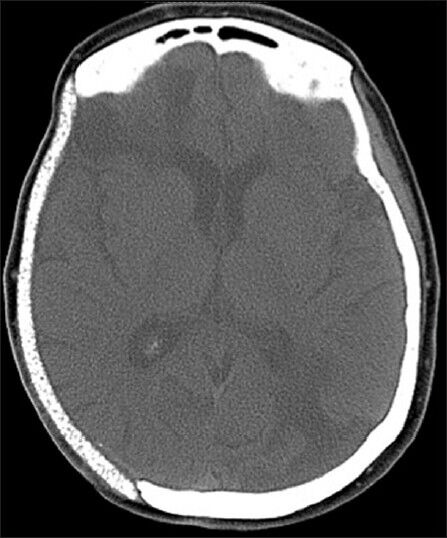
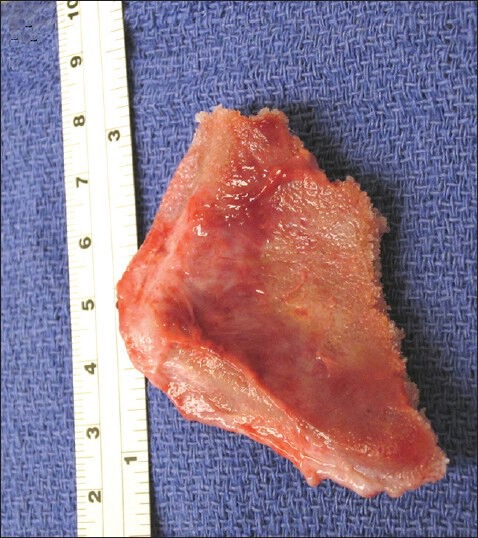
A 45-year-old woman sustained severe head trauma in a motor vehicle accident that required urgent surgical intervention. Because of progressive resorption of her native bone flap, she underwent replacement of her native flap with a hard tissue replacement/patient-matched implant cranioplasty. Eight years later, she sustained a traumatic laceration over her vertex that necessitated removal of her cranioplastic implant because of persistent local infection. Intraoperatively, the dural flap was ingrowing and firmly adherent to the inside surface of the porous cranioplasty. After several failed attempts to remove the whole implant piecemeal, we attempted to dissect the dural flap from the brain surface to remove it together with the cranioplastic implant but exposure of the extensive cortical adhesions between the brain surface and the dural flap was compromised by the hard overlying cranioplastic implant. Despite our meticulous attempts to cut off these cortical adhesions, a perisylvian blood vessel was avulsed, resulting in intraparenchymal hemorrhage.
In this case, dural adhesion and ingrowth to the underside of the cranioplasty implant led to disastrous bleeding when the implant needed to be removed years after initial implantation.
当必须更换大骨瓣或存在复杂或关键轮廓时,尤其是在面部附近,会使用定制植入物进行颅骨修复重建。这些植入物的并发症发生率较低,贴合不佳和术后感染是最常见的并发症。我们在此报告使用多孔植入物可能产生的一种潜在严重危害。
一名45岁女性在机动车事故中遭受严重头部创伤,需要紧急手术干预。由于其原生骨瓣逐渐吸收,她接受了用硬组织替代物/患者匹配植入物进行的颅骨成形术来替换原生骨瓣。八年后,她头顶遭受外伤性撕裂伤,由于局部感染持续存在,需要取出颅骨修复植入物。术中,硬脑膜瓣向内生长并牢固地附着在多孔颅骨成形术的内表面。在多次尝试逐块取出整个植入物失败后,我们试图将硬脑膜瓣从脑表面分离,以便与颅骨修复植入物一起取出,但硬脑膜瓣上方坚硬的颅骨修复植入物妨碍了暴露脑表面与硬脑膜瓣之间广泛的皮质粘连。尽管我们小心翼翼地试图切断这些皮质粘连,但一条大脑外侧裂血管被撕裂,导致脑实质内出血。
在本病例中,硬脑膜与颅骨修复植入物下侧的粘连和向内生长导致在初次植入多年后需要取出植入物时发生灾难性出血。