Jie Zhijun, Sun Wei, Wang Shanze, Koster Frederick, Li Bilan, Harrod Kevin S
Department of Respiratory Medicine, The Fifth People's Hospital of Shanghai, Fudan University, Shanghai, China.
Infectious Disease Program, Lovelace Respiratory Research Institute, Albuquerque, NM, USA.
Braz J Infect Dis. 2014 Jul-Aug;18(4):406-13. doi: 10.1016/j.bjid.2013.12.008. Epub 2014 Apr 26.
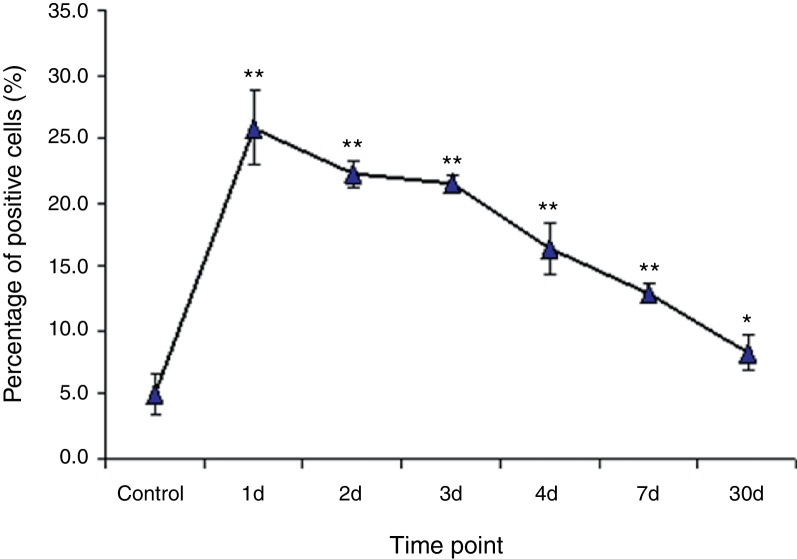
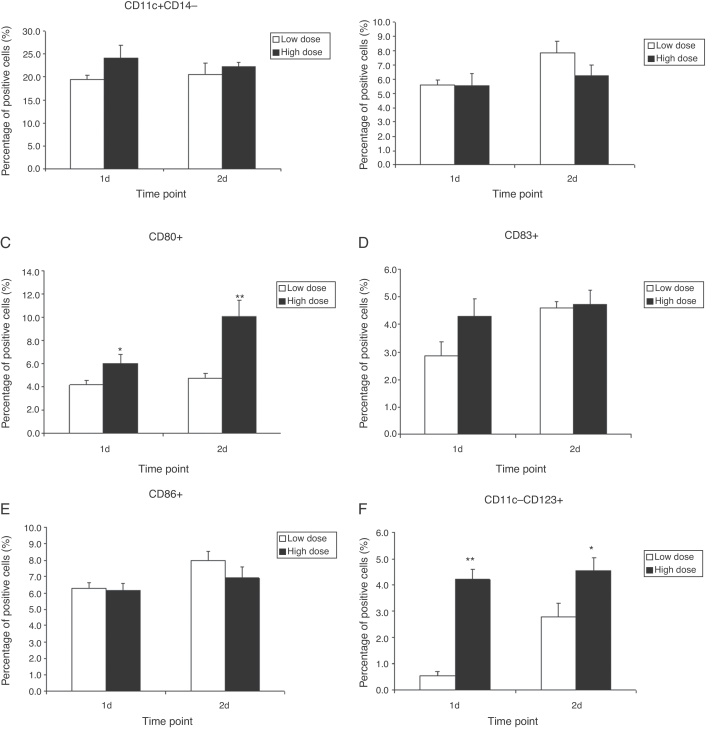
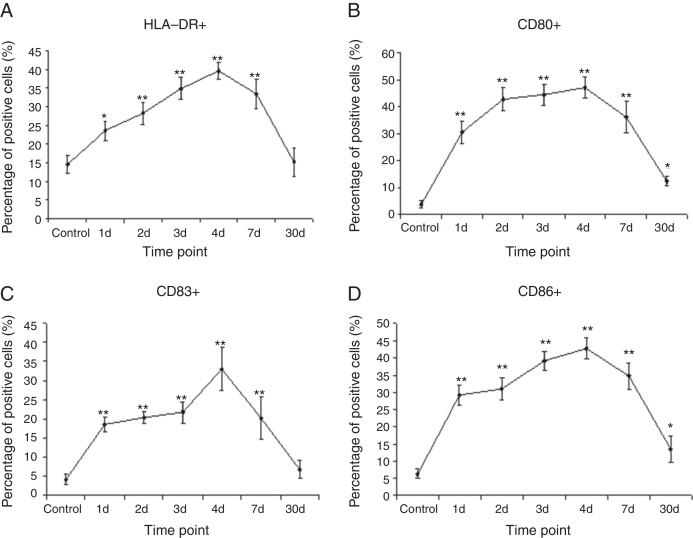
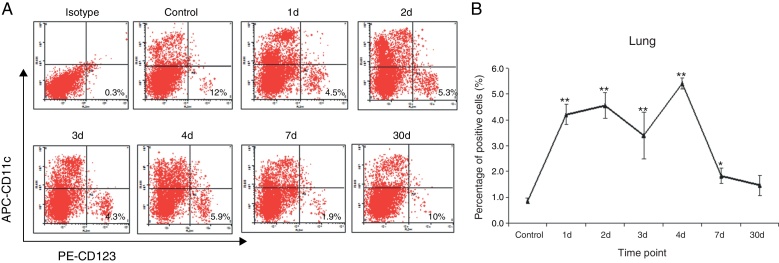
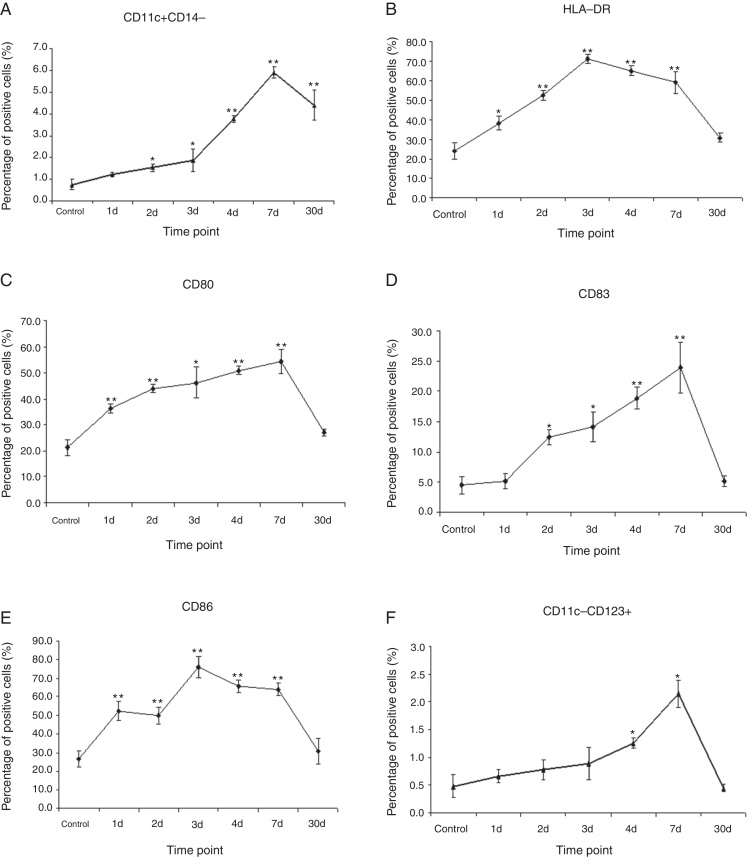
Dendritic cells (DCs) are readily infected by influenza viruses and play a crucial role in regulating host innate and adaptive immune responses to viral infection. The aims of this study are to characterize the dynamic changes in the numbers and maturation status of dendritic cells present in the lung and lung-associated lymph nodes (LALNs) in the model of a non-human primate (NHP) infected by influenza A virus (IAV). Cynomolgus macaques were infected with influenza A virus (H3N2) via bronchoscopy. Flow cytometry was used to analyze the DC numbers, maturation status and subsets during the time of acute infection (days 1, 2, 3, 4, 7) and the resolution phase (day 30). A dramatic increase in the numbers of influenza A virus-infected CD11c+CD14- myeloid dendritic cells (mDCs) and CD11c-CD123+ plasmacytoid dendritic cells (pDCs) were observed from day 1 to day 4 and peak up from day 7 post-infection. In lung and lung-associated lymph nodes, the numbers and maturation status of myeloid dendritic cells and plasmacytoid dendritic cells increased more slowly than those in the lung tissues. On day 30 post-infection, influenza A virus challenge increased the number of myeloid dendritic cells, but not plasmacytoid dendritic cells, compared with baseline. These findings indicate that dendritic cells are susceptible to influenza A virus infection, with the likely purpose of increasing mature myeloid dendritic cells numbers in the lung and lung and lung-associated lymph nodes, which provides important new insights into the regulation of dendritic cells in a non-human primate model.
树突状细胞(DCs)很容易被流感病毒感染,在调节宿主对病毒感染的固有免疫和适应性免疫反应中发挥关键作用。本研究的目的是在甲型流感病毒(IAV)感染的非人灵长类动物(NHP)模型中,表征肺和肺相关淋巴结(LALNs)中树突状细胞数量和成熟状态的动态变化。通过支气管镜检查将食蟹猴感染甲型流感病毒(H3N2)。使用流式细胞术分析急性感染期(第1、2、3、4、7天)和恢复期(第30天)的DC数量、成熟状态和亚群。从感染后第1天到第4天,观察到甲型流感病毒感染的CD11c+CD14-髓样树突状细胞(mDCs)和CD11c-CD123+浆细胞样树突状细胞(pDCs)数量急剧增加,并在感染后第7天达到峰值。在肺和肺相关淋巴结中,髓样树突状细胞和浆细胞样树突状细胞的数量和成熟状态的增加比肺组织中的增加更为缓慢。与基线相比,感染后第30天,甲型流感病毒攻击增加了髓样树突状细胞的数量,但没有增加浆细胞样树突状细胞的数量。这些发现表明,树突状细胞易受甲型流感病毒感染,其可能目的是增加肺和肺相关淋巴结中成熟髓样树突状细胞的数量,这为非人灵长类动物模型中树突状细胞的调节提供了重要的新见解。