1] Department of Urology, Federal Armed Forces Hospital, Hamburg 22049, Germany [2] Bundeswehr Institute of Radiobiology, Munich 80937, Germany.
1] Bundeswehr Institute of Radiobiology, Munich 80937, Germany [2] Department of Urology, Federal Armed Forces Central Hospital, Koblenz 56072, Germany.
Br J Cancer. 2014 May 27;110(11):2738-46. doi: 10.1038/bjc.2014.134. Epub 2014 May 1.
We aimed to better discriminate (occult) metastasised from non-metastasised seminoma based on transcriptional changes of small RNAs in the primary tumour.
Total RNAs including small RNAs were isolated from five testicular tumours of each, lymphogenic, occult and non-metastasised patients. Next-generation sequencing (SOLID, Life Technologies) was used to examine transcriptional changes. Small RNAs showing ⩾50 reads and a significant ⩾2-fold difference using non-metastasised tumours as the reference group were examined in univariate logistic regression analysis and combinations of two small RNAs were further examined using support vector machines.
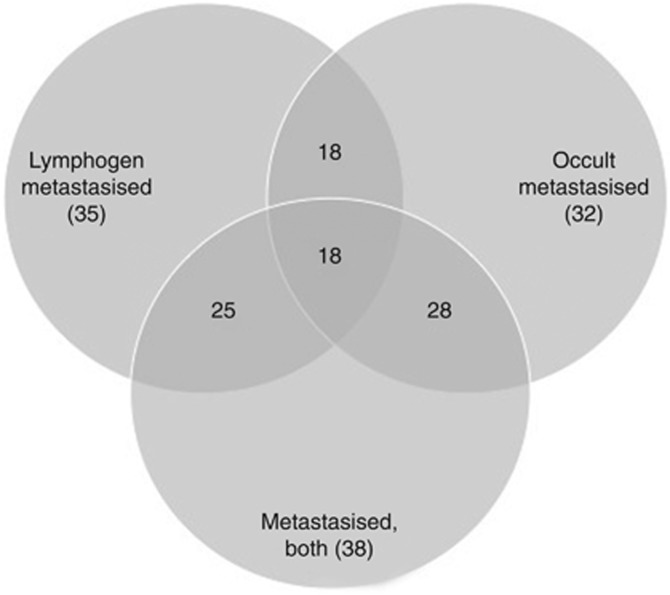
On average, 1.3 × 10(7), 1.4 × 10(7) and 1.7 × 10(7) small RNA reads were detectable in non-metastasised, occult and lymphogenic metastasised seminoma, respectively, of which 30-32% remained after trimming. Between 59 and 68% represented annotated reads and between 8.6 and 11% were annotated small RNA tags. Of them, 137 small RNAs showed>50 reads and a two-fold difference to the reference. In univariate analysis, 32-38 small RNAs significantly discriminated lymphogenic/occult from non-metastasised seminoma, and among these different comparisons, it were the same small RNAs in 51-88%. Many combinations of two of these small RNAs allowed a complete discrimination of metastasised from non-metastasised seminoma irrespective of the metastasis subtype.
Metastasised and non-metastasised seminoma can be completely discriminated with a combination of two small RNAs.
我们旨在通过原发肿瘤中小 RNA 的转录变化更好地区分(隐匿性)转移与非转移的精原细胞瘤。
从每个淋巴转移、隐匿性和非转移的患者的五个睾丸肿瘤中分离总 RNA 包括小 RNA。使用下一代测序(SOLID,Life Technologies)来检查转录变化。使用非转移肿瘤作为参考组,使用单变量逻辑回归分析检查显示 ⩾50 个读数且差异显著 ⩾2 倍的小 RNA,并使用支持向量机进一步检查两个小 RNA 的组合。
平均而言,非转移、隐匿性和淋巴转移的精原细胞瘤分别可检测到 1.3×10(7)、1.4×10(7)和 1.7×10(7)个小 RNA 读数,其中修剪后保留了 30-32%。其中 59-68%代表注释的读数,8.6-11%为注释的小 RNA 标签。其中,有 137 个小 RNA 的读数>50 且与参考值相差两倍。在单变量分析中,32-38 个小 RNA 可显著区分淋巴转移/隐匿性与非转移的精原细胞瘤,在这些不同的比较中,有 51-88%的小 RNA 是相同的。这些小 RNA 中的两个组合可以完全区分转移和非转移的精原细胞瘤,而与转移亚型无关。
转移和非转移的精原细胞瘤可以通过两个小 RNA 的组合完全区分。