Cai Jinquan, Yang Pei, Zhang Chuanbao, Zhang Wei, Liu Yanwei, Bao Zhaoshi, Liu Xing, Du Wenzhong, Wang Hongjun, Jiang Tao, Jiang Chuanlu
Department of Neurosurgery, The Second Affiliated Hospital of Harbin Medical University, Harbin, China.
Oncotarget. 2014 May 15;5(9):2551-61. doi: 10.18632/oncotarget.1838.
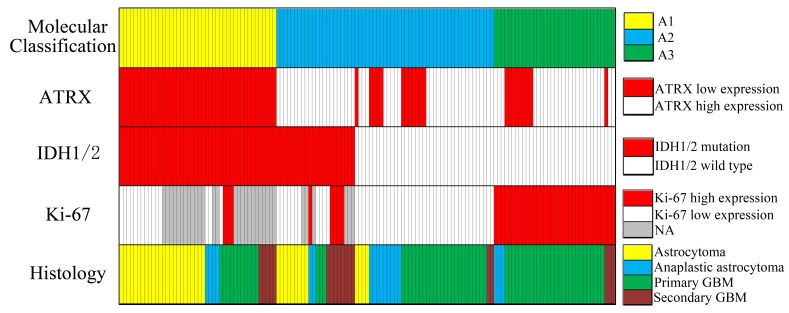
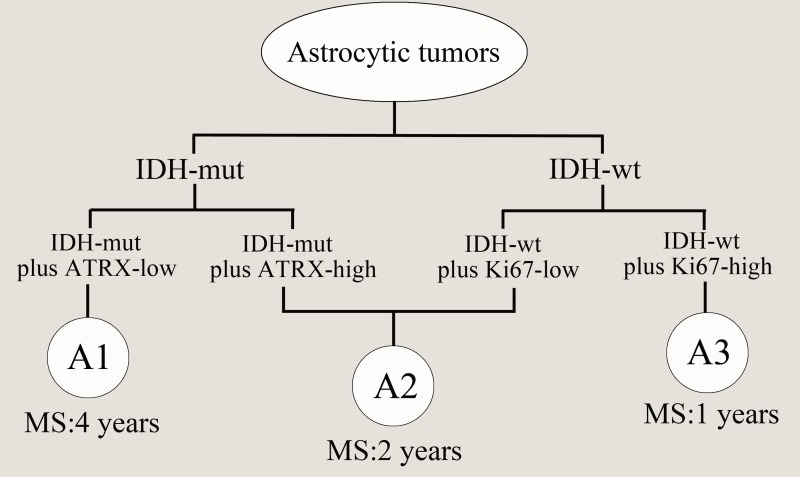
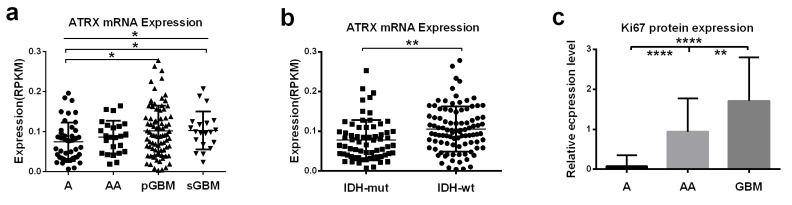
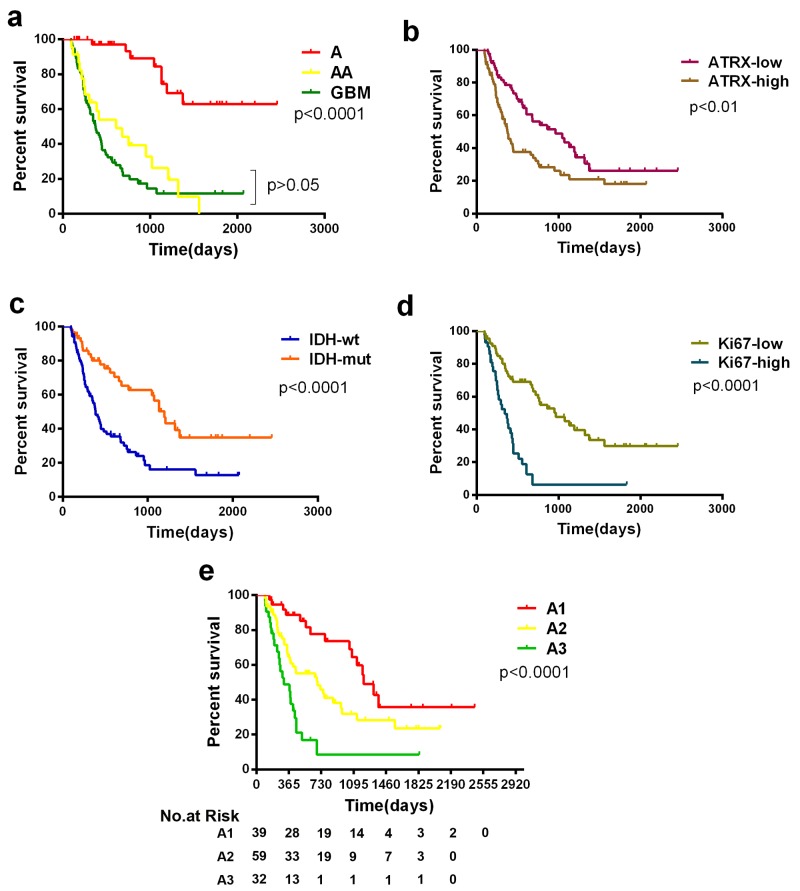
Astrocytic tumors are the most common primary brain tumors in adults. ATRX mutations have been identified in gliomas and are correlated with its loss of expression, which causes alternative lengthening of telomeres (ALT) leading to genomic instability. In this study, we aimed to explore the role of ATRX mRNA expression alteration in the progression and subclassification of astrocytic tumors and examine its impact on clinical outcome. We investigated ATRX mRNA expression and its association with IDH1 and IDH2 mutations in 169 adult astrocytic tumors using whole transcriptome sequencing. In our cohort, low ATRX mRNA expression was detected in 68% of astrocytomas, 50% of anaplastic astrocytomas and 41.6% of glioblastomas. Low ATRX expression closely overlapped with mutations in IDH1/2 (P<0.0001) in astrocytic tumors across WHO grades II-IV. Significant association between low ATRX expression and longer overall survival was identified in our cohort (P<0.01). ATRX combined with IDH1/2 and Ki-67 was used to re-classify patients with astrocytic tumors: group A1 containing IDH1/2 mutations and low ATRX expression predicted a better prognostic outcome, whereas group A3 carrying wild-type IDH1/2 and high Ki-67 expression had the shortest overall survival; IDH-mutant tumors with low ATRX expression and IDH-wild-type tumors with high Ki-67 expression were grouped into group A2. In summary, our results showed that ATRX in cooperation with IDH1/2 and Ki-67 defines three subgroups of astrocytic tumors regardless of the conventional WHO grades consensus. The molecular stratification in astrocytic tumors may aid in treatment strategy selection, therapeutic trial design, and clinical prognosis evaluation.
星形细胞瘤是成人中最常见的原发性脑肿瘤。已在胶质瘤中鉴定出ATRX突变,且其与表达缺失相关,这会导致端粒替代延长(ALT),进而导致基因组不稳定。在本研究中,我们旨在探讨ATRX mRNA表达改变在星形细胞瘤进展和亚分类中的作用,并研究其对临床结局的影响。我们使用全转录组测序研究了ATRX mRNA表达及其与169例成人星形细胞瘤中IDH1和IDH2突变的关联。在我们的队列中,68%的星形细胞瘤、50%的间变性星形细胞瘤和41.6%的胶质母细胞瘤中检测到低ATRX mRNA表达。在WHO II-IV级的星形细胞瘤中,低ATRX表达与IDH1/2突变密切重叠(P<0.0001)。在我们的队列中,发现低ATRX表达与更长的总生存期之间存在显著关联(P<0.01)。ATRX联合IDH1/2和Ki-67用于对星形细胞瘤患者进行重新分类:A1组包含IDH1/2突变且ATRX表达低,预测预后较好,而携带野生型IDH1/2和高Ki-67表达的A3组总生存期最短;低ATRX表达的IDH突变型肿瘤和高Ki-67表达的IDH野生型肿瘤归为A2组。总之,我们的结果表明,无论传统的WHO分级共识如何,ATRX与IDH1/2和Ki-67共同定义了星形细胞瘤的三个亚组。星形细胞瘤的分子分层可能有助于治疗策略的选择、治疗试验的设计和临床预后评估。