Graduate School of Medical Science and Engineering (GSMSE), Korea Advanced Institute of Science and Technology (KAIST), 291 Daehak-ro, Yuseong-gu, Daejeon 305-701, Korea.
Department of Urology, Seoul National University Hospital, 101 Daehak-ro, Jongno-gu, Seoul 110-744, Korea.
Int J Mol Sci. 2014 May 8;15(5):8106-21. doi: 10.3390/ijms15058106.
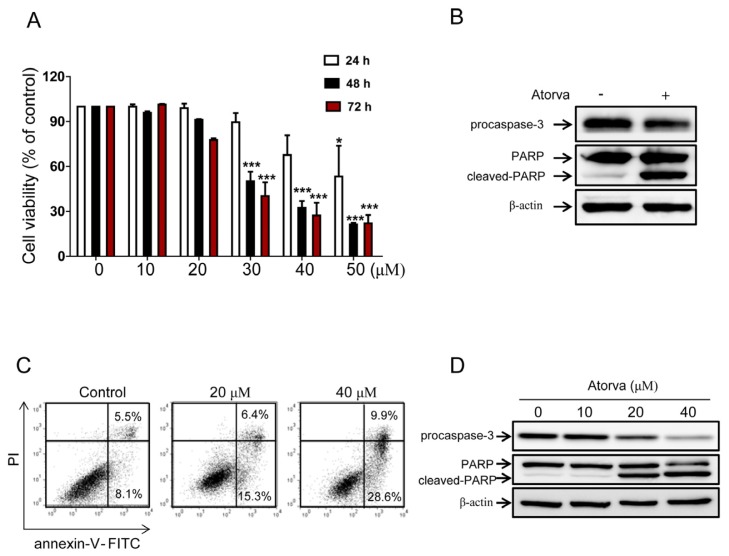
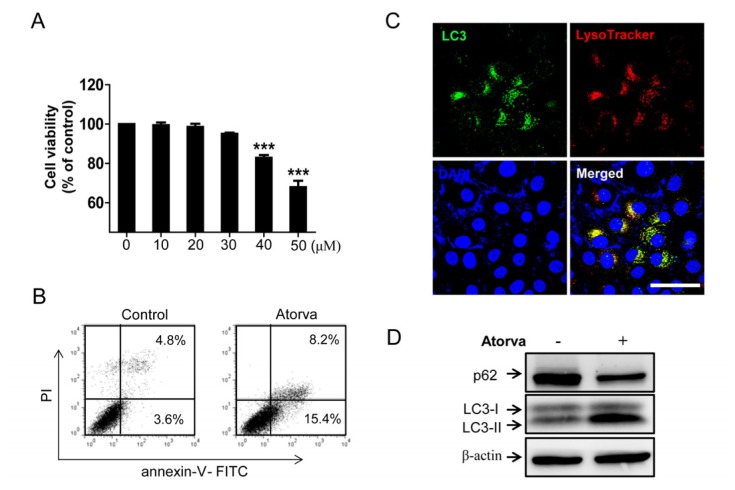
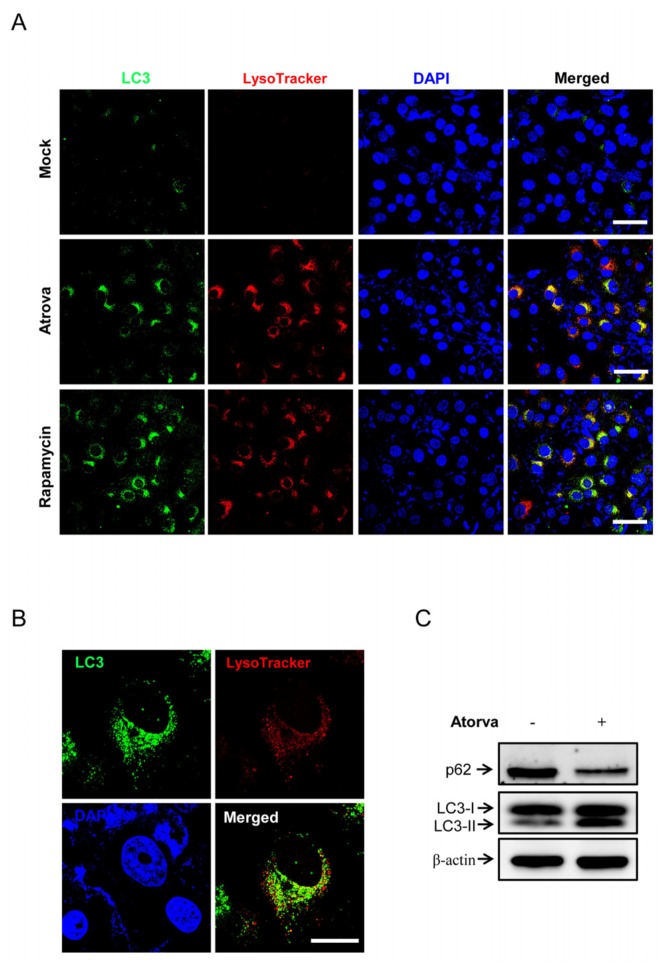
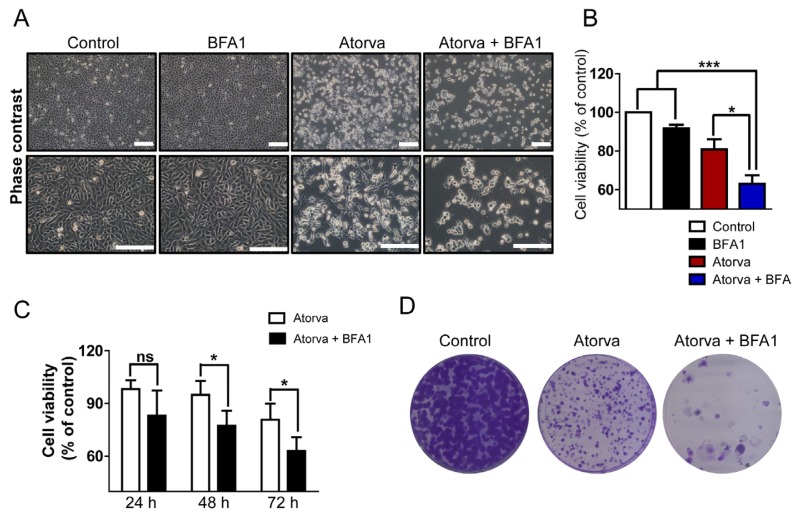
Statins are cholesterol reduction agents that exhibit anti-cancer activity in several human cancers. Because autophagy is a crucial survival mechanism for cancer cells under stress conditions, cooperative inhibition of autophagy acts synergistically with other anti-cancer drugs. Thus, this study investigates whether combined treatment of atorvastatin and autophagy inhibitors results in enhancing the cytotoxic effects of atorvastatin, upon human bladder cancer cells, T24 and J82, in vitro. To measure cell viability, we performed the EZ-Cytox cell viability assay. We examined apoptosis by flow cytometry using annexin-V/propidium iodide (PI and western blot using procaspase-3 and poly (ADP-ribose) polymerase (PARP) antibodies. To examine autophagy activation, we evaluated the co-localization of LC3 and LysoTracker by immunocytochemistry, as well as the expression of LC3 and p62/sequestosome-1 (SQSTM1) by western blot. In addition, we assessed the survival and proliferation of T24 and J82 cells by a clonogenic assay. We found that atorvastatin reduced the cell viability of T24 and J82 cells via apoptotic cell death and induced autophagy activation, shown by the co-localization of LC3 and LysoTracker. Moreover, pharmacologic inhibition of autophagy significantly enhanced atorvastatin-induced apoptosis in T24 and J82 cells. In sum, inhibition of autophagy potentiates atorvastatin-induced apoptotic cell death in human bladder cancer cells in vitro, providing a potential therapeutic approach to treat bladder cancer.
他汀类药物是降低胆固醇的药物,在几种人类癌症中表现出抗癌活性。由于自噬是癌细胞在应激条件下的关键生存机制,因此自噬的协同抑制与其他抗癌药物具有协同作用。因此,本研究探讨了阿托伐他汀与自噬抑制剂联合治疗是否会增强阿托伐他汀对体外人膀胱癌细胞 T24 和 J82 的细胞毒性作用。为了测量细胞活力,我们进行了 EZ-Cytox 细胞活力测定。我们通过流式细胞术使用 Annexin-V/碘化丙啶 (PI) 检测细胞凋亡,并用 procaspase-3 和多聚 (ADP-核糖) 聚合酶 (PARP) 抗体进行 Western blot。为了检测自噬激活,我们通过免疫细胞化学评估 LC3 和 LysoTracker 的共定位,以及通过 Western blot 评估 LC3 和 p62/自噬体 1 (SQSTM1) 的表达。此外,我们通过集落形成测定评估 T24 和 J82 细胞的存活和增殖。我们发现阿托伐他汀通过凋亡性细胞死亡降低 T24 和 J82 细胞的细胞活力,并通过 LC3 和 LysoTracker 的共定位诱导自噬激活。此外,自噬的药理抑制显著增强了 T24 和 J82 细胞中阿托伐他汀诱导的细胞凋亡。总之,抑制自噬增强了阿托伐他汀诱导的人膀胱癌细胞体外凋亡细胞死亡,为治疗膀胱癌提供了一种潜在的治疗方法。