Wu Haiyin, O'Neill Brian, Han Dawn D, Thirtamara-Rajamani Keerthi, Wang Yanlin, Gu Howard H
Department of Anesthesiology, Zhongnan Hospital of Wuhan University, 169 Donghu Road, Wuhan 430071, Hubei, China; Department of Pharmacology, The Ohio State University, Columbus, OH 43210, USA.
Department of Pharmacology, The Ohio State University, Columbus, OH 43210, USA.
Neuropharmacology. 2014 Nov;86:31-7. doi: 10.1016/j.neuropharm.2014.04.022. Epub 2014 May 13.
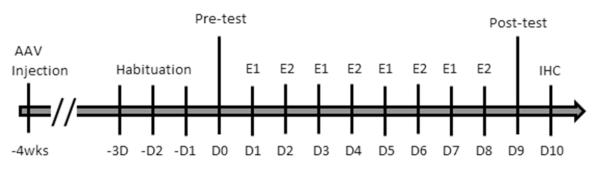
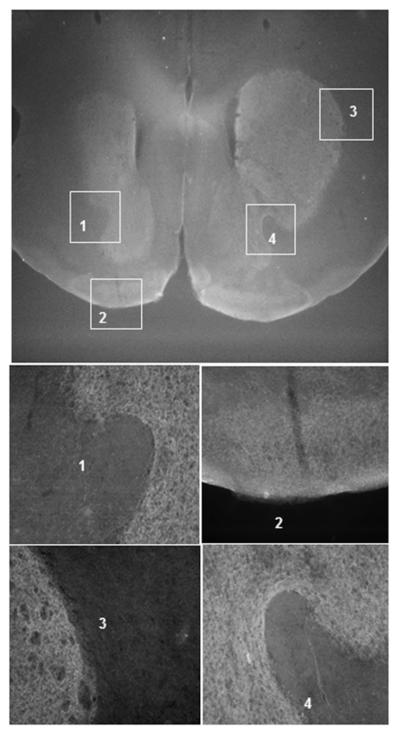
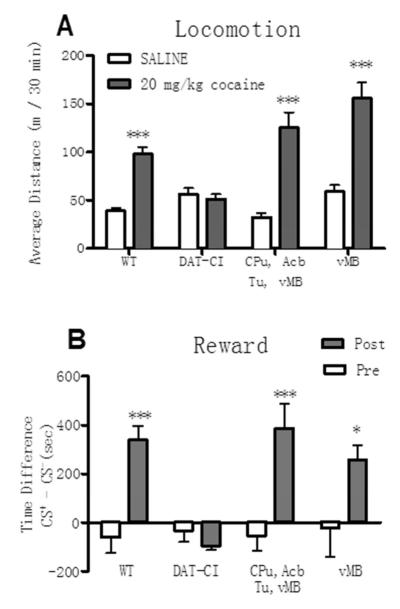
In previous studies, we generated knock-in mice with a cocaine-insensitive dopamine transporter (DAT-CI mice) and found cocaine does not stimulate locomotion or produce reward in these mice, indicating DAT inhibition is necessary for cocaine stimulation and reward. However, DAT uptake is reduced in DAT-CI mice and thus the lack of cocaine responses could be due to adaptive changes. To test this, we used adeno-associated virus (AAV) to reintroduce the cocaine-sensitive wild type DAT (AAV-DATwt) back into adult DAT-CI mice, which restores cocaine inhibition of DAT in affected brain regions but does not reverse the adaptive changes. In an earlier study we showed that AAV-DATwt injections in regions covering the lateral nucleus accumbens (NAc) and lateral caudate-putamen (CPu) restored cocaine stimulation but not cocaine reward. In the current study, we expanded the AAV-DATwt infected areas to cover the olfactory tubercle (Tu) and the ventral midbrain (vMB) containing the ventral tegmental area (VTA) and substantia nigra (SN) in addition to CPu and NAc with multiple injections. These mice displayed the restoration of both locomotor stimulation and cocaine reward. We further found that AAV-DATwt injection in the vMB alone was sufficient to restore both cocaine stimulation and reward in DAT-CI mice. AAV injected in the VTA and SN resulted in DATwt expression and distribution to the DA terminal regions. In summary, cocaine induced locomotion and reward can be restored in fully developed DAT-CI mice, and cocaine inhibition of DAT expressed in dopaminergic neurons originated from the ventral midbrain mediates cocaine reward and stimulation.
在先前的研究中,我们构建了具有对可卡因不敏感的多巴胺转运体的敲入小鼠(DAT-CI小鼠),并发现可卡因不会刺激这些小鼠的运动或产生奖赏效应,这表明DAT抑制对于可卡因刺激和奖赏是必需的。然而,DAT-CI小鼠中DAT摄取减少,因此缺乏可卡因反应可能是由于适应性变化。为了验证这一点,我们使用腺相关病毒(AAV)将对可卡因敏感的野生型DAT(AAV-DATwt)重新导入成年DAT-CI小鼠体内,这恢复了受影响脑区中可卡因对DAT的抑制作用,但并未逆转适应性变化。在早期的一项研究中,我们表明在覆盖伏隔核外侧核(NAc)和尾状核-壳核外侧(CPu)的区域注射AAV-DATwt可恢复可卡因刺激,但不能恢复可卡因奖赏。在当前的研究中,我们通过多次注射将AAV-DATwt感染区域扩大到除了CPu和NAc之外,还覆盖嗅结节(Tu)和包含腹侧被盖区(VTA)和黑质(SN)的腹侧中脑(vMB)。这些小鼠表现出运动刺激和可卡因奖赏的恢复。我们进一步发现,单独在vMB中注射AAV-DATwt足以恢复DAT-CI小鼠的可卡因刺激和奖赏。在VTA和SN中注射AAV导致DATwt表达并分布到多巴胺能终末区域。总之,在完全发育的DAT-CI小鼠中可恢复可卡因诱导的运动和奖赏,并且源自腹侧中脑的多巴胺能神经元中表达的可卡因对DAT的抑制介导了可卡因奖赏和刺激。