Division of Hematology/Oncology, University of North Carolina, Chapel Hill, NC.
Am J Hematol. 2014 Sep;89(9):907-14. doi: 10.1002/ajh.23762. Epub 2014 Jun 19.
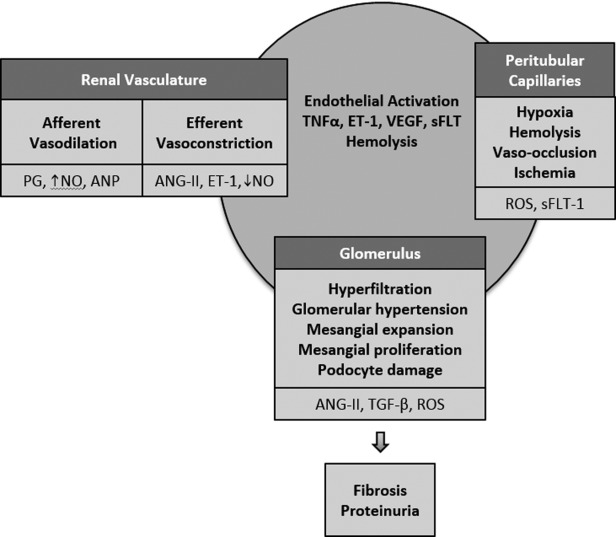
Sickle cell disease (SCD) produces many structural and functional abnormalities in the kidney, including glomerular abnormalities. Albuminuria is the most common manifestation of glomerular damage, with a prevalence between 26 and 68% in adult patients. The pathophysiology of albuminuria in SCD is likely multifactorial, with contributions from hyperfiltration, glomerular hypertension, ischemia-reperfusion injury, oxidative stress, decreased nitric oxide (NO) bioavailability, and endothelial dysfunction. Although its natural history in SCD remains inadequately defined, albuminuria is associated with increased echocardiography-derived tricuspid regurgitant jet velocity, systemic blood pressure, and hypertension, as well as history of stroke, suggesting a shared vasculopathic pathophysiology. While most patients with albuminuria are treated with angiotensin converting enzyme inhibitors/angiotensin receptor blockers, there are no published long-term data on the efficacy of these agents. With the improved patient survival following kidney transplantation, SCD patients with end-stage renal disease should be considered for this treatment modality. Given the high prevalence of albuminuria and its association with multiple SCD-related clinical complications, additional studies are needed to answer several clinically important questions in a bid to adequately elucidate its pathophysiology, natural history, and treatment.
镰状细胞病(SCD)可导致肾脏发生许多结构和功能异常,包括肾小球异常。白蛋白尿是肾小球损伤最常见的表现,在成年患者中的患病率为 26%至 68%。SCD 患者白蛋白尿的病理生理学可能是多因素的,涉及高滤过、肾小球高血压、缺血再灌注损伤、氧化应激、一氧化氮(NO)生物利用度降低和内皮功能障碍。尽管 SCD 中白蛋白尿的自然史仍未得到充分定义,但白蛋白尿与增加的超声心动图衍生三尖瓣反流射流速度、全身血压和高血压以及中风病史相关,提示存在共同的血管病理生理学。虽然大多数白蛋白尿患者接受血管紧张素转换酶抑制剂/血管紧张素受体阻滞剂治疗,但这些药物的疗效尚无长期数据。随着肾移植后患者生存率的提高,终末期肾病的 SCD 患者应考虑这种治疗方式。鉴于白蛋白尿的高患病率及其与多种 SCD 相关临床并发症的关联,需要进一步研究以回答一些临床上重要的问题,以充分阐明其病理生理学、自然史和治疗方法。