Denue Ballah Akawu, Kida Ibrahim Musa, Hammagabdo Ahmed, Dayar Ayuba, Sahabi Mohammed Abubakar
Department of Medicine, University of Maiduguri Teaching Hospital, PMB 1414, Maiduguri, Borno State, Nigeria.
Infect Dis (Auckl). 2013 Mar 20;6:25-33. doi: 10.4137/IDRT.S10477. eCollection 2013.
There are conflicting reports on the impact of highly active antiretroviral therapy (HAART) in resolving hematological complications. Whereas some studies have reported improvements in hemoglobin and other hematological parameters resulting in reduction in morbidity and mortality of HIV patients, others have reported no improvement in hematocrit values of HAART-treated HIV patients compared with HAART-naïve patients.
This current study was designed to assess the impact of HAART in resolving immunological and hematological complications in HIV patients by comparatively analyzing the results (immunological and hematological) of HAART-naive patients and those on HAART in our environment.
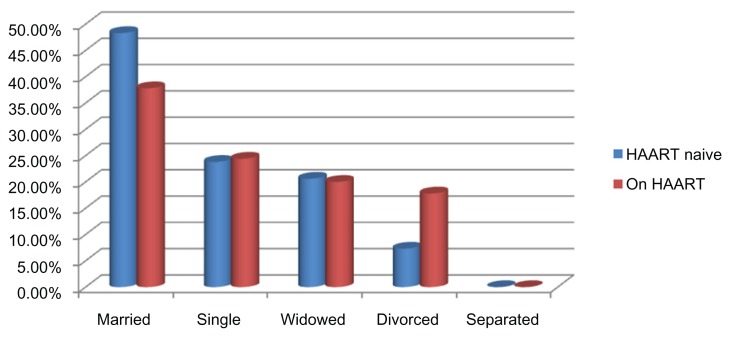
A total of 500 patients participated, consisting of 315 HAART-naive (119 males and 196 females) patients and 185 HAART-experienced (67 males and 118 females) patients. Hemoglobin (Hb), CD4+ T-cell count, total white blood count (WBC), lymphocyte percentage, plateletes, and plasma HIV RNA were determined.
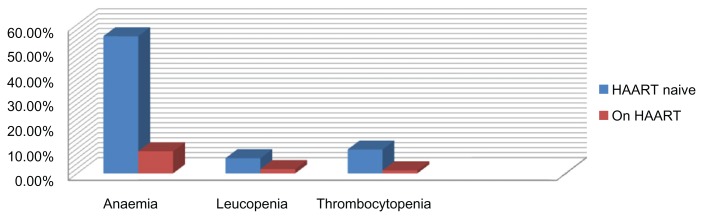
HAART-experienced patients were older than their HAART-naive counterparts. In HAART-naive patients, the incidence of anemia (packed cell volume [PCV] <30%) was 57.5%, leukopenia (WBC < 2.5), 6.1%, and thrombocytopenia < 150, 9.6%; it was, significantly higher compared with their counterparts on HAART (24.3%, 1.7%, and 1.2%, respectively). The use of HAART was not associated with severe anemia. Of HAART-naive patients, 57.5% had a CD4 count < 200 cells/μL in comparison with 20.4% of HAART-experienced patients (P < 0.001). The mean viral load log10 was significantly higher in HAART-naive than in HAART-experienced patients (P < 0.001). Total lymphocyte count < 1.0 was a significant predictor of <CD4 counts < 200 cells/μL in HAART-naïve patients, but this relationship was not observed in HAART-experienced patients.
HAART has the capability of reducing the incidence of anemia, other deranged hematological and immunological parameters associated with disease progression, and death in HIV-infected patients. Total lymphocyte count fails to predict CD4 count < 200 cells/μL in our cohort; thus, its use in the management and monitoring of HIV-infected patients in our settings is not reliable.
关于高效抗逆转录病毒疗法(HAART)对解决血液学并发症的影响,存在相互矛盾的报道。一些研究报告称,血红蛋白和其他血液学参数有所改善,从而降低了HIV患者的发病率和死亡率;而另一些研究则报告称,与未接受HAART治疗的患者相比,接受HAART治疗的HIV患者的血细胞比容值没有改善。
本研究旨在通过比较分析未接受HAART治疗的患者和在我们环境中接受HAART治疗的患者的结果(免疫学和血液学),评估HAART对解决HIV患者免疫和血液学并发症的影响。
共有500名患者参与,包括315名未接受HAART治疗的患者(119名男性和196名女性)和185名有HAART治疗经验的患者(67名男性和118名女性)。测定了血红蛋白(Hb)、CD4+T细胞计数、白细胞总数(WBC)、淋巴细胞百分比、血小板和血浆HIV RNA。
有HAART治疗经验的患者比未接受HAART治疗的患者年龄更大。在未接受HAART治疗的患者中,贫血(红细胞压积[PCV]<30%)的发生率为57.5%,白细胞减少(WBC<2.5)为6.1%,血小板减少<150为9.6%;与接受HAART治疗的患者相比,这些发生率显著更高(分别为24.3%、1.7%和1.2%)。使用HAART与严重贫血无关。未接受HAART治疗的患者中,57.5%的CD4计数<200个细胞/μL,而有HAART治疗经验的患者为20.4%(P<0.001)。未接受HAART治疗的患者的平均病毒载量log10显著高于有HAART治疗经验的患者(P<0.001)。在未接受HAART治疗的患者中,总淋巴细胞计数<1.0是CD4计数<200个细胞/μL的显著预测指标,但在有HAART治疗经验的患者中未观察到这种关系。
HAART有能力降低贫血、与疾病进展相关的其他血液学和免疫学参数紊乱以及HIV感染患者死亡的发生率。在我们的队列中,总淋巴细胞计数无法预测CD4计数<200个细胞/μL;因此,在我们的环境中,其在HIV感染患者的管理和监测中的应用不可靠。