Wang Hongxuan, Tang Yamei, Rong Xiaoming, Li Hui, Pan Rui, Wang Yidong, Peng Ying
Department of Neurology, Sun Yat-sen Memorial Hospital, Sun Yat-sen University, Guangzhou, Guangdong Province, China.
PLoS One. 2014 May 22;9(5):e97917. doi: 10.1371/journal.pone.0097917. eCollection 2014.
Hypertension is common after acute stroke onset. Previous studies showed controversial effects of early blood pressure (BP) lowering on stroke outcomes. The aim of this study is to assess the effects of early BP lowering on early and long-term outcomes after acute stroke.
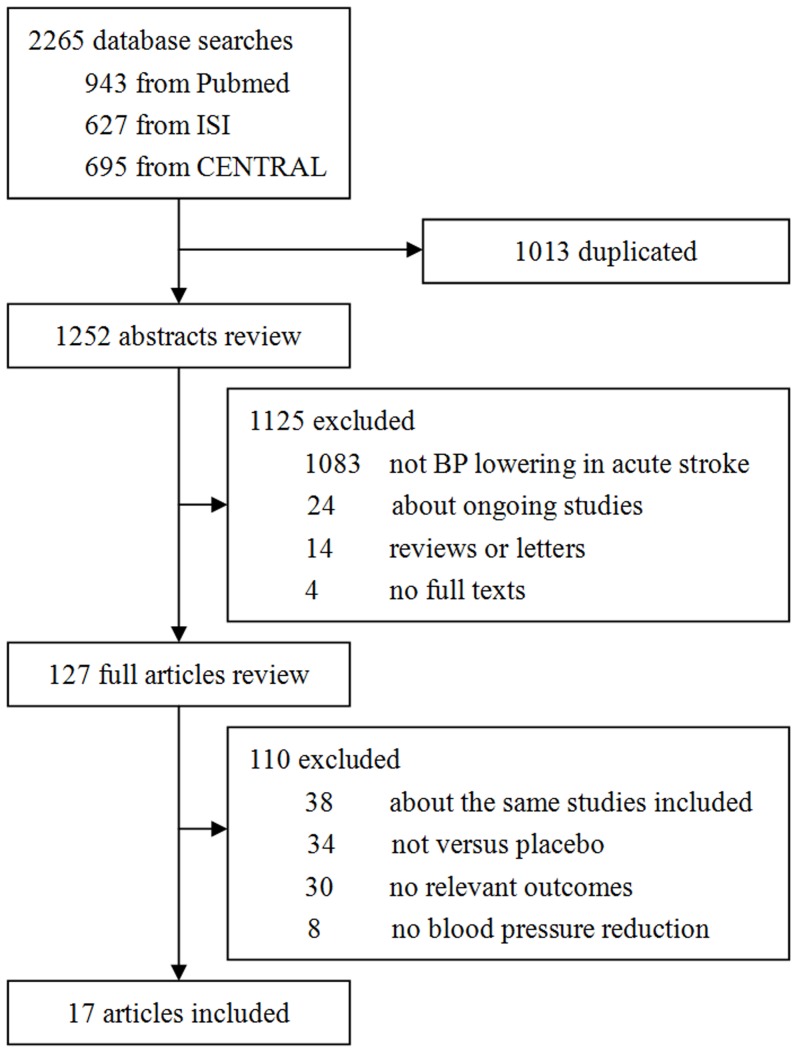
A meta-analysis was conducted with prospective randomized controlled trials assessing the effects of early BP lowering on early and long-term outcomes after acute stroke compared with placebo. Literature searching was performed in the databases from inception to December 2013. New evidence from recent trials were included. Outcomes were analyzed as early (within 30 days) and long-term (from 3 to 12 months) endpoints using summary estimates of relative risks (RR) and their 95% confidence intervals (CI) with the fixed-effect model or random-effect model.
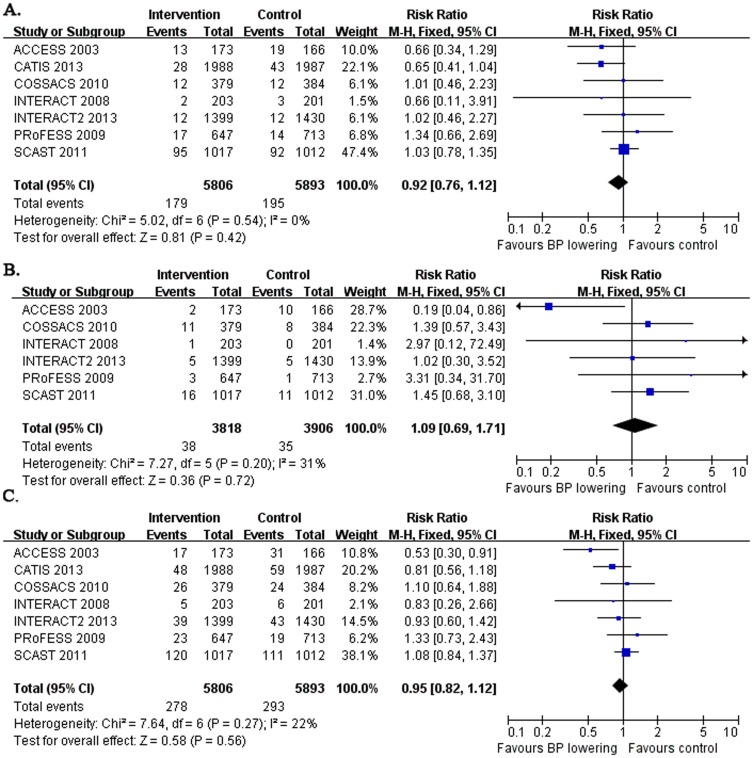
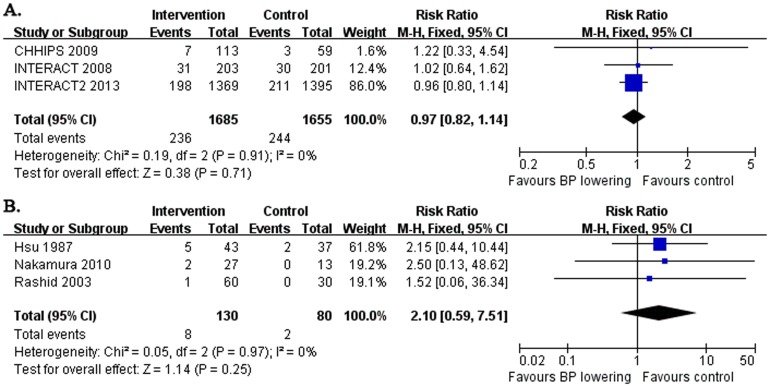
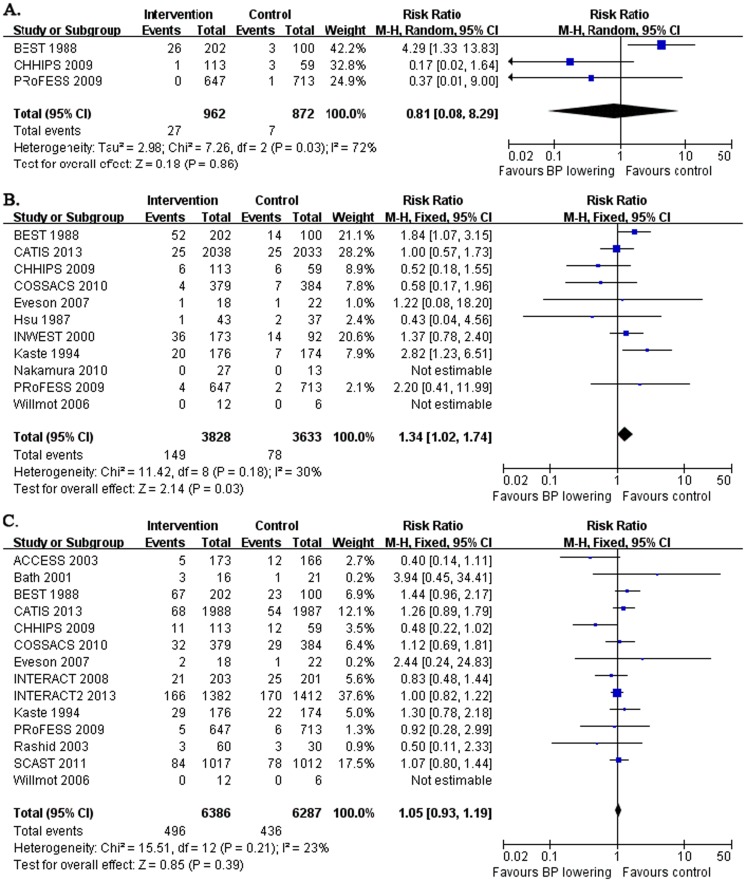
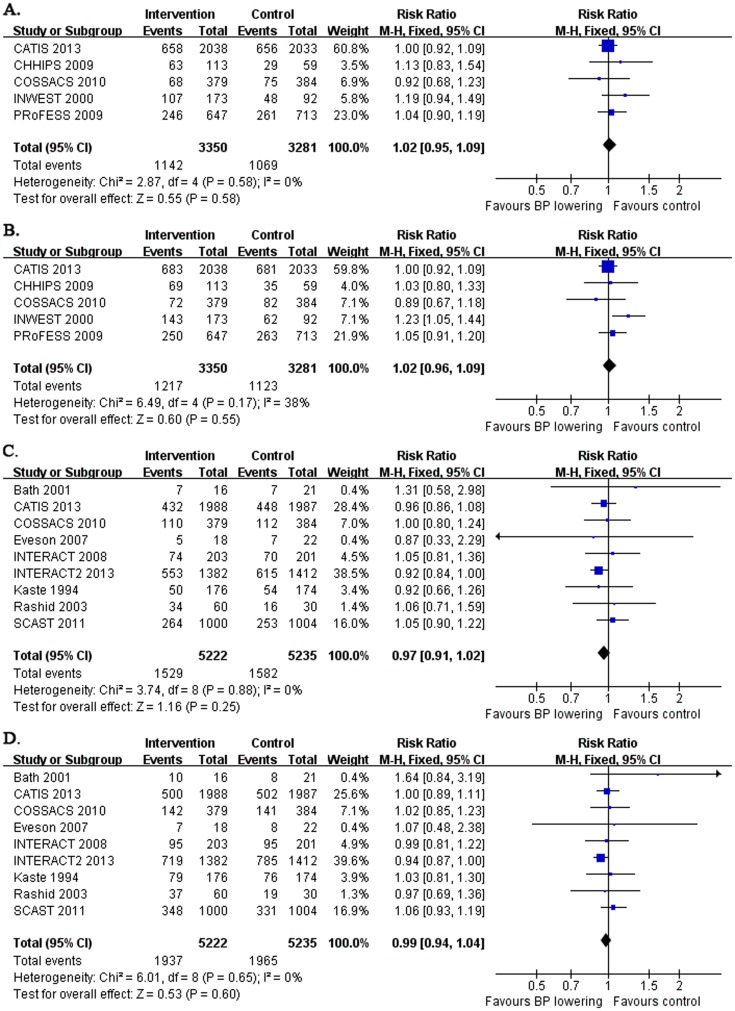
Seventeen trials providing data from 13236 patients were included. Pooled results showed that early BP lowering after acute stroke onset was associated with more death within 30 days compared with placebo (RR: 1.34 and 95% CI: 1.02, 1.74, p = 0.03). However the results showed that early BP lowering had no evident effect on early neurological deterioration, early death within 7 days, long-term death, early and long-term dependency, early and long-term combination of death or dependency, long-term stroke recurrence, long-term myocardial infarction and long-term CVE.
The new results lend no support to early BP lowering after acute stroke. Early BP lowering may increase death within 30 days after acute stroke.
急性卒中发病后高血压很常见。既往研究显示早期降低血压对卒中预后的影响存在争议。本研究旨在评估急性卒中后早期降低血压对早期及长期预后的影响。
进行一项荟萃分析,纳入前瞻性随机对照试验,比较早期降低血压与安慰剂对急性卒中后早期及长期预后的影响。检索从数据库建库至2013年12月的文献。纳入近期试验的新证据。采用固定效应模型或随机效应模型,以相对危险度(RR)及其95%置信区间(CI)的汇总估计值,将结局分析为早期(30天内)和长期(3至12个月)终点。
纳入17项试验,提供了13236例患者的数据。汇总结果显示,与安慰剂相比,急性卒中发病后早期降低血压与30天内更多死亡相关(RR:1.34,95%CI:1.02,1.74,p = 0.03)。然而,结果显示早期降低血压对早期神经功能恶化、7天内早期死亡、长期死亡、早期和长期依赖、早期和长期死亡或依赖的合并情况、长期卒中复发、长期心肌梗死和长期心血管事件无明显影响。
新结果不支持急性卒中后早期降低血压。早期降低血压可能增加急性卒中后30天内的死亡。