Guo Hongjuan, Zhu Guangfa, Wu Chunting
Department of Respiratory and Critical Care Medicine, Beijing Anzhen Hospital, Capital Medical University; Beijing Institute of Heart, Lung and Blood Vessel Diseases, Beijing 100029, China.
Zhongguo Fei Ai Za Zhi. 2014 May;17(5):369-77. doi: 10.3779/j.issn.1009-3419.2014.05.02.
Nuclear factor-κB is an important transcription factor and is closely associated with a variety of malignant tumors. The biological behavior of lung tumor cells can be reversed by inhibiting the expression of NF-κBp65 directly or indirectly. Nuclear factor-κBp65 gene shRNA recombinant plasmids were constructed and then infected with A549 cells. New stable cell lines were selected, and the ability of migration and adhesion was identified.
Both scramble control sequence and interference sequence (shRNA) of human nuclear factor-κBp65 were designed and synthesized to build recombinant plasmids, with BamH I site at the 5' end and Xho I and EcoR I sites at the 3' end. A549 cells were infected, and stable transfection strains were selected by puromycin. Western blot and qRT-PCR methods were applied to assess the interference efficient of NF-κBp65 and the protein expression level of IκBα. Transwell and MTT assays were carried out to analyze the ability of migration and adhesion of A549 cells separately.
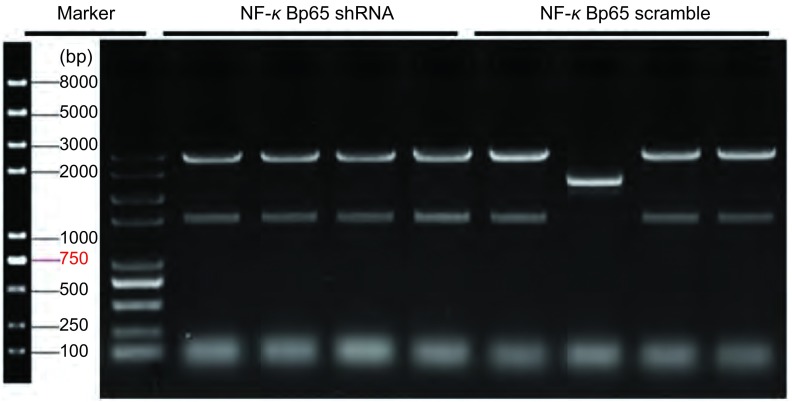
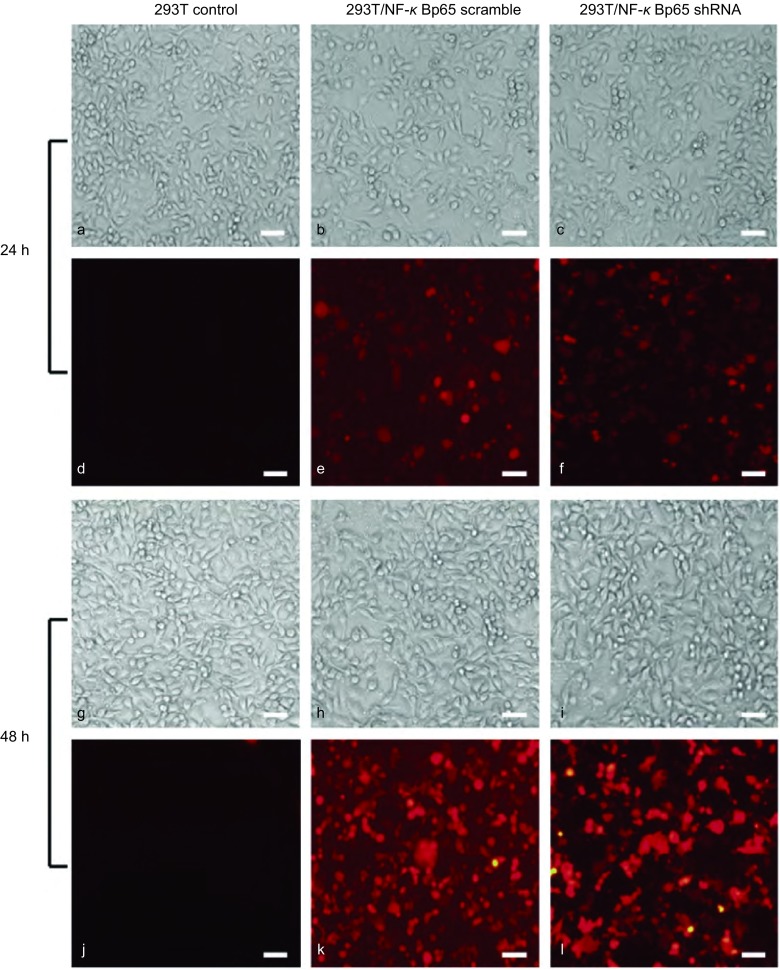
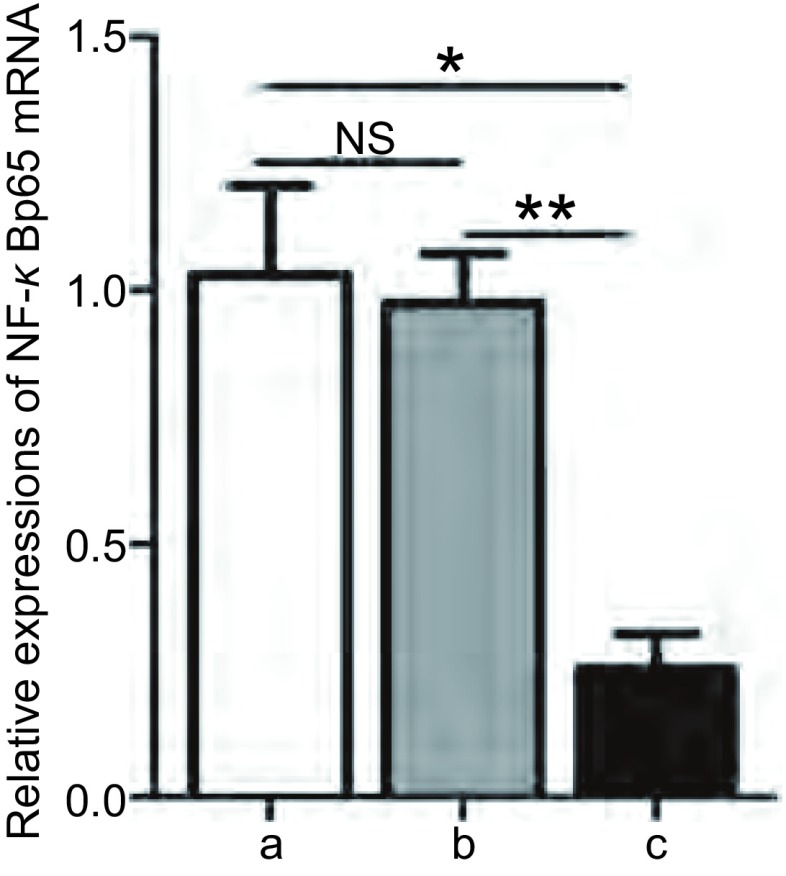
Recombinant plasmids were successfully built, and A549/NF-κB p65 scramble and A549/NF-κB p65 shRNA stable transfection strains were also successfully screened. Both mRNA and protein expression levels of NF-κBp65 showed that A549/NF-κBp65 shRNA cells decreased compared with A549/NF-κB p65 scramble cells and A549 cells, whereas the protein level of IκBα significantly increased. Both migration and adhesion abilities were also reduced.
In this study, both mRNA and protein expression levels of NF-κBp65 were effectively suppressed by RNA interference technique. NF-κBp65 inhibition can significantly reduce the migration and adhesion ability of A549 cells.
核因子-κB是一种重要的转录因子,与多种恶性肿瘤密切相关。直接或间接抑制NF-κBp65的表达可逆转肺肿瘤细胞的生物学行为。构建核因子-κBp65基因短发夹RNA(shRNA)重组质粒,然后感染A549细胞。筛选新的稳定细胞系,并鉴定其迁移和黏附能力。
设计并合成人核因子-κBp65的乱序对照序列和干扰序列(shRNA),构建重组质粒,5'端有BamH I酶切位点,3'端有Xho I和EcoR I酶切位点。感染A549细胞,用嘌呤霉素筛选稳定转染株。采用蛋白质免疫印迹法(Western blot)和实时定量聚合酶链反应(qRT-PCR)方法评估NF-κBp65的干扰效率及IκBα的蛋白表达水平。分别进行Transwell实验和MTT实验分析A549细胞的迁移和黏附能力。
成功构建重组质粒,也成功筛选出A549/NF-κB p65乱序和A549/NF-κB p65 shRNA稳定转染株。NF-κBp65的mRNA和蛋白表达水平均显示,A549/NF-κBp65 shRNA细胞与A549/NF-κB p65乱序细胞及A549细胞相比降低,而IκBα的蛋白水平显著升高。迁移和黏附能力也均降低。
本研究中,RNA干扰技术有效抑制了NF-κBp65的mRNA和蛋白表达水平。抑制NF-κBp65可显著降低A549细胞的迁移和黏附能力。