Marth Katharina, Focke-Tejkl Margarete, Lupinek Christian, Valenta Rudolf, Niederberger Verena
Division of Immunopathology, Department of Pathophysiology and Allergy Research, Center of Pathophysiology, Infectiology and Immunology, Medical University of Vienna, Vienna General Hospital, Vienna, Austria.
Department of Otorhinolaryngology, Medical University of Vienna, Vienna General Hospital, AKH 8J, 1090 Vienna, Austria.
Curr Treat Options Allergy. 2014 Feb 26;1(1):91-106. doi: 10.1007/s40521-013-0006-5. eCollection 2014.
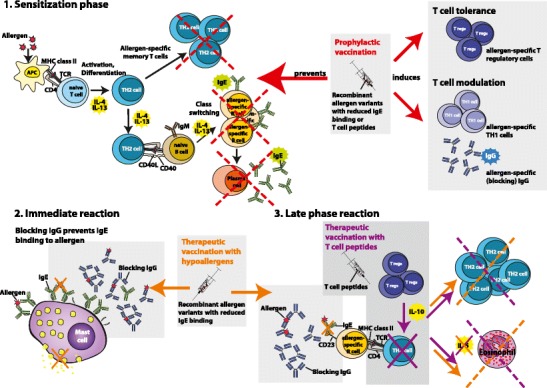
Allergic diseases are among the most common health issues worldwide. Specific immunotherapy has remained the only disease-modifying treatment, but it is not effective in all patients and may cause side effects. Over the last 25 years, allergen molecules from most prevalent allergen sources have been isolated and produced as recombinant proteins. Not only are these molecules useful in improved allergy diagnosis, but they also have the potential to revolutionize the treatment of allergic disease by means of immunotherapy. Panels of unmodified recombinant allergens have already been shown to effectively replace natural allergen extracts in therapy. Through genetic engineering, several molecules have been designed with modified immunological properties. Hypoallergens have been produced that have reduced IgE binding capacity but retained T cell reactivity and T cell peptides which stimulate allergen-specific T cells, and these have already been investigated in clinical trials. New vaccines have been recently created with both reduced IgE and T cell reactivity but retained ability to induce protective allergen-specific IgG antibodies. The latter approach works by fusing non-IgE reactive peptides derived from IgE binding sites of the allergens to a virus protein, which acts as a carrier and provides the T-cell help necessary for immune stimulation and protective antibody production. In this review, we will highlight the different novel approaches for immunotherapy and will report on prior and ongoing clinical studies.
过敏性疾病是全球最常见的健康问题之一。特异性免疫疗法一直是唯一能改变疾病进程的治疗方法,但并非对所有患者都有效,且可能会引起副作用。在过去25年里,已从最常见的过敏原来源中分离出过敏原分子,并将其制成重组蛋白。这些分子不仅有助于改进过敏诊断,还具有通过免疫疗法彻底改变过敏性疾病治疗方式的潜力。未经修饰的重组过敏原组合已被证明能在治疗中有效替代天然过敏原提取物。通过基因工程,已设计出几种具有改良免疫特性的分子。已生产出低变应原性过敏原,其IgE结合能力降低,但保留了T细胞反应性,还生产出了能刺激过敏原特异性T细胞的T细胞肽,并且这些已在临床试验中得到研究。最近已研发出新型疫苗,其IgE和T细胞反应性均降低,但保留了诱导保护性过敏原特异性IgG抗体的能力。后一种方法的原理是将源自过敏原IgE结合位点的非IgE反应性肽与一种病毒蛋白融合,该病毒蛋白作为载体,为免疫刺激和保护性抗体产生提供必要的T细胞辅助。在本综述中,我们将重点介绍免疫疗法的不同新方法,并报告之前和正在进行的临床研究。