Poh Yeh-Chuin, Chen Junwei, Hong Ying, Yi Haiying, Zhang Shuang, Chen Junjian, Wu Douglas C, Wang Lili, Jia Qiong, Singh Rishi, Yao Wenting, Tan Youhua, Tajik Arash, Tanaka Tetsuya S, Wang Ning
1] Laboratory for Cell Biomechanics and Regenerative Medicine, Department of Biomedical Engineering, School of Life Science and Technology, Huazhong University of Science and Technology, Wuhan, Hubei 430074, China [2] Department of Mechanical Science and Engineering, College of Engineering, University of Illinois at Urbana-Champaign, Urbana, Illinois 61801, USA.
Laboratory for Cell Biomechanics and Regenerative Medicine, Department of Biomedical Engineering, School of Life Science and Technology, Huazhong University of Science and Technology, Wuhan, Hubei 430074, China.
Nat Commun. 2014 May 30;5:4000. doi: 10.1038/ncomms5000.
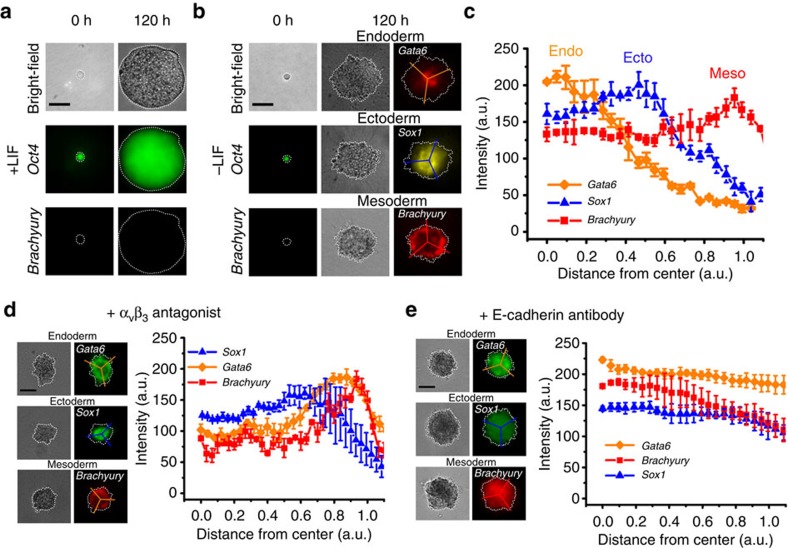
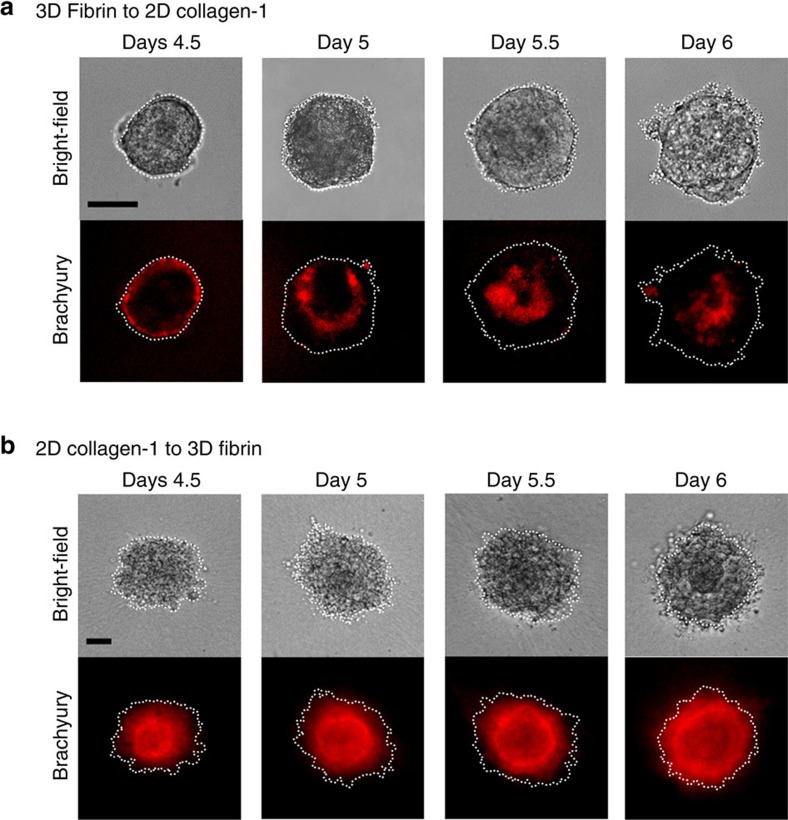
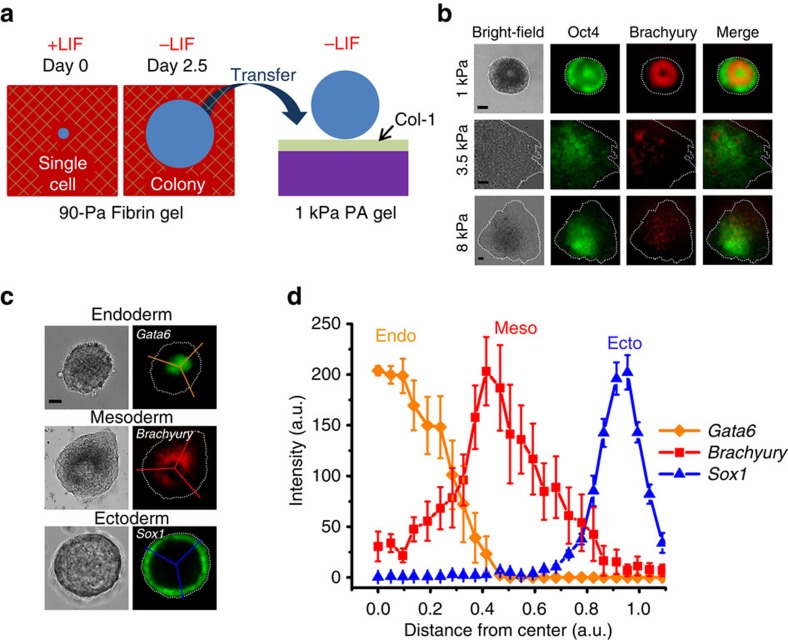
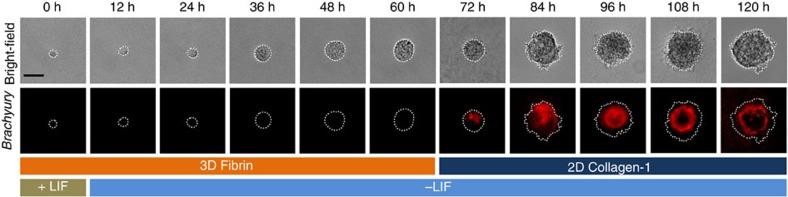
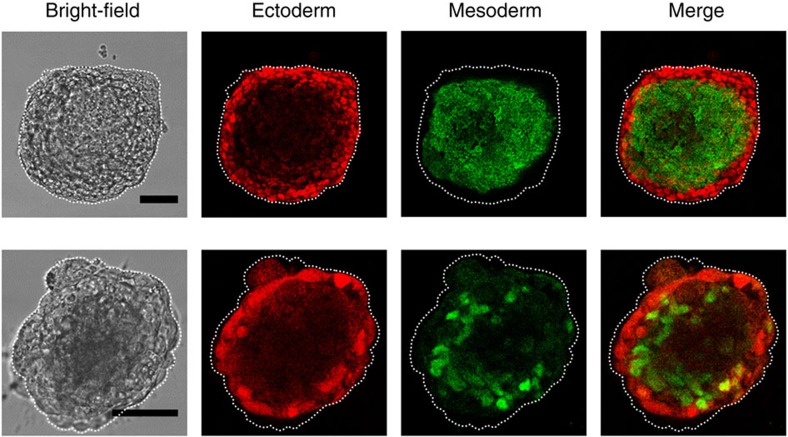
Mammalian inner cell mass cells undergo lineage-specific differentiation into germ layers of endoderm, mesoderm and ectoderm during gastrulation. It has been a long-standing challenge in developmental biology to replicate these organized germ layer patterns in culture. Here we present a method of generating organized germ layers from a single mouse embryonic stem cell cultured in a soft fibrin matrix. Spatial organization of germ layers is regulated by cortical tension of the colony, matrix dimensionality and softness, and cell-cell adhesion. Remarkably, anchorage of the embryoid colony from the 3D matrix to collagen-1-coated 2D substrates of ~1 kPa results in self-organization of all three germ layers: ectoderm on the outside layer, mesoderm in the middle and endoderm at the centre of the colony, reminiscent of generalized gastrulating chordate embryos. These results suggest that mechanical forces via cell-matrix and cell-cell interactions are crucial in spatial organization of germ layers during mammalian gastrulation. This new in vitro method could be used to gain insights on the mechanisms responsible for the regulation of germ layer formation.
在原肠胚形成过程中,哺乳动物的内细胞团细胞会经历谱系特异性分化,形成内胚层、中胚层和外胚层的胚层。在培养中复制这些有组织的胚层模式一直是发育生物学中的一项长期挑战。在此,我们展示了一种从培养在柔软纤维蛋白基质中的单个小鼠胚胎干细胞生成有组织胚层的方法。胚层的空间组织受集落的皮质张力、基质维度和柔软度以及细胞间粘附的调节。值得注意的是,将胚状体集落从三维基质锚定到约1千帕的胶原蛋白-1包被的二维底物上,会导致所有三个胚层的自我组织:外层为外胚层,中间为中胚层,集落中心为内胚层,这让人联想到广义的原肠胚形成的脊索动物胚胎。这些结果表明,通过细胞-基质和细胞-细胞相互作用产生的机械力在哺乳动物原肠胚形成过程中胚层的空间组织中至关重要。这种新的体外方法可用于深入了解负责胚层形成调节的机制。