Wu Jing, Hu Yifei, Jia Yujiang, Su Yingying, Cui Huixia, Liu Huixin, Wang Ning
National Center for AIDS/STD Control and Prevention, China Center for Disease Control and Prevention, Beijing, China.
Department of Preventive Medicine, School of Medicine, Vanderbilt University, Nashville, Tennessee, United States of America.
PLoS One. 2014 May 29;9(5):e98366. doi: 10.1371/journal.pone.0098366. eCollection 2014.
The purpose of this review was to assess the prevalence of unprotected anal intercourse (UAI) among men who have sex with men (MSM) in China.
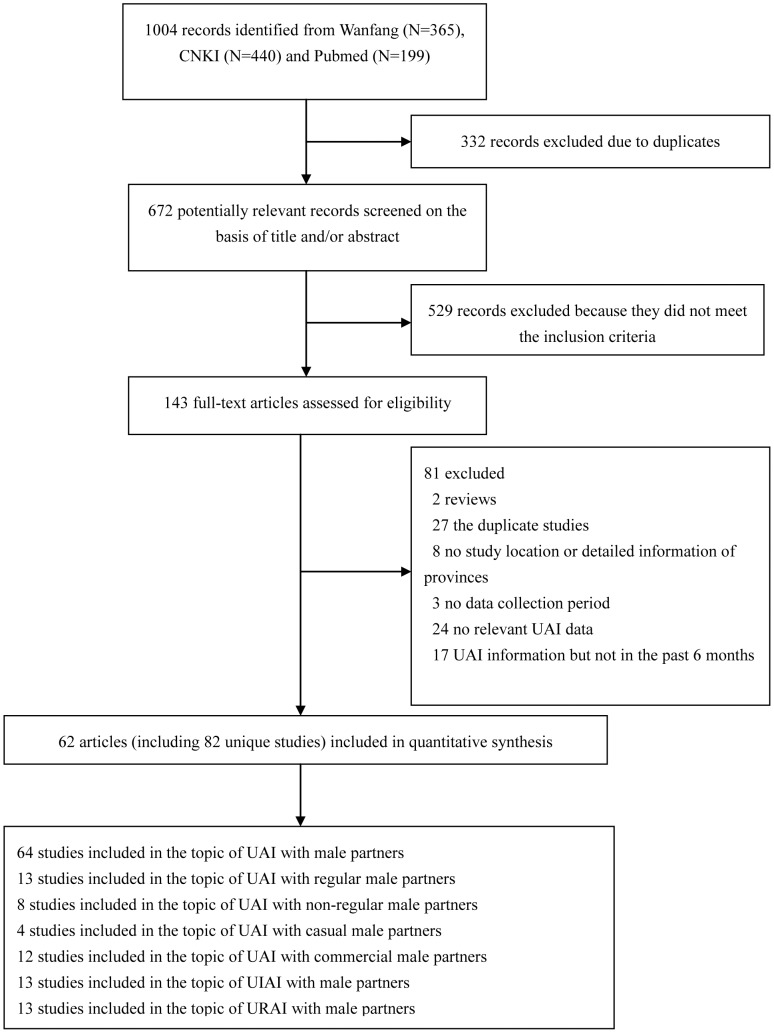
A comprehensive search was conducted including online databases like "Wanfang", Chinese National Knowledge Infrastructure, PubMed and manual searches. Analyses using random-effects models were performed to estimate the prevalence of UAI among MSM in China.
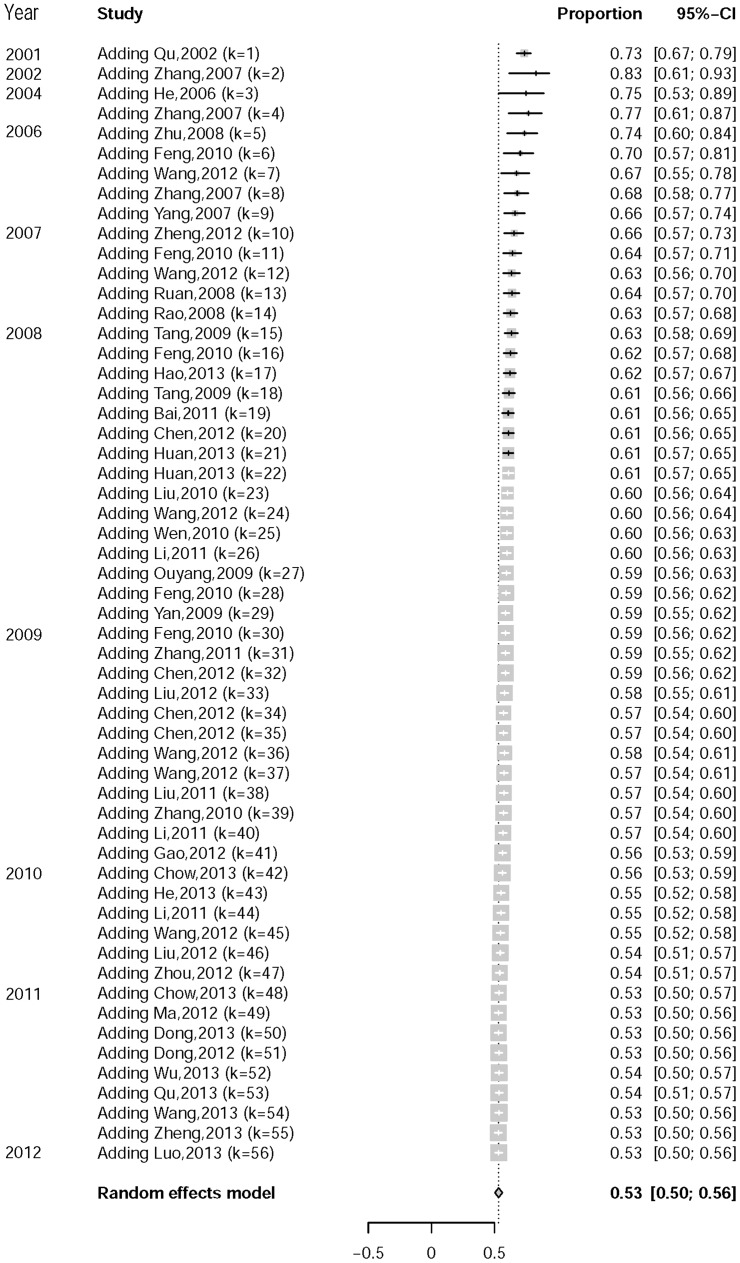
Sixty-two articles reporting eighty-two studies were selected. The pooled prevalence rates of UAI with any male partner, with regular male partners, with non-regular male partners, with casual male partners, and with commercial male partners among MSM were 53%(95%CI: 51-56%), 45%(95%CI: 39-51%), 34%(95%CI: 24-45%), 33%(95%CI: 30-36%), 12% (95%CI: 5-26%), respectively. A cumulative meta-analysis found that the pooled UAI prevalence decreased over time.
Although the prevalence of UAI with male partners among MSM in China presents a decreasing trend over the past decade, the concomitant rise in HIV prevalence and incidence indicates that current prevention intervention efforts are insufficient to effectively contain the spread of HIV. Therefore, the persistently high prevalence of risky sexual behaviors underscores the need for innovative and effective prevention strategies among MSM.
本综述旨在评估中国男男性行为者(MSM)中无保护肛交(UAI)的流行情况。
进行了全面检索,包括在线数据库如“万方”、中国知网、PubMed以及手工检索。采用随机效应模型进行分析,以估计中国男男性行为者中无保护肛交的流行率。
选取了62篇报告82项研究的文章。男男性行为者中与任何男性伴侣、固定男性伴侣、非固定男性伴侣、临时性男性伴侣以及商业性男性伴侣发生无保护肛交的合并流行率分别为53%(95%CI:51 - 56%)、45%(95%CI:39 - 51%)、34%(95%CI:24 - 45%)、33%(95%CI:30 - 36%)、12%(95%CI:5 - 26%)。累积荟萃分析发现,合并的无保护肛交流行率随时间下降。
尽管在过去十年中,中国男男性行为者与男性伴侣发生无保护肛交的流行率呈下降趋势,但与此同时艾滋病毒流行率和发病率的上升表明,当前的预防干预措施不足以有效遏制艾滋病毒的传播。因此,危险性行为持续高发凸显了在男男性行为者中需要创新和有效的预防策略。