Department of Epidemiology, Tulane University School of Public Health and Tropical Medicine, New Orleans, Louisiana, United States of America.
State Key Laboratory of Cardiovascular Disease, Fuwai Hospital, National Center of Cardiovascular Diseases, Chinese Academy of Medical Sciences and Peking Union Medical College, Beijing, China.
PLoS One. 2014 May 30;9(5):e98432. doi: 10.1371/journal.pone.0098432. eCollection 2014.
Serum and glucocorticoid regulated kinase (SGK) plays a critical role in the regulation of renal sodium transport. We examined the association between SGK genes and salt sensitivity of blood pressure (BP) using single-marker and gene-based association analysis.
A 7-day low-sodium (51.3 mmol sodium/day) followed by a 7-day high-sodium intervention (307.8 mmol sodium/day) was conducted among 1,906 Chinese participants. BP measurements were obtained at baseline and each intervention using a random-zero sphygmomanometer. Additive associations between each SNP and salt-sensitivity phenotypes were assessed using a mixed linear regression model to account for family dependencies. Gene-based analyses were conducted using the truncated p-value method. The Bonferroni-method was used to adjust for multiple testing in all analyses.
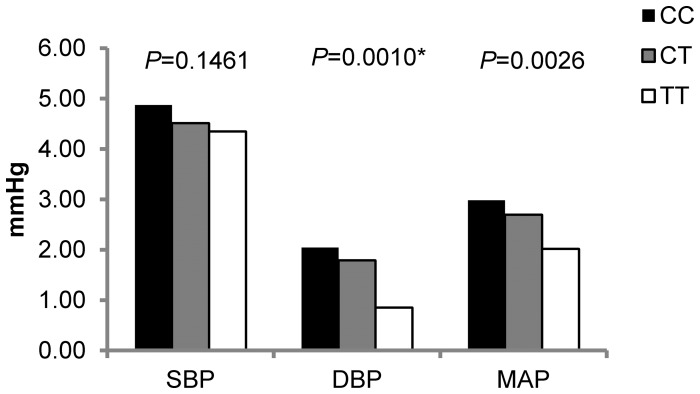
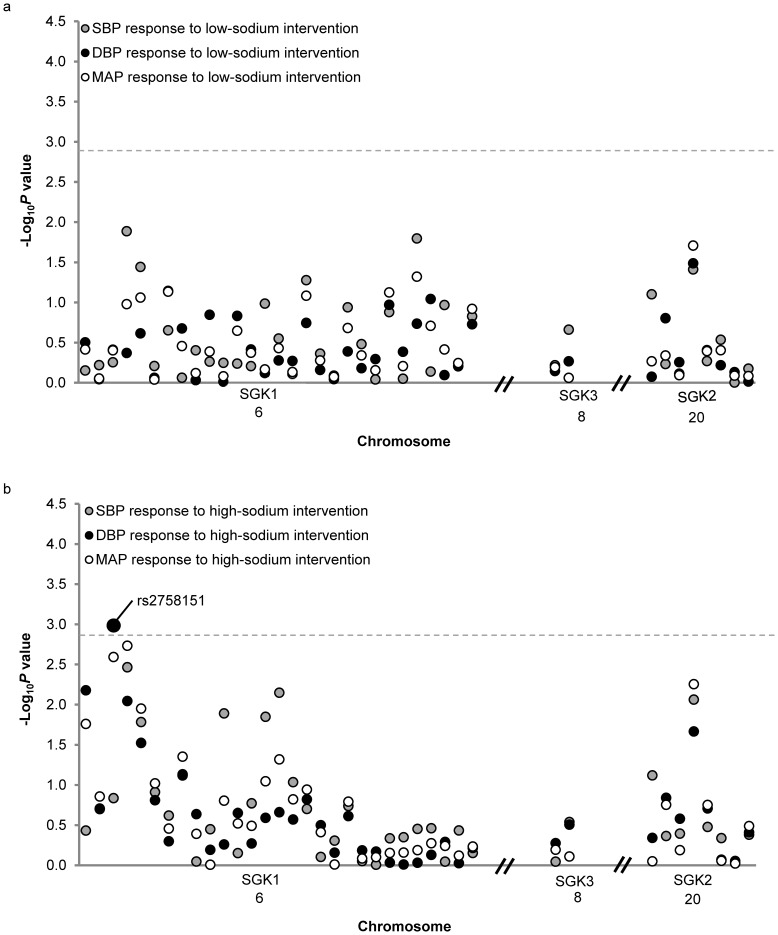
In single-marker association analyses, SGK1 marker rs2758151 was significantly associated with diastolic BP (DBP) response to high-sodium intervention (P = 0.0010). DBP responses (95% confidence interval) to high-sodium intervention for genotypes C/C, C/T, and T/T were 2.04 (1.57 to 2.52), 1.79 (1.42 to 2.16), and 0.85 (0.30 to 1.41) mmHg, respectively. Similar trends were observed for SBP and MAP responses although not significant (P = 0.15 and 0.0026, respectively). In addition, gene-based analyses demonstrated significant associations between SGK1 and SBP, DBP and MAP responses to high sodium intervention (P = 0.0002, 0.0076, and 0.00001, respectively). Neither SGK2 nor SGK3 were associated with the salt-sensitivity phenotypes in single-maker or gene-based analyses.
The current study identified association of the SGK1 gene and BP salt-sensitivity in the Han Chinese population. Further studies are warranted to identify causal SGK1 gene variants.
血清和糖皮质激素调节激酶 (SGK) 在调节肾脏钠转运中起着关键作用。我们使用单标记物和基于基因的关联分析来研究 SGK 基因与血压 (BP) 盐敏感性之间的关系。
1906 名中国参与者进行了为期 7 天的低钠(51.3mmol 钠/天)干预,随后进行了为期 7 天的高钠干预(307.8mmol 钠/天)。使用随机零汞柱血压计在基线和每个干预时测量 BP。使用混合线性回归模型评估每个 SNP 与盐敏感性表型的加性关联,以考虑家庭依赖性。使用截断 p 值方法进行基于基因的分析。在所有分析中,使用 Bonferroni 方法对多重检验进行调整。
在单标记物关联分析中,SGK1 标记物 rs2758151 与高钠干预时舒张压 (DBP) 反应显著相关(P=0.0010)。基因型 C/C、C/T 和 T/T 的 DBP 反应(95%置信区间)分别为 2.04(1.57 至 2.52)、1.79(1.42 至 2.16)和 0.85(0.30 至 1.41)mmHg。尽管没有统计学意义(P=0.15 和 0.0026),但 SBP 和 MAP 反应也观察到类似的趋势。此外,基于基因的分析表明,SGK1 与 SBP、DBP 和 MAP 对高钠干预的反应之间存在显著关联(P=0.0002、0.0076 和 0.00001,分别)。SGK2 和 SGK3 均未在单标记物或基于基因的分析中与盐敏感性表型相关。
本研究在汉族人群中确定了 SGK1 基因与 BP 盐敏感性的关联。需要进一步的研究来确定因果性 SGK1 基因变异。